
Xenia Hotels & Resorts: Strategic Portfolio Moves and Brand Dynamics in a Cyclical Upscale Market
Xenia Hotels & Resorts is demonstrating strong operational momentum with double-digit RevPAR and EBITDAre growth in 2026, driven by renovations and premium-market exposure. Yet, the company’s reliance on third-party managers, exposure to supply growth, and fixed-cost structure amplify sensitivity to industry and economic cycles.
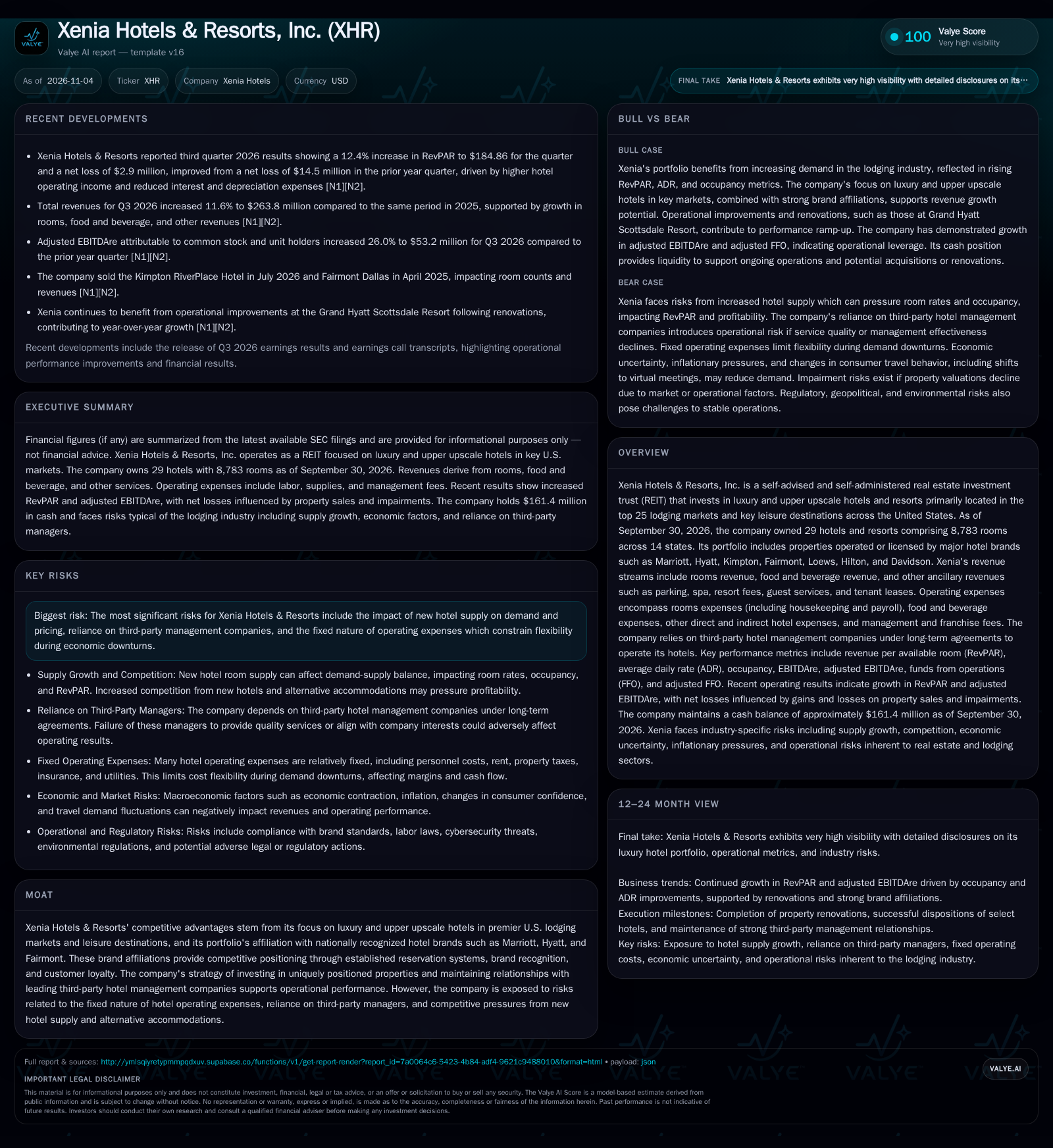
Xenia Hotels & Resorts is capitalizing on premium U.S. hotel markets and brand partnerships, delivering a 12.4% RevPAR increase and 26% EBITDAre growth in Q3 2026. Portfolio repositioning and renovations are supporting performance, but the company remains exposed to macro cycles, new supply, and the operational limits of third-party management. Monitoring the sustainability of RevPAR gains, cost pressures, and capital allocation will be critical as the cycle evolves. [N1] [N2]
Xenia Hotels & Resorts is riding a wave of improved operating performance in 2026, with double-digit RevPAR and EBITDAre gains fueled by premium market exposure, brand partnerships, and targeted renovations. However, as a luxury and upper-upscale REIT with a concentrated U.S. portfolio, Xenia’s fortunes are closely tied to travel cycles, competitive supply, and the effectiveness of its third-party operators. The company’s recent asset sales and operational ramp-ups highlight the challenge of balancing growth, capital allocation, and risk management in a sector that remains acutely cyclical and operationally complex.
Performance Gains Reflect Portfolio Realignment
Xenia Hotels & Resorts reported a 12.4% increase in RevPAR to $184.86 and an 11.6% rise in total revenues to $263.8 million in Q3 2026, indicating robust demand recovery and successful operational initiatives. Adjusted EBITDAre attributable to common stock and unit holders increased 26% year-over-year to $53.2 million, outpacing revenue growth and suggesting improving operating leverage. The net loss narrowed sharply to $2.9 million from $14.5 million in the prior-year quarter, with the improvement partly attributable to higher hotel operating income and lower interest and depreciation expenses. However, year-to-date results remain sensitive to property sales, as reflected in the disposition of the Kimpton RiverPlace Hotel in July 2026 and the Fairmont Dallas in April 2025, which have reduced room count and altered revenue contributions. The company reported cash and liquidity metrics for the period; these figures do not by themselves establish operating runway, investment capacity, financial flexibility, or financing capacity. [N1] [N2] [S2]
Upscale Hotel Economics: Balancing Growth Potential with Structural Constraints
Xenia’s revenue model is anchored in rooms, food and beverage, and ancillary services—each influenced by occupancy and average daily rate (ADR) trends. The company’s premium market focus and affiliations with top-tier brands support higher ADRs and occupancy, which in turn drive RevPAR. Renovations, like those completed at the Grand Hyatt Scottsdale Resort, can unlock incremental pricing power and guest volume, but require significant upfront capital and disrupt short-term earnings.
Operating leverage is inherent in the hotel business: variable costs (such as housekeeping and F&B supplies) rise with occupancy, but many expenses—personnel, property taxes, insurance, management and franchise fees—are fixed or semi-fixed. This structure amplifies EBITDA gains in periods of rising demand but can quickly erode margins in downturns. Xenia’s reliance on third-party managers means management and franchise fees are a recurring cost, and the company’s ability to adjust operating practices is mediated by these partners. Capital needs are episodic and lumpy, driven by property acquisitions, renovations, or required brand standards upgrades.
Strengths and Vulnerabilities in Brand Alliances and Market Positioning
Affiliations with leading brands such as Marriott, Hyatt, Hilton, and Kimpton provide Xenia with access to global reservation systems, established customer loyalty programs, and strong brand recognition, which can drive premium pricing and sustained demand. Operating primarily in the top 25 U.S. lodging markets and key leisure destinations further fortifies Xenia’s positioning, as these markets tend to have higher barriers to entry and more resilient demand profiles.
However, these same advantages expose Xenia to intense competition from both established REIT peers and new hotel supply, especially in high-growth urban and resort markets. Alternative accommodations (such as short-term rentals) and shifts in business travel patterns post-pandemic add further pressure. The third-party management model helps mitigate operational complexity but introduces execution risk if partners underperform or fail to maintain brand standards. Ultimately, Xenia’s moat is rooted in location quality and brand alignment, but is not immune to industry-wide supply-demand imbalances or shifts in travel behavior.
Potential for Outperformance with Robust Premium Demand and Renovation Returns
A favorable scenario for Xenia would see continued strength in leisure and business travel demand across its premium markets, supporting further RevPAR and ADR increases. Successful property renovations (such as the Grand Hyatt Scottsdale) could deliver outsized ROI, enabling above-market rate growth and improved guest satisfaction. If new supply is absorbed without materially diluting pricing power, and third-party managers maintain high service quality, Xenia could realize significant operating leverage—translating revenue gains into disproportionate EBITDA and FFO growth.
Confirmation would come from sustained double-digit RevPAR growth, stable or improving EBITDA margins, and visible ADR premiums versus local competitors. Conversely, if RevPAR gains stall, renovation returns disappoint, or new supply meaningfully pressures rates and occupancy, this upside scenario would be challenged.
Portfolio Streamlining Enables Growth Despite Economic Cycles
The most plausible outcome is that Xenia delivers mid-single-digit annual RevPAR growth as travel demand normalizes, with EBITDAre improvements tracking slightly ahead due to incremental operating leverage. Portfolio reshaping—via selective dispositions and targeted renovations—continues to improve average property quality and market mix, but net asset growth is modest given competitive acquisition conditions and capital discipline.
Margins remain stable but are capped by persistent wage inflation, elevated property taxes, and rising brand and management fees. This scenario would be confirmed by steady RevPAR and FFO growth, disciplined capex, and consistent dividend payouts; it would be challenged by a material downturn in travel demand, operational disruption at key assets, or a sharp rise in new supply in core markets.
Fixed-Cost Structure Heightens Risk from Demand Downturns or Oversupply
An adverse scenario could unfold if macroeconomic conditions deteriorate—through recession, geopolitical events, or a sharp pullback in travel—leading to falling occupancy and downward pressure on ADR. Simultaneously, accelerated new hotel openings in Xenia’s core markets could further dilute pricing power. Given the company’s high fixed cost base, even moderate revenue declines would disproportionately impact EBITDA and FFO, potentially forcing dividend cuts, deferred renovations, or distressed asset sales.
Execution risk could also materialize if third-party managers underperform or fail to adapt to changing market conditions, eroding guest satisfaction and brand value. Confirmation of this scenario would include declining RevPAR, shrinking EBITDA margins, negative FFO, and asset impairments. Early warning signs would be negative occupancy trends, rising operating costs outpacing revenue, or significant management turnover at key properties.
Xenia’s Operational and Market Factors to Monitor for Future Outcomes
Year-over-year RevPAR and ADR trends across the portfolio, especially in renovated and recently acquired properties.
EBITDAre and FFO growth rates relative to revenue growth, revealing the degree of operating leverage and margin resilience.
The pace, cost, and ROI of property renovations—particularly whether recent investments translate into sustained rate and occupancy premiums.
Asset disposition and acquisition activity, including realized gains/losses and changes in average portfolio quality or market exposure.
Labor cost inflation and other operating expense trends, which could compress margins if revenue growth falters.
Third-party manager performance and any changes in key management agreements or operator relationships.
Supply pipeline in Xenia’s core markets—a surge in new rooms could pressure pricing and occupancy.
If disclosed, guest satisfaction, loyalty program engagement, and brand-standard compliance metrics, which would signal operational health and brand alignment.
Disclaimer: This is research-only, informational analysis and not investment advice. It may include AI-generated interpretation and general industry context. Always verify important details using primary sources.

Comments