
BioMarin’s Strategic Reset: Portfolio Evolution, Regulatory Headwinds, and the Next Phase of Rare Disease Commercialization
BioMarin Pharmaceutical navigates a pivotal period marked by a major gene therapy withdrawal, a fresh $475M licensing move in Fabry disease, and persistent net losses—even as its Q3 2026 results topped expectations. The company’s future will hinge on pipeline execution, pricing leverage in rare diseases, and resilience to tightening reimbursement and regulatory scrutiny.
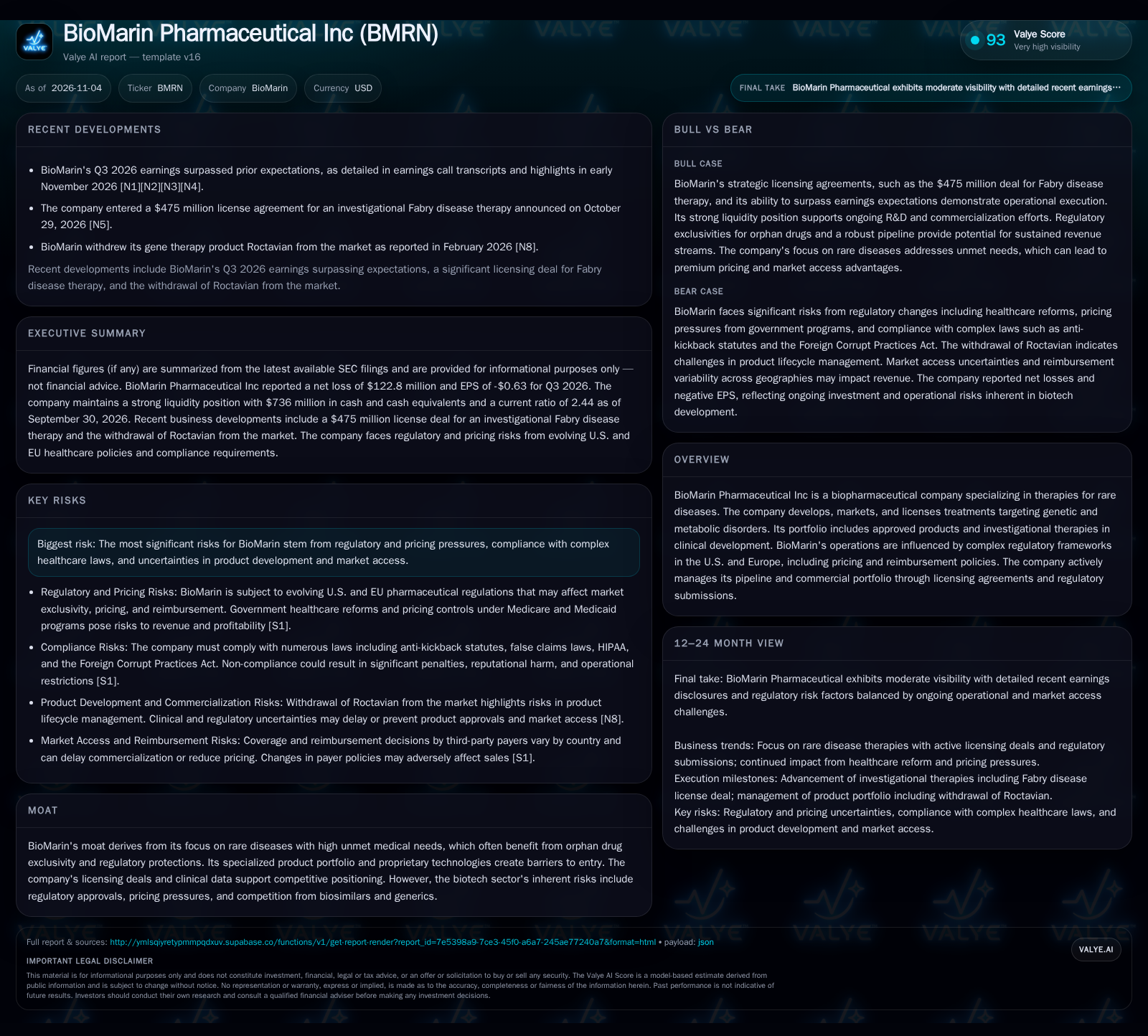
BioMarin faces a complex transition: the withdrawal of its gene therapy Roctavian and a new $475M Fabry disease licensing deal underscore both risk and opportunity. While Q3 2026 earnings exceeded forecasts, losses persist and regulatory and pricing pressures are intensifying. The company’s cash position supports continued R&D, but future value depends on successful commercial launches and navigating payer and policy headwinds. [S2] [N1] [N5] [N8]
BioMarin Pharmaceutical stands at a strategic crossroads. The withdrawal of Roctavian, its high-profile gene therapy, has forced a reassessment of product risk and portfolio durability. Yet, the company continues to capitalize on its rare disease expertise, most recently through a $475 million licensing deal in Fabry disease. While Q3 2026 earnings beat expectations, BioMarin remains unprofitable and faces mounting regulatory and reimbursement pressures. The company’s next chapter will be defined by its ability to translate scientific assets and pipeline investments into sustainable commercial returns, all while navigating increasingly complex payer and policy environments.
Recent Developments Redefine BioMarin’s Trajectory
Three facts sharply shape BioMarin’s present outlook. First, the company posted a net loss of $122.8 million in Q3 2026, but earnings topped analyst expectations, reflecting both ongoing investment and better-than-feared operational control. Second, BioMarin announced a $475 million license agreement for an investigational Fabry disease therapy in late October 2026, signaling a renewed push in its rare disease pipeline after the high-profile withdrawal of Roctavian, its gene therapy, from the market as of February 2026. Together, these developments highlight a company in transition, balancing the need for pipeline renewal against the realities of product setbacks and external headwinds. [S2] [N1] [N5] [N8]
Rare Disease Model: High Margins, Volatile Returns, and Capital Demands
BioMarin’s business model is built on developing and commercializing therapies for rare, often genetic, diseases. This strategy promises premium pricing and market exclusivity under orphan drug frameworks, but comes with inherently volatile economics. Revenue per patient is high, but the patient pools are small and commercialization requires substantial upfront investment in R&D, regulatory submissions, and market access negotiations.
Fixed costs—especially R&D and regulatory compliance—dominate the cost structure, creating high operating leverage: as new therapies launch, incremental margins can be substantial if pricing and reimbursement are secured. However, variable costs also arise from manufacturing complexities and post-marketing surveillance, particularly for gene or enzyme replacement therapies.
The $475 million Fabry disease license deal exemplifies BioMarin’s capital allocation approach: large upfront (or milestone-based) payments to secure pipeline assets with potential for long-term exclusivity. But this model is sensitive to development and regulatory risk, as seen with the Roctavian withdrawal, which likely resulted in sunk costs and lost future revenues.
However, persistent net losses highlight the need for eventual commercial success or disciplined cost management to achieve sustainable profitability. [S2] [N5] [N8]
Defensibility Hinges on Orphan Drug Dynamics and Pipeline Depth
BioMarin’s primary competitive advantage is its specialization in rare diseases—therapeutic areas with high unmet need, limited competition, and regulatory incentives such as orphan drug exclusivity. These factors create barriers to entry: new competitors must overcome significant scientific, regulatory, and commercial hurdles.
However, the competitive landscape in rare diseases is evolving. Larger biopharma companies and emerging biotech firms are increasingly targeting these niches, attracted by premium pricing and regulatory support. Additionally, advances in gene editing, RNA therapies, and next-generation biologics threaten to disrupt traditional enzyme or small molecule approaches.
The withdrawal of Roctavian underscores the risk that even successful clinical development does not guarantee commercial durability—regulatory outcomes, real-world efficacy, or safety issues can rapidly erode a competitive moat. BioMarin’s ability to replenish its pipeline, secure payer coverage, and maintain pricing power will determine how durable its competitive position remains, especially as health technology assessments and drug price negotiations intensify in both the U.S. and Europe. [S1] [N8]
Pipeline Execution and Pricing Power Drive Renewed Value Creation
In a favorable scenario, BioMarin’s recent Fabry disease license translates into a successful late-stage clinical program, regulatory approval, and premium pricing, leveraging the company’s rare disease commercialization expertise. The company’s remaining pipeline assets advance efficiently, and new launches benefit from orphan drug exclusivity, supporting high revenue per patient and robust gross margins.
Regulatory and reimbursement environments remain relatively stable, allowing BioMarin to maintain pricing power in core markets. Operational discipline enables a transition to profitability as new therapies offset R&D costs and legacy product attrition.
Evidence that would confirm this scenario includes: positive late-stage clinical trial results and regulatory filings for key pipeline assets; clear, multi-year reimbursement agreements in major geographies; and a visible inflection from net losses to operating profit as new products scale. Accelerating top-line growth from new launches and sustained or expanding margins would also support this thesis.
Managing Through Volatility as the Pipeline Turns Over
The most plausible outcome is continued volatility as BioMarin manages the fallout from Roctavian’s withdrawal, invests in the Fabry disease program, and seeks to stabilize its commercial portfolio. Revenue growth may be modest as legacy products mature and new launches ramp gradually, with persistent pricing and reimbursement challenges across markets.
Operating losses may narrow but not disappear, as R&D and compliance costs remain high relative to revenue, especially if payer negotiations delay or limit new product uptake.
This scenario would be confirmed by steady but unspectacular revenue growth, continued net losses or near-breakeven results, and incremental pipeline progress—such as regulatory submissions or reimbursement approvals—without transformative commercial breakthroughs. A flat or modestly improving margin profile and ongoing disclosure of regulatory and payer risks would also be consistent with this outlook. [S2] [N1] [N2] [N3] [N4] [N5] [N8]
Pipeline Disappointments and Pricing Pressures Expose Structural Risks
In a negative scenario, BioMarin’s new pipeline assets—including the Fabry disease therapy—face clinical or regulatory setbacks, delaying or preventing commercial launch. Payer pushback intensifies, with stricter reimbursement criteria or price cuts eroding the economics of both new and existing products.
Regulatory reforms in the U.S. (such as implementation of Inflation Reduction Act price negotiations) and Europe further constrain pricing, compress margins, and increase compliance costs. The company’s fixed cost base becomes a liability, and persistent net losses raise questions about long-term sustainability or the need for additional capital.
This scenario would be confirmed by failed or delayed regulatory filings, negative late-stage trial results, explicit denials or restrictions from major payers, and deteriorating gross or operating margins. Escalating disclosures around regulatory investigations, compliance penalties, or liquidity concerns would further validate the downside case. [S1] [N8]
Milestones That Will Define BioMarin’s Next Chapter
Progress of the investigational Fabry disease therapy: clinical trial data, regulatory filings, and any announced reimbursement or pricing agreements would directly impact the pipeline value. [N5]
Commercial performance of legacy products and any new launches: quarterly revenue and gross margin trends, if disclosed, will reveal the effectiveness of BioMarin’s commercial strategy.
Net loss trajectory and margin improvement: a shift toward breakeven or profitability would signal operating leverage and successful portfolio execution. [S2]
Regulatory and payer landscape changes: any updates on U.S. or EU drug price negotiations, reimbursement changes, or Inflation Reduction Act impacts would affect future economics. [S1]
Compliance disclosures: new or escalating investigations, settlements, or penalties related to anti-kickback, FCPA, or other healthcare laws could alter risk and cost structure.
Pipeline attrition or advancement: updates on other late-stage clinical candidates, FDA/EMA review outcomes, or portfolio reprioritizations would test the resilience of BioMarin’s R&D engine.
If disclosed, real-world patient uptake and retention rates for newly launched products would help test the durability of BioMarin’s rare disease commercial model.
Disclaimer: This is research-only, informational analysis and not investment advice. It may include AI-generated interpretation and general industry context. Always verify important details using primary sources.

Comments