
Limbach Holdings in 2026: Margin Volatility, Liquidity Constraints, and the Next Phase of Specialty Contracting Economics
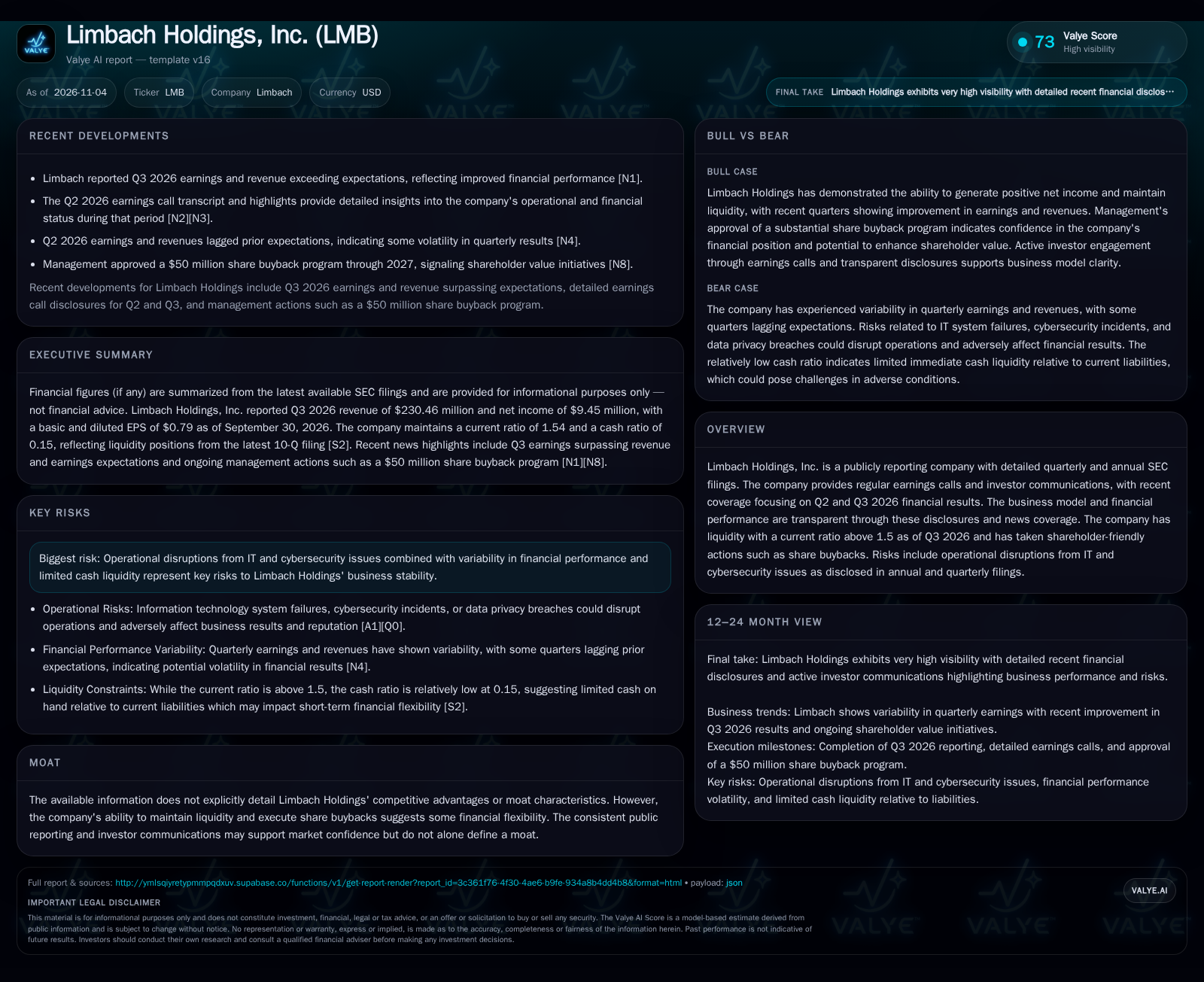
Limbach Holdings posted a Q3 2026 revenue rebound and net income growth, but the company’s reported cash ratio and history of earnings variability make its near-term performance highly sensitive to project timing, customer payment cycles, and potential IT disruptions.
Limbach Holdings posted a Q3 2026 revenue rebound and net income growth, but the company’s reported cash ratio and history of earnings variability make its near-term performance highly sensitive to project timing, customer payment cycles, and potential IT disruptions. The business model’s exposure to fixed-cost leverage and operational risk remains central to the equity story.
With management highlighting operational risks from IT and cybersecurity, the business faces a delicate balance between margin expansion and exposure to execution shocks. The key question is whether Limbach can sustain improved profitability while managing liquidity and operational hazards in a cyclical, project-based industry.
Q3 2026 Earnings Rebound Highlights Sensitivity to Project Flow
Limbach Holdings reported Q3 2026 revenue of $230.46 million and net income of $9.45 million, a sequential improvement that exceeded expectations after a weaker Q2 [S2] [N1] [N4]. Basic and diluted EPS reached $0.79 for the quarter [S2]. As of September 30, 2026, the company carried $29.06 million in cash and equivalents, with current assets totaling $302.05 million against $196.70 million in current liabilities, resulting in a current ratio of 1.54 and a cash ratio of just 0.15 [S2]. The combination of volatile quarterly results and low immediate liquidity makes Limbach highly sensitive to project execution, customer payment timing, and the risk of operational disruption.
Project-Driven Revenue, Margin Leverage, and the Constraints of Working Capital
Limbach’s core business model revolves around project-based mechanical contracting, where revenue recognition and cash flow are closely tied to project milestones, customer payment schedules, and change-order management. Gross margins in this sector can be highly variable, as fixed overhead costs must be absorbed over a fluctuating project base. This creates operating leverage—when project volumes are strong, incremental margin expansion is possible, but underutilization or project delays can rapidly erode profitability.
The company’s reported cash ratio suggests that most liquidity is tied up in receivables, retainage, or work-in-progress inventory rather than immediately available cash.
Capital expenditure requirements in specialty contracting are generally modest compared to manufacturing or asset-heavy industries, but ongoing investment in IT systems and compliance—especially given the explicit cyber risk disclosures—may become a growing cost center. Sustained profitability thus depends on disciplined project selection, efficient execution, and tight control of receivables and payables.
The project-based nature of Limbach’s revenue cycle inherently subjects the company to timing mismatches between incurred costs and received payments, which can exacerbate liquidity pressures even during periods of reported profitability. This dynamic underscores the critical importance of working capital management, particularly the velocity of receivables collection and the negotiation of payment terms with both customers and suppliers. Moreover, the variability of project scopes and the potential for scope creep require robust contract management capabilities to prevent margin erosion from unanticipated cost increases.
Navigating a Fragmented Specialty Contracting Landscape
Limbach operates in a highly fragmented industry characterized by numerous regional and local competitors, as well as a handful of large national players. Barriers to entry at the project level are relatively low, but established relationships, reputation for execution, and prequalification with large customers provide some insulation to incumbents. The company’s consistent public reporting and investor outreach may enhance its credibility with institutional clients, but these factors do not in themselves create a durable moat.
Competitive differentiation in this sector often hinges on expertise in complex projects, safety record, ability to manage multifaceted subcontractor relationships, and responsiveness to customer needs. Technology adoption—such as advanced project management software or integrated building systems—can improve efficiency and risk management, but also raises the stakes for IT system reliability and cyber resilience. Price competition can be intense, especially during periods of soft demand or project delays, making cost control and disciplined bidding essential.
Sustained Project Execution and Margin Expansion Drive Earnings Surprise
A favorable trajectory for Limbach would require continued strong project execution, with on-time delivery, limited cost overruns, and efficient change-order management translating into sustained margin expansion.
Upside would be confirmed by consecutive quarters of revenue and net income growth, stable or rising gross margins, and a reported liquidity-ratio trends alongside declining days sales outstanding (DSO). Evidence of large project wins, repeat business from institutional clients, or increased cross-selling of integrated services would further validate the scenario. Conversely, a return to volatile results or cash drain would weaken the case.
Volatility Persists as Project Mix and Payment Cycles Dictate Results
Confirmation would come from stable, albeit choppy, revenue and earnings trends, with occasional outperformance during strong project quarters and underperformance when project timing or collections slip. Falsification would occur if the company delivers several quarters of stable cash flow and margin improvement or, conversely, if a major working capital or IT disruption causes a material setback.
Operational Disruptions or Payment Delays Expose Liquidity Vulnerabilities
A negative scenario could unfold if Limbach encounters a significant IT system failure, cybersecurity incident, or major customer payment delay—any of which could rapidly drain its reported cash balance given the reported cash ratio. Project execution missteps, cost overruns, or a downturn in new awards could further expose the company to margin compression and liquidity stress.
This scenario would be evidenced by a sudden drop in cash and equivalents, rising current liabilities, missed project milestones, or a spike in write-offs and bad debt expense. A material negative revision to earnings guidance or the need to secure emergency financing would further confirm downside pressures.
Benchmarks for Testing Limbach’s Project-Driven Thesis
Quarterly gross margin trends, especially relative to project mix and cost overruns, would clarify whether margin expansion is sustainable.
Disclosure of large new project awards, backlog growth, or repeat customer wins would signal future revenue visibility if provided.
Updates on IT infrastructure investments and cyber incident disclosures would provide insight into operational risk mitigation.
Quarterly commentary on payment cycles and customer concentration, if disclosed, would illuminate potential vulnerabilities.
Evidence of continued share buybacks or dividends, and their scale relative to free cash flow generation, would test claims of potential financial flexibility.
Any material change in current liabilities or evidence of short-term borrowing would be a red flag for liquidity stress.
Disclaimer: This is research-only, informational analysis and not investment advice. It may include AI-generated interpretation and general industry context. Always verify important details using primary sources.

Comments