
LGI Homes in 2026: Land Banking, Interest Rate Sensitivity, and the Economics of Scalable Homebuilding
LGI Homes remains a notable player in U.S. single-family homebuilding, leveraging integrated land acquisition and construction, while navigating the cyclical pressures of interest rates, housing demand, and input costs. Recent financials spotlight stable execution in a volatile macro environment, but the company's exposure to variable-rate debt and sector cyclicality highlight both opportunity and risk.
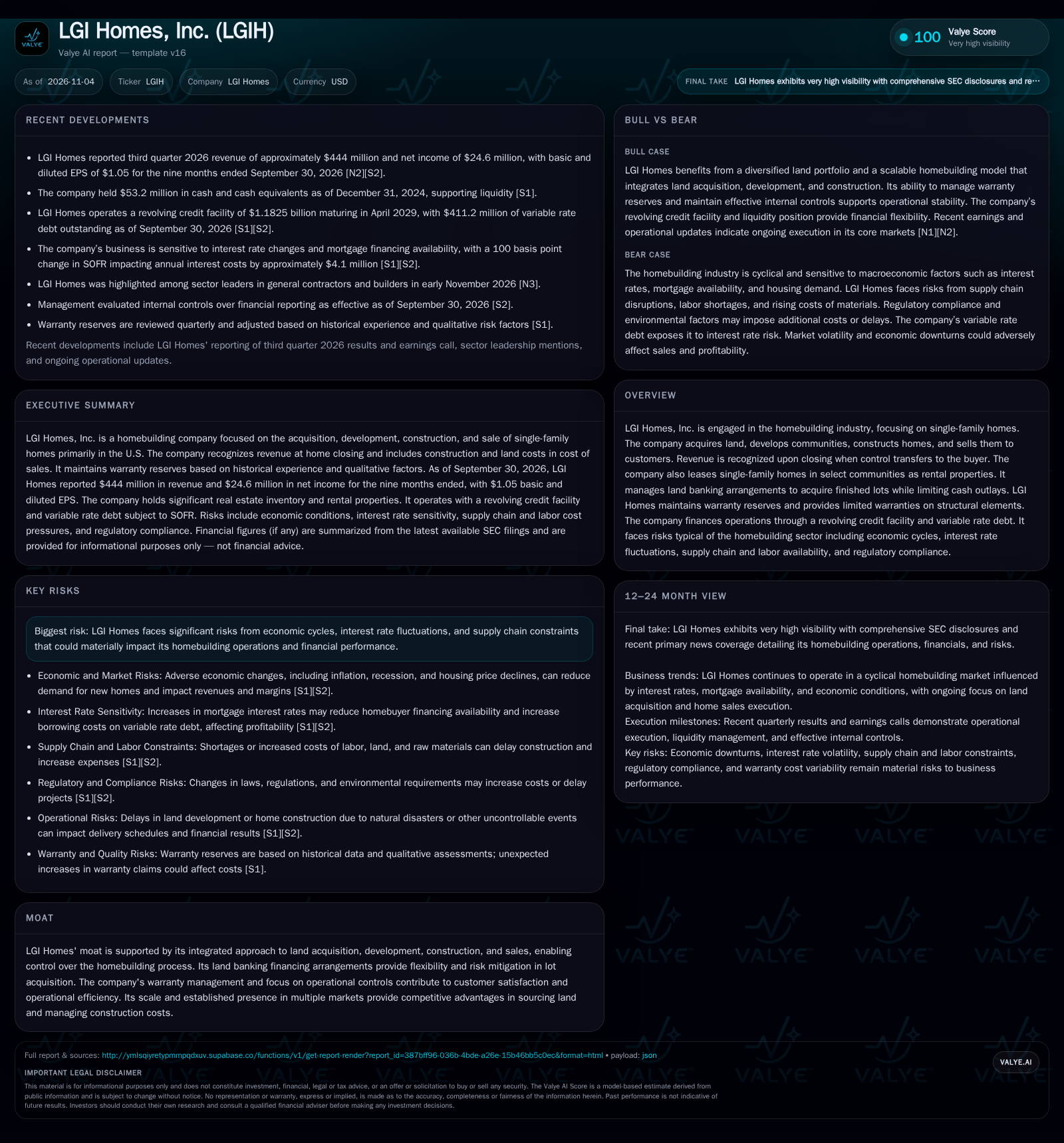
LGI Homes reported $444 million in revenue and $24.6 million in net income for the first nine months of 2026, reflecting ongoing operational execution in its core markets. The company's strategic use of land banking, a $1.18 billion credit facility, and substantial inventory underpin its scale and flexibility. However, exposure to rising interest rates and cyclical housing demand create ongoing uncertainty for profitability and cash flows. Key watchpoints include absorption rates, gross margins, inventory turns, and the evolving cost of capital. [S1] [S2] [N2]
LGI Homes, Inc. has maintained its position as a prominent U.S. homebuilder through an integrated approach to land acquisition, development, and construction, while also managing a diverse inventory and navigating ongoing market volatility. The company’s latest financials reveal steady execution, yet its exposure to interest rate fluctuations and the cyclical nature of the housing market pose both opportunities and challenges. With substantial real estate holdings, a scalable business model, and access to significant credit, LGI Homes seeks to balance growth with prudent risk management—an equation that will be tested as macroeconomic conditions evolve. [S1] [S2] [N2]
Recent Results Highlight Operating Stability but Expose Interest Rate Risk
LGI Homes reported $444 million in revenue and $24.6 million in net income for the nine months ended September 30, 2026, with basic and diluted EPS of $1.05. These results suggest continued operational momentum despite sector-wide pressures. The company’s inventory stood at approximately $3.5 billion at year-end 2025, underscoring the scale of its ongoing development pipeline. Financing is supported by a $1.1825 billion revolving credit facility, with $411.2 million in variable-rate debt outstanding as of September 2026—directly tying future interest expense to SOFR movements. A 100-basis-point SOFR increase could add $4.1 million in annual interest cost, demonstrating direct exposure to rate hikes. [S1] [S2] [N2]
How LGI Homes Generates Value: Volume, Margin, and Capital Efficiency
LGI Homes’ core revenue model centers on the construction and sale of single-family homes, with revenue recognized at closing when title and possession transfer to the buyer. This model is capital-intensive, requiring significant upfront investment in land, development, and construction, much of which is carried as inventory until homes are sold. Cost of sales encompasses land, construction, capitalized interest, and related costs, meaning gross margin depends on both pricing power and cost discipline.
Operating leverage is inherent in the homebuilding model: fixed costs (land, development, overhead) are spread over the volume of homes delivered, so higher absorption rates can boost margins. Conversely, slow sales or inventory buildup increases holding costs and erodes profitability. The company’s use of land banking arrangements helps manage cash flow and reduce the risk of overcommitting to land in softening markets.
LGI Homes also owns a portfolio of rental properties ($107 million net value as of December 2025), which may provide some income diversification, but the home sales business remains dominant. Financing needs are substantial, as reflected in the large credit facility and variable-rate debt. The cost of capital is a key determinant of ultimate profitability, especially given the direct SOFR exposure.
Competitive Landscape: Scale, Land Control, and Execution as Differentiators
LGI Homes competes with national, regional, and local homebuilders, as well as with resale homes, rental options, and, to a limited extent, institutional single-family rental platforms. Its integrated approach—controlling land acquisition, development, construction, and sales—enables tighter cost controls and faster cycle times compared to less vertically integrated peers.
The company’s scale allows for more efficient land sourcing and the ability to weather regional or cyclical downturns by shifting focus across markets. Land banking arrangements provide a structural advantage by reducing upfront risk and enhancing capital efficiency. However, these advantages are counterbalanced by intense competition for developable land, persistent labor shortages, and rising input costs, which can erode margins if not managed aggressively.
Switching costs for homebuyers are low; differentiation typically comes from location, price point, perceived value, and quality of experience. While LGI’s warranty program and operational controls may aid customer satisfaction, they are unlikely to create a true moat. The company’s ability to consistently execute—delivering homes on time and on budget—remains its primary defense in a fragmented industry.
Margin Expansion and Accelerated Absorption If Rates Stabilize and Demand Holds
In a favorable scenario, interest rates stabilize or decline, improving mortgage affordability and stimulating buyer demand. LGI Homes could then accelerate home deliveries, improve inventory turns, and leverage its fixed cost base, resulting in margin expansion. Successful management of supply chain and labor inputs would allow the company to maintain or even widen gross margins, especially if it retains pricing power in key markets.
The company’s large inventory and land banking flexibility would support rapid deployment of new communities, while the credit facility could fund opportunistic land acquisitions as competitors retrench. Evidence supporting this scenario would include sequential improvement in gross margins, rising absorption rates, and inventory turnover acceleration. Confirmation would also come from stable or falling cancellation rates and expanding order backlogs, if disclosed.
Operating Through the Cycle: Moderate Growth, Tight Margin Management
The most plausible path is one of measured expansion, with LGI Homes navigating ongoing macro volatility by adjusting pace, mix, and capital allocation. Interest rates may remain elevated but not spike further, allowing for steady—if unspectacular—sales volumes. Inventory would be managed tightly to avoid excess buildup, and land banking would be used to limit cash outlays. Margins could be pressured by ongoing labor and material cost inflation, but operational discipline would likely prevent significant erosion.
Under this scenario, the company would continue to report modest profitability, supported by effective cost controls, judicious use of its credit facility, and careful management of warranty and quality costs. Evidence would include stable gross margins, inventory levels consistent with sales pace, and continued access to affordable credit. A lack of major impairment charges and steady warranty reserve trends would also support this outlook.
Adverse Macro Shocks: Rate Spikes or Housing Demand Collapse
A negative scenario could unfold if interest rates rise sharply or economic conditions deteriorate, leading to a sudden drop in housing demand. This would likely result in slower home sales, rising inventory, and increased carrying costs. The company’s variable-rate debt would become more expensive, directly pressuring net income and cash flow. In this environment, LGI Homes might be forced to discount homes to clear inventory, compressing gross margins and potentially triggering impairment charges on land holdings.
Supply chain disruptions or labor shortages could further delay construction, exacerbate costs, and lead to missed delivery schedules. Evidence of this scenario would include declining absorption rates, rising unsold inventory, margin compression, and higher interest expense. An uptick in cancellation rates or increased warranty claims could compound the pressure. If the company draws more heavily on its credit facility without corresponding cash generation, liquidity constraints could emerge.
Benchmarks for Testing LGI Homes’ Strategic Execution and Resilience
Sequential and year-over-year changes in gross margin, as this reflects the company’s ability to manage input costs and pricing power.
Absorption rates (homes sold per active community per month), if disclosed, to gauge market demand and sales velocity.
Inventory turnover and the ratio of completed homes to homes in progress, signaling efficiency in delivery and risk of inventory buildup.
Interest expense as a percentage of revenue and overall debt levels, tracking the impact of SOFR rate changes on profitability.
Land acquisition pace and the split between owned and optioned/banked lots, which affects capital commitment and flexibility.
Warranty reserve adjustments and claims trends, which may indicate emerging quality or cost issues.
Disclosure of cancellation rates and backlog/order trends, if provided, as early signals of demand volatility.
Disclaimer: This is research-only, informational analysis and not investment advice. It may include AI-generated interpretation and general industry context. Always verify important details using primary sources.

Comments