
IPG Photonics: Fiber Laser Profit Recovery, Global Exposure, and the Test of Industrial Demand Cycles
IPG Photonics delivered a Q3 profit rebound and revenue outperformance, underscoring its position as a global fiber laser leader.
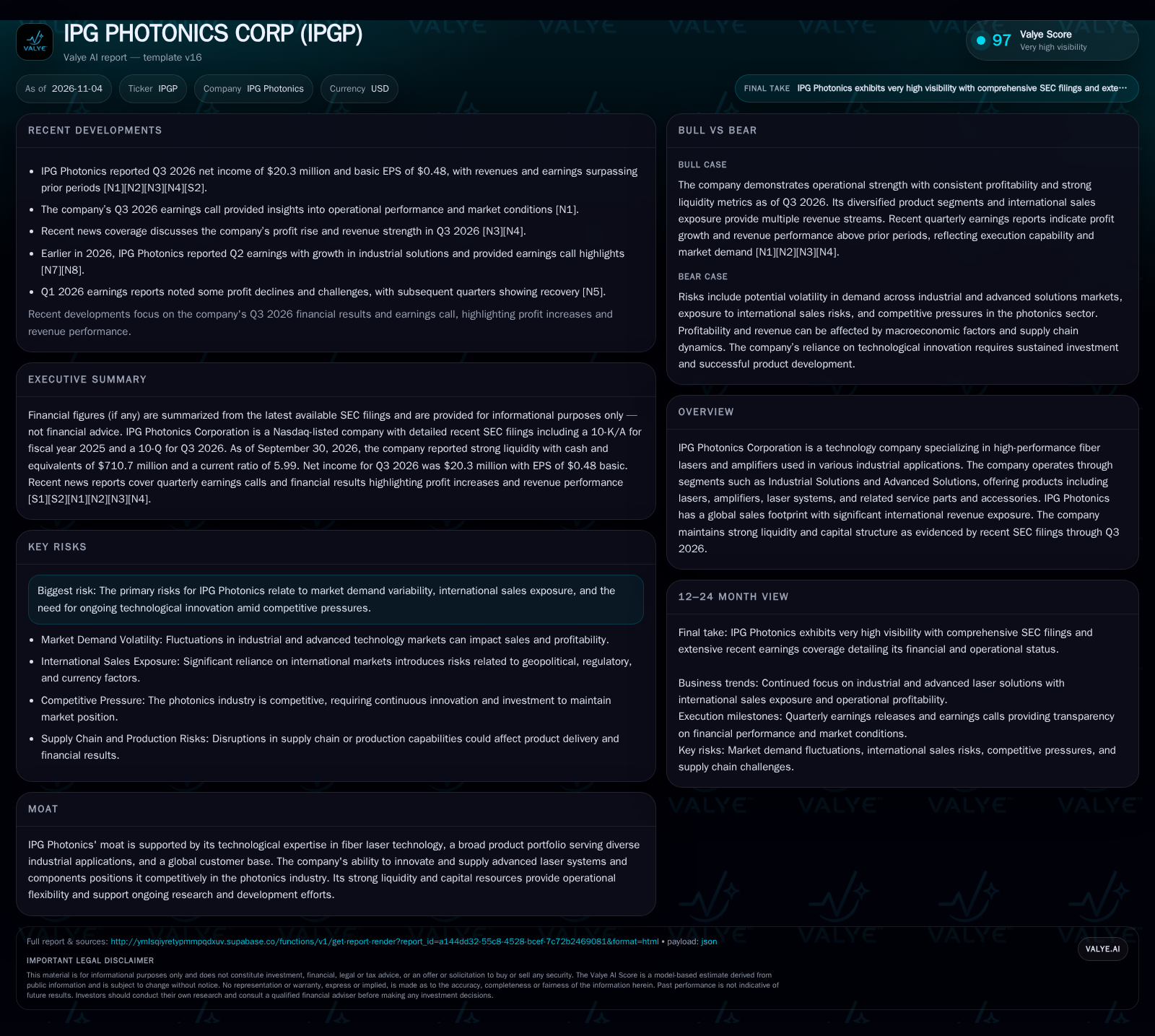
IPG Photonics posted a Q3 2026 net income of $20.3 million, with revenues and profits exceeding expectations after a volatile start to the year. The core question is whether IPG’s technology edge and diversified solutions can deliver durable profit growth through the cycle [S2] [N1] [N2] [N3] [N4].
IPG Photonics, a leader in high-performance fiber lasers and photonics solutions, has rebounded in Q3 2026 with profits and revenues surpassing expectations after a choppy start to the year. With a substantial reported cash balance and a broad product portfolio serving industrial and advanced technology markets worldwide, IPG’s near-term stability appears solid. However, the company’s long-term trajectory hinges on its ability to sustain innovation, manage international headwinds, and maintain pricing power as industrial cycles ebb and flow.
Profit Rebound and Liquidity Buffer Define Q3 2026
IPG Photonics reported a net income of $20.3 million for the quarter ended September 30, 2026, with basic EPS of $0.48 and diluted EPS of $0.47 [S2]. This marks a notable improvement versus the profit declines seen earlier in the year, with Q3 revenues and earnings topping analyst estimates [N2] [N3] [N4]. The company’s cash and equivalents totaled $710.7 million, supplemented by $215.3 million in short-term investments, yielding a current ratio of 5.99 and a cash ratio of 3.6 [S2]. IPG’s recent financial performance signals operational resilience, but it follows a period of demand volatility, particularly in its industrial end-markets [N5]. The company’s international sales exposure remains material, which can amplify both opportunity and risk depending on global macro conditions.
Fiber Laser Economics: Pricing, Volume, and Operating Leverage
IPG’s core business is built around high-power fiber lasers, amplifiers, and integrated laser systems. Revenue is driven by a mix of product sales—primarily to industrial customers in automotive, manufacturing, and electronics—and recurring streams from service parts and accessories. Pricing power in this sector is typically a function of proprietary technology, performance differentiation, and the ability to address demanding industrial applications. However, as fiber laser adoption matures, price competition can intensify, especially from Asian and European rivals, potentially pressuring gross margins.
Volume growth often tracks with capital expenditure cycles in manufacturing and heavy industry, making IPG’s top line susceptible to macroeconomic swings. The company’s cost structure includes significant fixed costs in R&D and manufacturing, which means operating leverage can be substantial during upswings in demand but also exposes margins during slowdowns.
The company reported cash and liquidity metrics for the period; these figures do not by themselves establish operating runway, investment capacity, financial flexibility, or financing capacity. [S2] However, the company’s capital efficiency and ability to convert innovation into profitable volume will be critical as the fiber laser market becomes more competitive and commoditized.
How Technology Leadership and Global Reach Shape Competitive Standing
IPG’s competitive moat rests on its technological expertise in fiber lasers and a broad product portfolio that addresses a wide range of industrial applications [S2]. The company’s history of vertical integration—from semiconductor laser diodes to finished laser systems—has historically enabled cost advantages, quality control, and rapid innovation cycles. This foundation has made IPG a preferred supplier for manufacturers seeking high-performance, reliable laser solutions.
However, the global photonics landscape is evolving rapidly. Competitors from Asia and Europe have narrowed the technology gap, often competing aggressively on price and targeting growth in emerging markets. Substitution risk is rising as alternative laser and non-laser manufacturing technologies improve. In advanced solutions, such as additive manufacturing or microelectronics, barriers to entry are higher, but so is the pace of technological change.
IPG’s international sales footprint is a double-edged sword: it enables access to high-growth regions but also exposes the company to geopolitical, regulatory, and currency risks that can disrupt operations or erode margins [N5]. The company’s ability to sustain its innovation lead and deepen customer integration will likely determine how defensible its competitive position remains.
Sustained Industrial Uptick and Advanced Applications Drive Multi-Year Growth
In a favorable scenario, global industrial demand continues to recover, driving increased capital expenditure in manufacturing, automotive, and electronics. IPG leverages its technology edge to win share in both established and emerging laser applications, such as precision welding, battery manufacturing, and microfabrication. The company’s R&D investments translate into new product launches that command premium pricing and open new verticals, particularly in advanced solutions.
Operating leverage amplifies profit growth as higher volumes absorb fixed costs, and gross margins stabilize or expand due to a richer mix of differentiated products. International sales contribute positively, with stable macro conditions and effective risk management limiting currency and geopolitical disruptions.
Evidence for this scenario would include consecutive quarters of accelerating revenue and margin expansion, new customer wins in advanced applications, and disclosures of major product innovations or strategic partnerships. Conversely, if volume growth stalls or margins compress despite new launches, the upside case would be undermined.
Navigating Cyclical Recovery with Persistent Volatility
The most plausible trajectory is one where IPG Photonics delivers lumpy but positive growth as industrial demand recovers unevenly across geographies and end-markets. Advanced solutions provide incremental growth, but are not yet large enough to offset cyclical swings in core industrial sales.
International exposure continues to be a source of both growth and risk, with periodic disruptions from currency, regulatory, or geopolitical events.
This scenario would be confirmed by continued positive but uneven quarterly results, stable or slightly improving margins, and incremental product launches. Evidence against it would include a sustained decline in revenues, significant margin erosion, or major execution missteps in new technology rollouts.
Margin Compression and External Shocks Challenge Profitability
The adverse scenario envisions a combination of persistent industrial weakness, intensified price competition, and adverse international developments. If manufacturing investment slows globally—due to recession, trade tensions, or sector-specific downturns—IPG could see significant volume declines and downward pricing pressure, particularly if rivals discount aggressively to capture share.
Innovation cycles may fail to deliver sufficient differentiation, allowing lower-cost competitors to erode IPG’s margins in core segments. International disruptions—such as sanctions, tariffs, or currency devaluations—could further undermine profitability, especially given the company’s heavy overseas exposure.
Evidence for this scenario would include several quarters of falling revenues, declining gross and operating margins, negative earnings surprises, or management guidance cuts. Conversely, resilience in profit margins and continued innovation traction would weigh against the downside case.
What Will Determine if IPG Photonics Sustains Its Recovery?
Quarterly revenue growth rates by segment, particularly the Industrial Solutions and Advanced Solutions businesses, if disclosed, to assess end-market demand and product mix evolution.
Gross margin trends, as a gauge of pricing power, product differentiation, and the impact of competitive pressures.
R&D expenditure levels and the cadence of new product launches, which would indicate whether IPG is maintaining its innovation edge.
International sales breakdown and any commentary on currency, regulatory, or geopolitical headwinds, to monitor external risk exposure.
Customer concentration metrics, if disclosed, to evaluate dependency on a small set of large buyers and related revenue stability risks.
Updates on supply chain stability, lead times, and inventory levels, which could signal either operational resilience or emerging bottlenecks.
Management guidance, commentary, and explanations for any material deviations in quarterly earnings or margin performance.
Disclaimer: This is research-only, informational analysis and not investment advice. It may include AI-generated interpretation and general industry context. Always verify important details using primary sources.

Comments