
Third Coast Bancshares Strengthens Texas Presence: Growth Dynamics and Regional Banking Realities
Third Coast Bancshares has achieved rapid asset and deposit growth through mergers and branch expansion across Texas, reporting strong Q3 2026 profits and a pending $239.6 million Great Plains merger. The bank’s future hinges on its ability to manage integration risks, defend margins amid shifting rates, and sustain credit quality in a concentrated regional market.
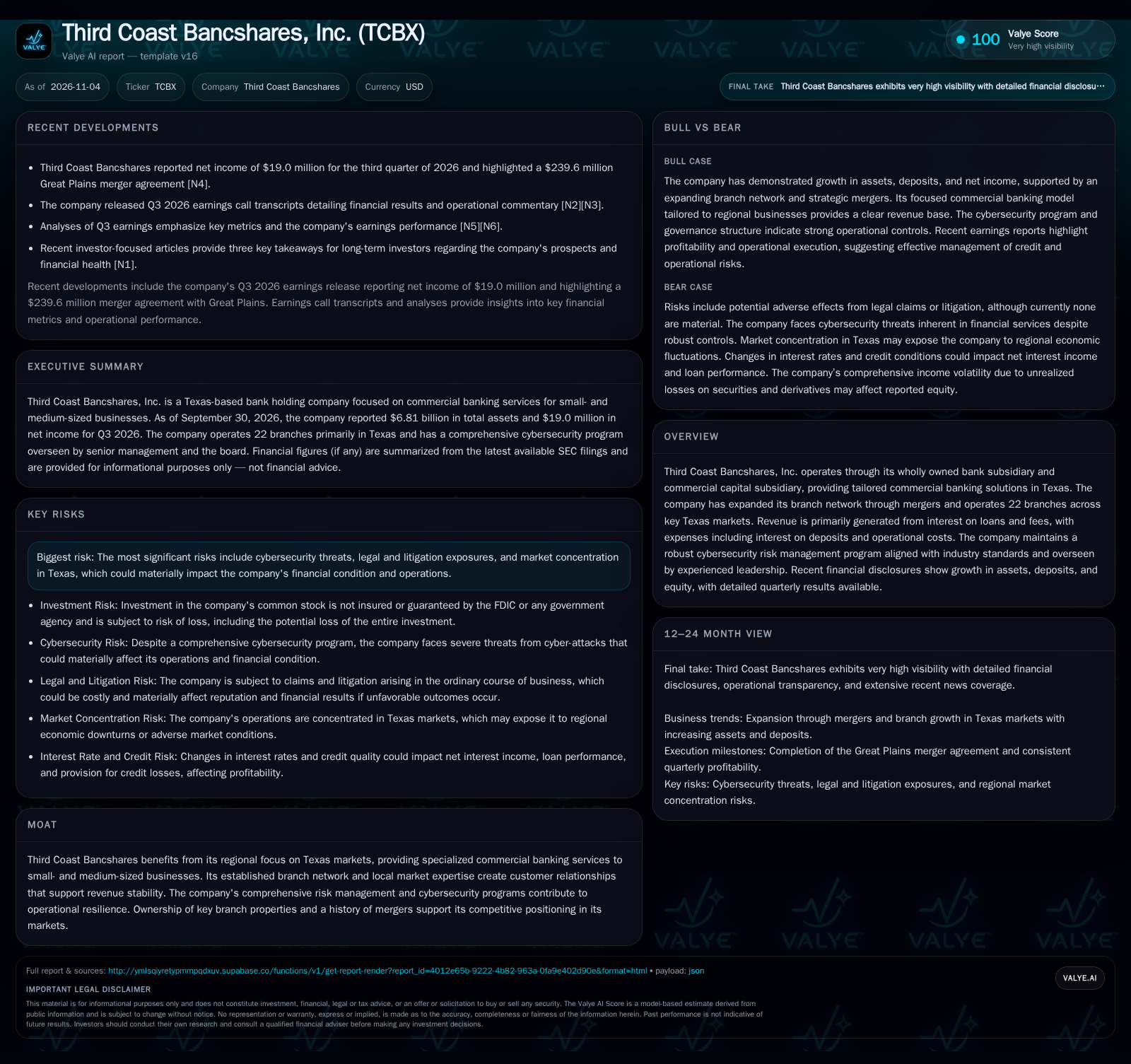
Third Coast Bancshares (TCBX) reported $6.81 billion in assets and $19.0 million in Q3 2026 net income, following robust expansion via mergers and branch growth in Texas. With a $239.6 million Great Plains merger pending, the company’s trajectory will depend on integration execution, interest rate dynamics, and credit risk management in a regionally concentrated franchise. [S2] [N4]
Third Coast Bancshares, Inc. (TCBX) is emerging as a formidable regional bank in Texas, leveraging mergers and branch expansion to nearly double its balance sheet within a year. As of September 30, 2026, TCBX’s assets reached $6.81 billion, and the bank posted $19.0 million in quarterly net income—momentum that has drawn attention to its growth strategy and operational execution. Yet, with a $239.6 million Great Plains merger pending and a footprint still deeply tied to Texas’s economic fortunes, the company’s next phase will test its ability to integrate acquisitions, defend its net interest margin, and manage credit risk as it scales.
2026 Snapshot Marked by Rapid Expansion and Earnings Gains
As of September 30, 2026, Third Coast Bancshares reported total assets of $6.81 billion, up from $5.34 billion at the end of 2025, with total deposits rising to $5.92 billion and shareholders’ equity to $674.9 million. The company generated net income of $19.0 million in Q3 2026, with net interest income at $59.5 million and provision for credit losses of $0.54 million. A $239.6 million merger agreement with Great Plains was recently announced, signaling another step in TCBX’s growth strategy. This period represents both a validation of the bank’s expansion model and a set of new integration and risk management challenges. [S2] [N4]
Profitability Influenced by Scale, Margins, and Funding Expenses
Third Coast Bancshares’ core business economics rely on the spread between interest earned on loans and the cost of deposits and borrowings—a classic net interest margin model. Most revenue is derived from interest on commercial loans to small and mid-sized businesses, with additional fee income from service and loan-related charges. The cost structure is dominated by interest on deposits (which rise with rate competition) and fixed and variable noninterest expenses such as salaries, benefits, and branch occupancy.
Rapid asset and deposit growth, both organic and via mergers, creates the potential for operating leverage: as the bank increases its loan book, fixed costs (such as branch operations and corporate overhead) can be spread across a larger base, potentially boosting margins. However, this benefit is counterbalanced by integration costs, credit risk provisioning, and the challenge of maintaining low funding costs as deposit competition intensifies.
A rising rate environment can initially expand net interest margins if asset yields reset faster than deposit costs. But as market rates rise, pressure on deposit pricing can compress margins, especially for banks with a heavy reliance on commercial and non-core deposits. The bank’s ability to reprice loans, attract stable low-cost deposits, and manage noninterest expenses will be pivotal in determining future profitability.
Niche Strength and Concentration Risk from Regional Focus
TCBX’s competitive positioning is rooted in its Texas-centric footprint and focus on commercial banking for small and mid-sized enterprises. This specialization can foster strong customer relationships, local market intelligence, and tailored product offerings, creating switching frictions for established business clients. The expanded branch network from recent mergers increases brand visibility and access to new markets within Texas.
However, the bank’s concentration in Texas exposes it to regional cyclical risks—such as volatility in the state’s energy, real estate, and construction sectors. Larger national and super-regional banks, as well as fintech-enabled non-bank lenders, are relevant competitors that may pressure pricing, digital service expectations, and deposit retention. The ability to sustain credit quality and maintain a localized service advantage will be critical to defending share against these broader players.
Ownership of several key branch properties may support cost control, but the branch-heavy model could face future challenges if digital banking adoption accelerates and physical presence becomes less of a differentiator.
Growth Potential Hinges on Integration Success and Credit Management
If TCBX executes a smooth integration of the Great Plains merger—realizing expected synergies without significant customer attrition or operational disruption—the bank could accelerate its earnings growth and further expand its share in key Texas markets. Effective cross-selling to newly acquired customers, disciplined credit underwriting, and retention of key commercial relationships would drive both revenue and cost efficiencies.
A favorable rate environment, where loan yields remain strong and deposit costs are contained, could further expand net interest margins. Evidence for this upside would include post-merger expense ratios declining, net interest margin stabilization or expansion, low non-performing loan levels, and positive operating leverage in quarterly results. If TCBX demonstrates above-peer loan growth without a corresponding rise in credit losses, the case for sustained regional banking outperformance would strengthen.
Continued Expansion Faces Integration and Margin Challenges
The most plausible path is that TCBX continues to grow assets and deposits via both organic expansion and the successful, if operationally taxing, integration of Great Plains. Net interest income remains the primary driver of profitability, but margin gains are offset by higher funding costs and expenses tied to integration and branch operations.
Credit quality remains generally sound, though some uptick in provision for credit losses may occur as the loan book grows and economic conditions fluctuate. The bank’s return on assets and equity remains in line with regional peers, but operating leverage is partially absorbed by recurring noninterest expenses and periodic merger-related costs.
Confirmation of this scenario would be quarterly reports showing steady asset and loan growth, stable or slightly compressed net interest margins, and manageable levels of non-performing assets and credit loss provisions.
Credit and Margin Pressures Could Mount if Integration Falters
In an adverse scenario, integration of the Great Plains merger proves more disruptive than anticipated, resulting in customer attrition, higher-than-expected expenses, and operational inefficiencies. If Texas experiences a localized economic downturn—particularly in commercial real estate or energy—credit quality could deteriorate, forcing higher provisions for loan losses and eroding profitability.
Escalating competition for deposits, especially if interest rates remain high or rise further, could compress net interest margins and force the bank to pay up for funding. Evidence for this downside would include a spike in non-performing loans, rising loan loss provisions, expense ratios that fail to decline post-merger, and net interest margin contraction in subsequent quarters.
Signals of Durability in Third Coast’s Growth Approach
Quarterly net interest margin (NIM) trends, especially post-Great Plains merger, would help test the bank’s ability to defend profitability in a changing rate environment.
Non-performing assets (NPAs) and provision for credit losses, if disclosed, should be monitored for early signs of credit deterioration as the loan book expands.
Expense ratios and cost synergies realized following the Great Plains integration will indicate whether the bank is capturing expected efficiencies.
Deposit growth versus cost of deposits will show the bank’s ability to attract and retain funding without excessive rate competition.
Commercial loan growth in core Texas markets, if disclosed, would reflect continued demand and the effectiveness of relationship banking.
Retention of key commercial clients and cross-sell penetration post-merger would provide insight into franchise stickiness and integration execution.
Updates on unrealized losses on securities and derivatives—visible in comprehensive income—would help assess balance sheet risk and potential capital impacts.
Regulatory capital ratios, if disclosed, will be important for gauging the bank’s capacity to support further growth and absorb shocks.
Disclaimer: This is research-only, informational analysis and not investment advice. It may include AI-generated interpretation and general industry context. Always verify important details using primary sources.

Comments