
Knife River’s Vertically Integrated Model: Margin Pressures, Public Sector Reliance, and the Next Phase of Aggregates Expansion
Knife River Corporation’s strategy hinges on leveraging its vast aggregate reserves and vertically integrated operations to drive growth and margin improvement. However, the company faces near-term headwinds from contracting margin compression, competitive bidding, and input cost volatility, even as public infrastructure funding remains robust.
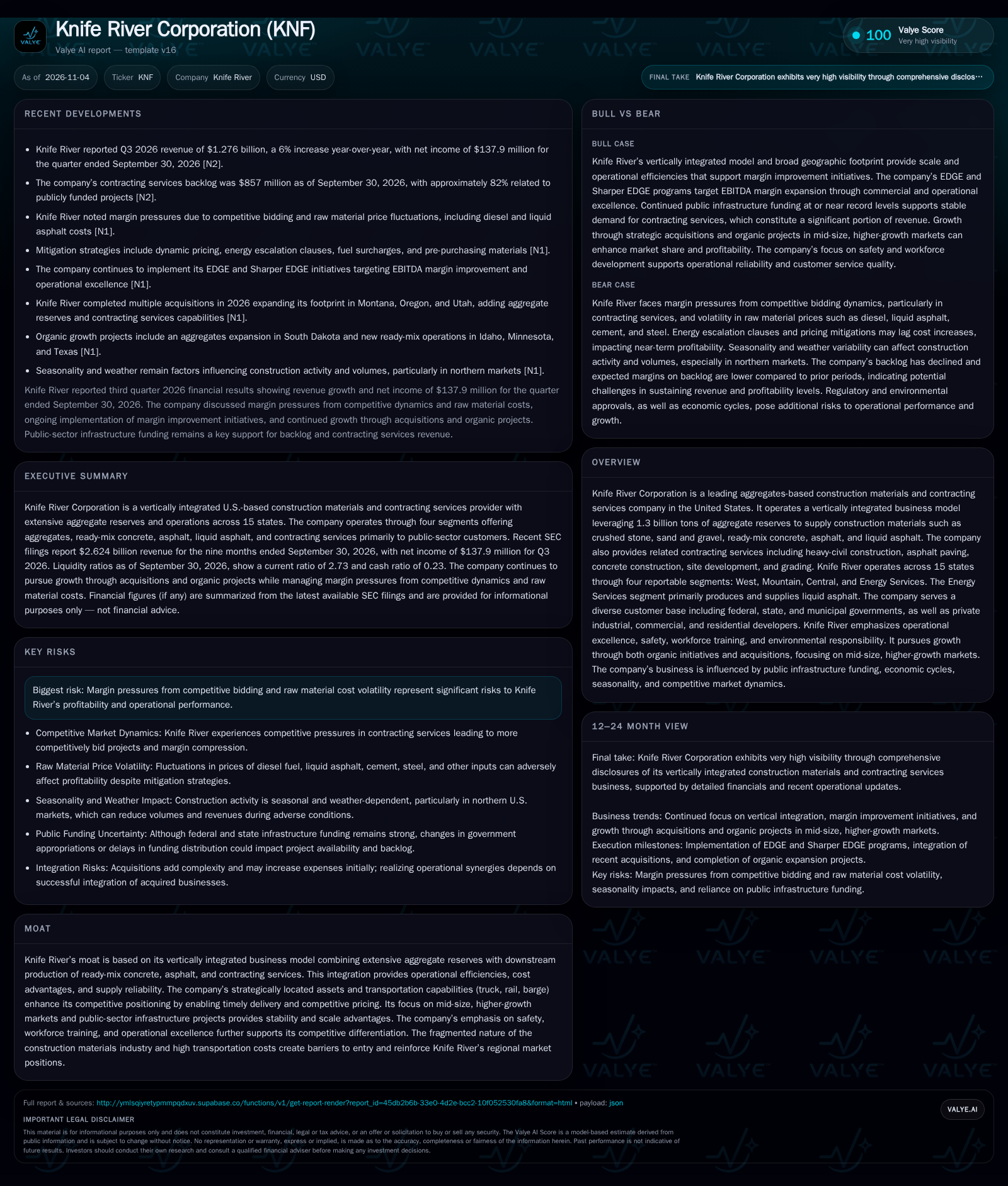
Knife River’s revenue has grown year-over-year, supported by acquisitions and infrastructure demand, but margin compression—especially in contracting services—has emerged amid competitive bidding and rising input costs. The company’s $857 million backlog is heavily reliant on public-sector projects, and while recent acquisitions have expanded its footprint, expected margins on backlog are lower than in prior periods. The EDGE and Sharper EDGE programs target operational improvements, but execution risk remains as integration and raw material pricing volatility continue to challenge profitability [S2].
Knife River Corporation has built a formidable regional presence in construction materials and contracting services, anchored by 1.3 billion tons of aggregate reserves and a deliberately vertically integrated business model. As of Q3 2026, the company reports solid revenue growth and a robust public-sector-oriented backlog, but faces persistent margin compression—particularly in contracting services—amid intensifying competition and raw material price volatility. With recent acquisitions expanding its asset base and operational footprint, Knife River’s ability to execute on margin improvement initiatives while managing integration risks and cost pressures will define its next phase of performance [S2].
Recent Performance: Growth, Margin Compression, and Acquisitions Shape the Outlook
Knife River reported $2.624 billion in revenue for the nine months ended September 30, 2026, and net income of $137.9 million for Q3 2026. While revenue grew 6% year-over-year in Q3, net income declined slightly, reflecting ongoing margin pressure [S2]. The company’s contracting services backlog stood at $857 million at quarter-end, with 82% linked to public-sector projects. However, the expected margins on this backlog are lower than in prior periods, suggesting a more competitive environment and potential profitability challenges ahead [S2].
Knife River has been active on the acquisition front, completing multiple deals in 2026—including the notable Strata Corporation acquisition in March—expanding its aggregate reserves and regional presence in Montana, Oregon, and Utah [S1] [S2]. The company reported cash and liquidity metrics for the period; these figures do not by themselves establish operating runway, investment capacity, financial flexibility, or financing capacity. [S2]
How Knife River’s Vertical Integration Drives Economics—and Where It Faces Pressure
Knife River’s vertically integrated structure is designed to capture margin across the construction materials value chain. The company controls sourcing, processing, and downstream sales of aggregates, ready-mix concrete, asphalt, and liquid asphalt, with roughly 35% of aggregate volumes consumed internally to support higher-value products and contracting services [S1]. This integration should, in theory, enable better cost control, supply reliability, and partial insulation from third-party input price shocks.
However, the economics of this model are sensitive to both fixed and variable costs. High fixed costs (plants, equipment, reserves) mean that operating leverage can boost profitability in strong demand periods, but also amplifies downside risk during slowdowns or when margin pressure emerges—such as from competitive bidding or raw material inflation. Variable input costs, particularly for diesel, liquid asphalt, cement, and steel, are subject to global commodity swings. Knife River employs dynamic pricing, escalation clauses, and pre-purchasing to mitigate this risk, but these tools may lag rapid cost changes or face resistance in competitive bids [S2].
The company’s capital intensity is significant: maintaining and expanding aggregate reserves, plants, and transportation infrastructure requires ongoing investment, as does the integration of acquired businesses. The EDGE and Sharper EDGE initiatives aim to improve EBITDA margins through operational efficiency, but the translation of these efforts into sustainable profit improvement remains to be fully demonstrated [S1] [N1].
Navigating Fragmented Markets, High Entry Barriers, and Public-Sector Dynamics
Knife River operates in a highly fragmented industry characterized by regional competitors, high transportation costs, and significant barriers to entry due to permitting, aggregate reserves, and capital requirements. Its vertically integrated footprint and control of 1.3 billion tons of reserves across 208 aggregate sites afford scale advantages in sourcing and logistics [S1].
The company’s competitive set includes national and regional aggregates and construction materials providers, as well as local contracting firms. While vertical integration offers cost and supply advantages, the contracting services segment is exposed to fierce price-based competition, especially for public-sector projects where contracts are often awarded to the lowest bidder. This dynamic is currently contributing to margin compression, as reflected in the declining expected margins on backlog [S2].
Knife River’s reliance on public-sector work (81% of contracting revenue) provides volume stability but also limits pricing power and increases exposure to government funding cycles. The company’s focus on mid-size, higher-growth markets may partially mitigate these risks, but does not fully insulate it from macroeconomic or regulatory headwinds.
Margin Recovery and Integration Success Could Unlock Significant Value
If Knife River can successfully execute its EDGE and Sharper EDGE initiatives, integrate recent acquisitions smoothly, and leverage its expanded footprint, there is potential for meaningful EBITDA margin expansion. Key to this scenario is the company’s ability to pass through input cost inflation via dynamic pricing and escalation clauses, and to achieve operational synergies from its acquisitions [S1] [N1].
Continued strong public infrastructure funding—currently at or near record levels in most operating regions—could sustain high utilization rates and provide a buffer against private-sector volatility [S2]. If the company demonstrates improving contracting services margins in future quarters, rising backlog quality (i.e., higher expected margins), and sustained top-line growth from both organic and acquired assets, upside could materialize.
Evidence supporting this scenario would include sequential improvement in EBITDA margins, higher realized pricing in contracting services, and successful integration milestones from recent acquisitions.
Sustained Public-Sector Demand Offsets Margin Headwinds—But Profitability Remains Pressured
The most probable path for Knife River involves continued revenue growth driven by public-sector infrastructure demand and incremental contributions from acquisitions, but with contracting services margins remaining under pressure due to competitive bidding and input cost volatility. The backlog is likely to remain robust, but expected margins may stay below historical averages unless cost inflation eases or pricing power improves [S2].
The EDGE and Sharper EDGE programs may deliver moderate operational improvements, but offsetting headwinds from integration costs, wage inflation, and commodity price swings could limit near-term margin expansion. Seasonality and weather may introduce quarter-to-quarter volatility, especially in the northern states.
Confirmation of this scenario would be continued top-line growth with stable or only modestly improved margins, and backlog levels that reflect ongoing public-sector demand but do not show a clear trend toward higher profitability.
Prolonged Margin Compression and Funding Volatility Erode Value Creation
A less favorable scenario would see Knife River’s margin pressures deepen, either from further intensification of competitive bidding—especially in public projects—or from a new wave of input cost inflation that outpaces the company’s ability to adjust contract pricing. If public-sector funding were to slow or become more unpredictable, both backlog and utilization rates could decline, amplifying the negative impact of high fixed costs.
Integration missteps from the recent spate of acquisitions could drive up operating expenses and distract management from efficiency initiatives, compounding profitability challenges. In such a scenario, the company could see flat or declining revenues, further margin erosion, and reduced free cash flow, potentially constraining its ability to invest in further growth.
Evidence for this downside would include continued or accelerating declines in contracting services margins, shrinking backlog or backlog with further deteriorating expected margins, and negative surprises on integration costs or project execution.
Testing Knife River’s Margin Story: What Needs to Go Right (or Wrong)
Contracting services margin trends—both reported and expected on backlog—will be a direct barometer of the effectiveness of EDGE initiatives and pricing strategies.
EBITDA margin progression, if disclosed, would clarify whether operational improvements are translating into sustainable profit gains.
Integration costs and synergy realization from 2026 acquisitions, including Strata, are important to monitor for both cost containment and revenue enhancement.
Aggregate and downstream product pricing trends, and the company’s ability to pass through input cost increases, would help test pricing power.
The mix of public versus private sector contracting revenue, and any changes in public infrastructure funding levels or project timing, will affect both volume and margin outlook.
Backlog composition—not just size but expected margin and project type—will indicate the quality of future revenue.
Seasonality and weather impacts, particularly in northern markets, may drive quarter-to-quarter volatility; construction volumes in shoulder periods would help gauge resilience.
Liquidity trends over time, especially in the context of ongoing capital investment and acquisition integration, would clarify the company’s potential financial flexibility.
Disclaimer: This is research-only, informational analysis and not investment advice. It may include AI-generated interpretation and general industry context. Always verify important details using primary sources.

Comments