
IFF’s 2026 Outlook: Profitability Pressures Amid Operational Strength
International Flavors & Fragrances Inc. reported a Q3 2026 net loss but raised its full-year guidance after surpassing earnings and revenue expectations.
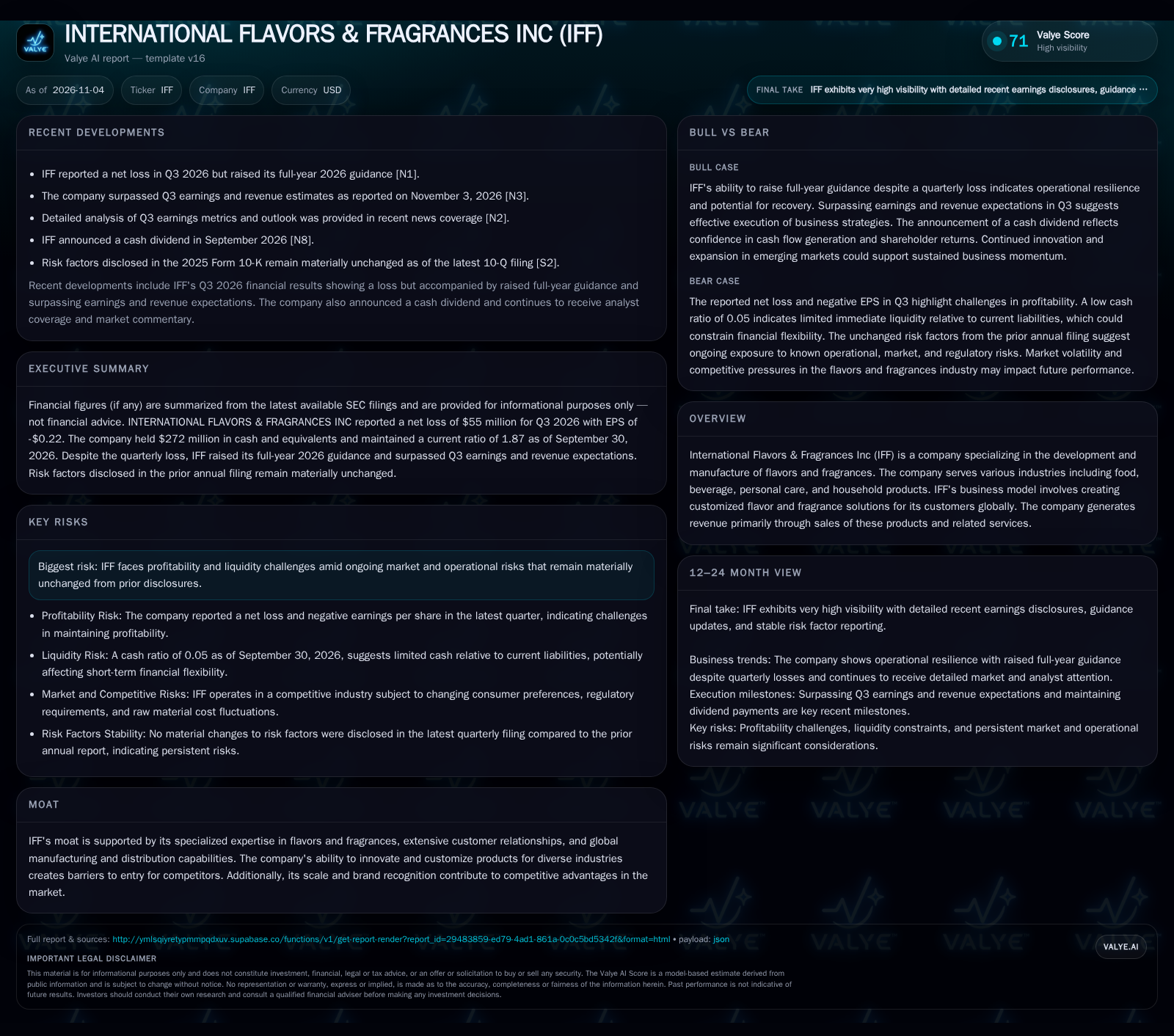
IFF posted a net loss of $55 million in Q3 2026 but surprised by lifting full-year guidance and beating quarterly expectations. The core thesis hinges on whether IFF can convert its scale, innovation, and customer relationships into sustained profitability despite ongoing industry and balance-sheet pressures. [S2] [N1] [N3] [N8]
International Flavors & Fragrances Inc. (IFF) enters the final quarter of 2026 at a crossroads: the company delivered a $55 million net loss in Q3, yet management raised full-year guidance and beat consensus expectations for both earnings and revenue. The coming quarters will test whether IFF’s execution can outpace its persistent financial and strategic risks. [S2] [N1] [N3] [N8]
Quarterly Loss and Optimistic Forecasts Highlight IFF’s Mixed Performance
IFF reported a net loss of $55 million for Q3 2026, translating to an EPS of -$0.22. This marks continued pressure on the company’s bottom line, with profitability remaining elusive. Despite these losses, management raised full-year 2026 guidance and exceeded Q3 earnings and revenue expectations, suggesting either improving operating conditions or successful cost/portfolio actions that are not yet fully visible in the reported quarterly figures. [S2] [N1] [N3]
The cited source reports dividend-related activity; that disclosure alone does not establish dividend-policy continuity, management confidence, or a material constraint on capital flexibility. [S2] [N8]
Risk disclosures from the 2025 annual report remain materially unchanged, indicating that the company’s key operational, market, and regulatory exposures are persistent rather than resolved. [S1] [S2]
Revenue Growth and Economic Headwinds in IFF’s Custom Solutions Approach
IFF’s economic engine is built on developing and manufacturing customized flavors and fragrances for global food, beverage, personal care, and household product companies. Revenue is primarily generated through product sales, with some related service income. The company’s ability to tailor solutions to customer needs—often requiring close technical collaboration—creates stickier relationships and some switching friction, but also entails high R&D and formulation costs.
Pricing power in this industry is mixed: large CPG customers can exert significant pressure, and cost pass-throughs for raw material inflation are not always immediate or complete. Volume growth is tied to both underlying customer demand and IFF’s ability to innovate, win new business, or expand into adjacent segments and emerging markets.
The cost structure blends a high fixed-cost base (R&D, manufacturing footprint, regulatory compliance) with variable input costs (raw materials, logistics). This creates operating leverage when volumes grow but also amplifies downside risk if volumes decline or input costs spike. Capital needs are ongoing—innovation and regulatory approval cycles require sustained investment, and working capital requirements can be significant given the global, complex customer base.
Profitability depends on IFF’s ability to maintain high utilization of its assets, successfully pass through input cost increases, and drive mix toward higher-margin specialty and proprietary solutions. In periods of cost inflation or demand volatility, margin compression is a recurring risk.
IFF’s Innovation and Scale Offer Strengths Alongside Market Risks
IFF operates in a highly competitive sector with global peers ranging from other specialized flavors and fragrance firms to diversified chemicals and ingredient providers. Its core competitive advantages are rooted in technical expertise, breadth of portfolio, global reach, and the ability to co-develop bespoke solutions with large, sophisticated customers.
Deep integration into customer formulations and long development cycles create meaningful switching frictions—customers are reluctant to swap suppliers for core product lines due to risks of altered taste, scent, or regulatory compliance. This dynamic supports retention and can buffer against pure price-based competition.
However, barriers to entry are not absolute. Smaller, agile competitors can innovate rapidly in niche segments, and large CPG customers may pursue dual sourcing or internal R&D to limit dependence on any single supplier. Raw material volatility and regulatory changes can also level the playing field, forcing even incumbents like IFF to adapt quickly or risk margin erosion.
IFF’s global manufacturing and distribution footprint provides scale benefits and supply chain resilience, but also exposes the company to currency, geopolitical, and operational risks that can offset some of the advantages of size.
Accelerated Commercial Execution Could Unlock Margin Improvement and Growth
The most favorable scenario would see IFF’s raised full-year guidance validated by sustained improvement in both volume and margin performance over the next several quarters. This could be driven by successful pass-through of raw material costs, increased demand from emerging markets, and a mix shift toward higher-value specialty solutions.
Confirmation would come from a return to positive net income, evidence of expanding gross and operating margins, and continued outperformance against consensus expectations. Additional signs would include new customer wins, successful product launches, and increased R&D productivity translating to commercialized innovations.
Falsification would occur if margin improvements fail to materialize, volumes stagnate or decline, or if the company is forced to curtail its dividend or seek external financing to meet obligations.
A Realistic Scenario of Industry Challenges and Earnings Stability for IFF
The most likely outcome is that IFF manages to stabilize its financial performance, with modest sequential improvement but continued volatility in profitability and cash flow. The company may benefit from some operating leverage if demand remains steady, but persistent cost pressures and competitive pricing could limit margin expansion.
Management’s raised guidance may prove achievable if operational execution continues to improve and cost headwinds are at least partially offset by mix improvements and incremental pricing.
Risk factors—ranging from raw material volatility to customer concentration and regulatory complexity—are likely to remain prominent, keeping the company in a mode of cautious optimization rather than aggressive growth.
Falsification would involve renewed losses, a deterioration in working capital, or the emergence of new, material risk disclosures.
Liquidity Constraints and Margin Erosion Pose Risks to IFF’s Market Standing
A downside scenario would see profitability fail to recover, with continued net losses and further margin compression due to inability to fully pass through costs or defend volumes against competition.
In the most severe case, the company might be forced to seek external capital at unfavorable terms, restructure assets, or divest business lines to shore up liquidity.
Falsification would require a swift return to profitability and visible improvement in cash flow generation.
Factors Influencing IFF’s Conversion of Scale and Innovation into Profits
Quarterly net income and EPS trends—continued losses or a return to profitability will clarify the effectiveness of operational actions.
Gross and operating margin progression—improvement would indicate successful cost pass-through and/or mix shift; stagnation or decline would suggest persistent margin pressure.
Revenue growth by segment and geography—details on where growth is coming from (e.g., emerging markets, specialty products) would illuminate the sustainability of top-line momentum.
New product launches and customer wins—evidence of successful innovation and commercial traction would support the argument for IFF’s differentiated position.
Any material changes in disclosed risk factors—new or escalating risks in regulatory, supply chain, or customer concentration areas would suggest a shift in the risk/reward profile.
Management guidance updates—raising or lowering full-year or medium-term targets would provide a real-time test of confidence and execution.
Disclaimer: This is research-only, informational analysis and not investment advice. It may include AI-generated interpretation and general industry context. Always verify important details using primary sources.

Comments