
Glacier Bancorp: Managing Credit and Rate Risks for Regional Banking Resilience
Glacier Bancorp enters late 2026 with a $20.9 billion loan book, disciplined credit-loss provisioning, and a focus on interest-rate risk management—yet the interplay of regional competition, economic cycles, and evolving rate environments will test both its risk controls and profit durability.
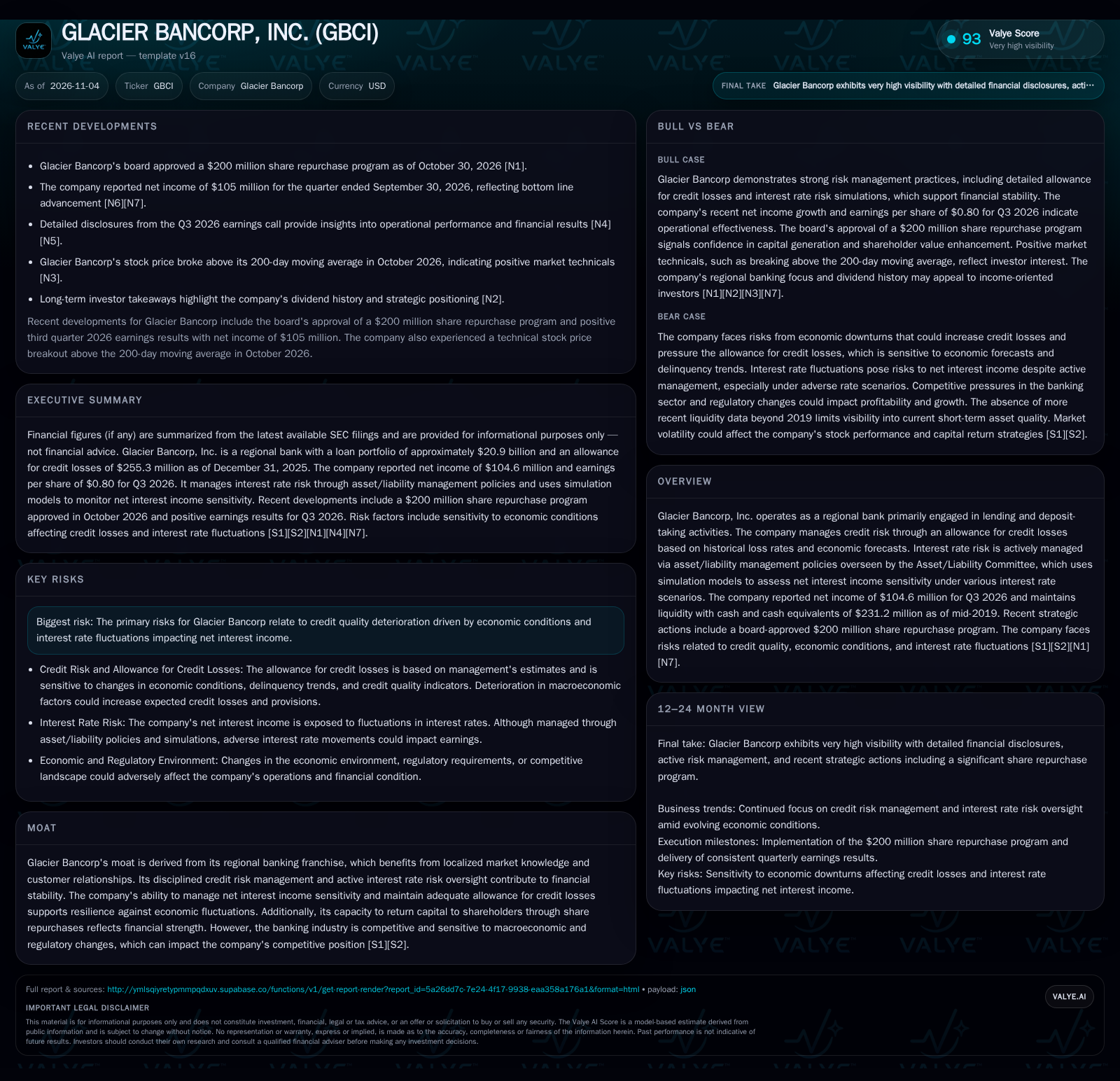
Glacier Bancorp reported Q3 2026 net income of $104.6 million, supported by a $20.9 billion loan portfolio and a $255.3 million allowance for credit losses. The bank’s primary risks are credit deterioration and interest-rate swings, which it manages through simulation-driven ALCO oversight. Recent share price technicals are positive, but visibility into current reported liquidity position due to outdated short-term cash disclosures. The sustainability of current profitability will depend on future credit trends, rate management, and regional competitive dynamics. [S1] [S2] [N3] [N7]
Glacier Bancorp, a regional banking franchise with a $20.9 billion loan book, closed the third quarter of 2026 with net income of $104.6 million and a detailed risk management posture. The company’s commitment to robust credit-loss provisioning and simulation-based interest rate risk oversight underpins its stability, even as it faces the perennial challenges of credit cycles and volatile rate environments. With positive stock price momentum, Glacier’s near-term outlook appears constructive, but the durability of its earnings will hinge on the trajectory of credit quality, the bank’s ability to navigate interest rate shifts, and how it responds to regional competition and regulatory change. [S1] [S2] [N3] [N7]
Recent Profitability and Risk Posture Define Glacier’s Near-Term Profile
Glacier Bancorp reported net income of $104.6 million for the third quarter of 2026, driven by its $20.9 billion loan portfolio and ongoing expansion in its regional banking markets [S2] [N7]. The company’s allowance for credit losses (ACL) stood at $255.3 million as of year-end 2025, highlighting a continued focus on provisioning for potential economic headwinds [S1]. Interest rate risk remains the primary market risk, managed through simulation-driven oversight by the Asset/Liability Committee (ALCO) [S1]. Notably, the stock broke above its 200-day moving average in October 2026, reflecting constructive investor sentiment [N3]. However, the last disclosed cash and cash equivalents figure is dated from mid-2019, which limits visibility into current liquidity [S2]. These facts frame a business that is operationally sound but remains exposed to external shocks and competitive dynamics.
How Glacier Bancorp Earns: Spread Income, Credit Costs, and Operating Leverage
Glacier Bancorp’s core business model centers on the traditional spread between interest earned on its loan portfolio and interest paid on deposits and other funding sources. Net interest income is the primary revenue driver, with profitability depending on both the volume and mix of loans versus deposits, as well as the bank’s ability to manage funding costs as rates fluctuate.
Credit risk is an ever-present variable: the company’s $255.3 million ACL reflects management’s estimate of losses over the expected life of the loan book, and future provisioning could swing with shifts in regional economic conditions or borrower quality [S1]. Operating leverage in a regional bank is typically moderate—fixed costs related to branch infrastructure and compliance are material, but digitalization and scale in back-office operations can incrementally improve margins if loan and deposit growth outpace expense growth.
Glacier’s earnings profile is thus a function of: (1) net interest margin (NIM) resilience as rates move, (2) disciplined credit underwriting and loss recognition, and (3) the ability to grow or retain low-cost deposits, especially in a competitive or rising-rate environment. Capital and funding needs are generally met through a mix of core deposits and wholesale funding, but sustained loan growth or shocks to credit quality could necessitate external capital or liquidity actions.
Regional Banking Dynamics: Local Relationships vs. Scale and Digital Threats
Glacier Bancorp’s competitive position is anchored in its regional franchise—local market knowledge, community ties, and relationship-driven lending offer advantages over national and purely digital banks, particularly with small-to-midsize business borrowers and retail customers.
However, the competitive landscape is evolving. Large national banks and digital-first challengers are increasing pressure on deposit pricing and customer acquisition costs. In addition, non-bank lenders and fintech platforms continue to erode traditional lending and payments revenue streams. Regulatory expectations around risk management, compliance, and capital adequacy are also rising, raising the bar for operational discipline.
Glacier’s disciplined approach to credit risk and interest rate management may buffer some shocks, but its ability to defend margins and retain customers could be tested if competitors offer superior digital convenience, higher deposit rates, or more aggressive lending terms. The company’s moat is thus durable but not unassailable—continued investment in technology and customer experience, as well as prudent risk governance, will be key to sustaining its edge.
If Credit Quality Holds and Deposit Costs Remain Contained, Profits Could Compound
In a favorable scenario, Glacier Bancorp could leverage its robust credit underwriting and stable deposit base to deliver compounding profit growth. If regional economic conditions remain benign, credit losses may stay below long-term averages, allowing the company to release excess provisions or maintain a modest ACL relative to loan growth. Effective interest rate risk management—supported by ALCO’s simulation models—could insulate net interest income from moderate rate volatility, especially if deposit betas (the rate at which deposit costs rise relative to market rates) remain low.
Confirmation of this trajectory would include continued growth in net interest income, stable or improving NIMs, low net charge-offs, and evidence of sticky, low-cost deposit growth. This scenario would be further validated by positive operating leverage (revenue growing faster than expenses), limited need for additional capital, and robust shareholder returns through dividends or buybacks.
Falsification would come from a spike in non-performing loans, rising deposit costs outpacing asset yield improvements, or a deterioration in operating efficiency—any of which would signal that the company’s risk controls or competitive moat are under strain.
Profitability Anchored by Risk Controls, but Exposed to Credit and Rate Headwinds
The most plausible scenario is that Glacier Bancorp maintains profitability through disciplined credit and interest rate management, but faces periodic pressure from changing economic and competitive conditions. Credit losses may fluctuate with regional cycles, requiring periodic adjustments to the ACL, but not reaching levels that threaten solvency or capital adequacy.
Interest rate risk is likely to remain a key variable: if rates rise rapidly or the yield curve inverts, net interest margins could compress unless the company can reprice assets faster than liabilities. Competitive pressure may force higher deposit rates, squeezing spreads, especially if larger or digital-first banks become more aggressive in Glacier’s core markets.
This scenario would be confirmed by steady, if unspectacular, earnings growth, moderate provisioning activity, and stable capital ratios. Falsification could occur if margin compression accelerates, credit quality unexpectedly deteriorates, or if regulatory or technological changes disrupt the company’s core relationship-driven banking model.
Economic Downturn or Rate Shock Could Trigger Higher Losses and Margin Compression
A negative scenario for Glacier Bancorp would involve a regional economic downturn, leading to increased delinquencies and credit losses across its $20.9 billion loan book. In this environment, the allowance for credit losses could prove inadequate, forcing larger provisions and eroding net income [S1].
Simultaneously, if interest rates move unfavorably—such as a rapid rise in short-term rates or a sharp yield curve inversion—the cost of deposits could climb faster than asset yields, compressing net interest margins. This double impact could significantly reduce profitability and, in severe cases, threaten regulatory capital buffers.
Confirmation of this scenario would include a sharp increase in non-performing assets, rising charge-offs, a declining net interest margin, and any need to raise external capital or reduce dividends/buybacks. Falsification would require evidence that credit quality is resilient even in a downturn, and that Glacier can defend its margins through pricing power or differentiated funding sources.
What Will Test Glacier Bancorp’s Resilience in the Next Cycle?
Quarterly trends in net charge-offs and non-performing assets—if disclosed—will be critical in gauging underlying credit quality direction.
Net interest margin (NIM) movement relative to peer banks and to changes in short- and long-term rates will reveal the effectiveness of interest rate risk management.
Deposit growth and the mix of core versus higher-cost or brokered deposits would help assess franchise strength and funding cost resilience.
Allowance for credit losses as a percentage of loans, especially as economic forecasts shift, will indicate management’s risk posture and provisioning discipline.
Operating efficiency ratio (expenses as a percentage of revenue), if disclosed, would help test whether Glacier is achieving positive operating leverage.
Progress or investment in digital banking capabilities, as evidenced by customer adoption rates or new product launches, would help gauge Glacier’s ability to defend against digital competition.
Regulatory or macroeconomic developments in Glacier’s core regions, particularly those affecting real estate, small business lending, or consumer credit, could materially alter risk outlook and profitability.
Disclaimer: This is research-only, informational analysis and not investment advice. It may include AI-generated interpretation and general industry context. Always verify important details using primary sources.

Comments