
Revolve Group in 2026: AI Ambitions, Luxury Tailwinds, and the Margin Risks of Modern Apparel Retail
Revolve Group’s latest quarter shows ongoing profitability, reported liquidity position, and momentum in its luxury FWRD segment, but macro and operational headwinds—including tariffs, returns, and shifting consumer demand—continue to test the durability of its hybrid platform and AI-driven strategy.
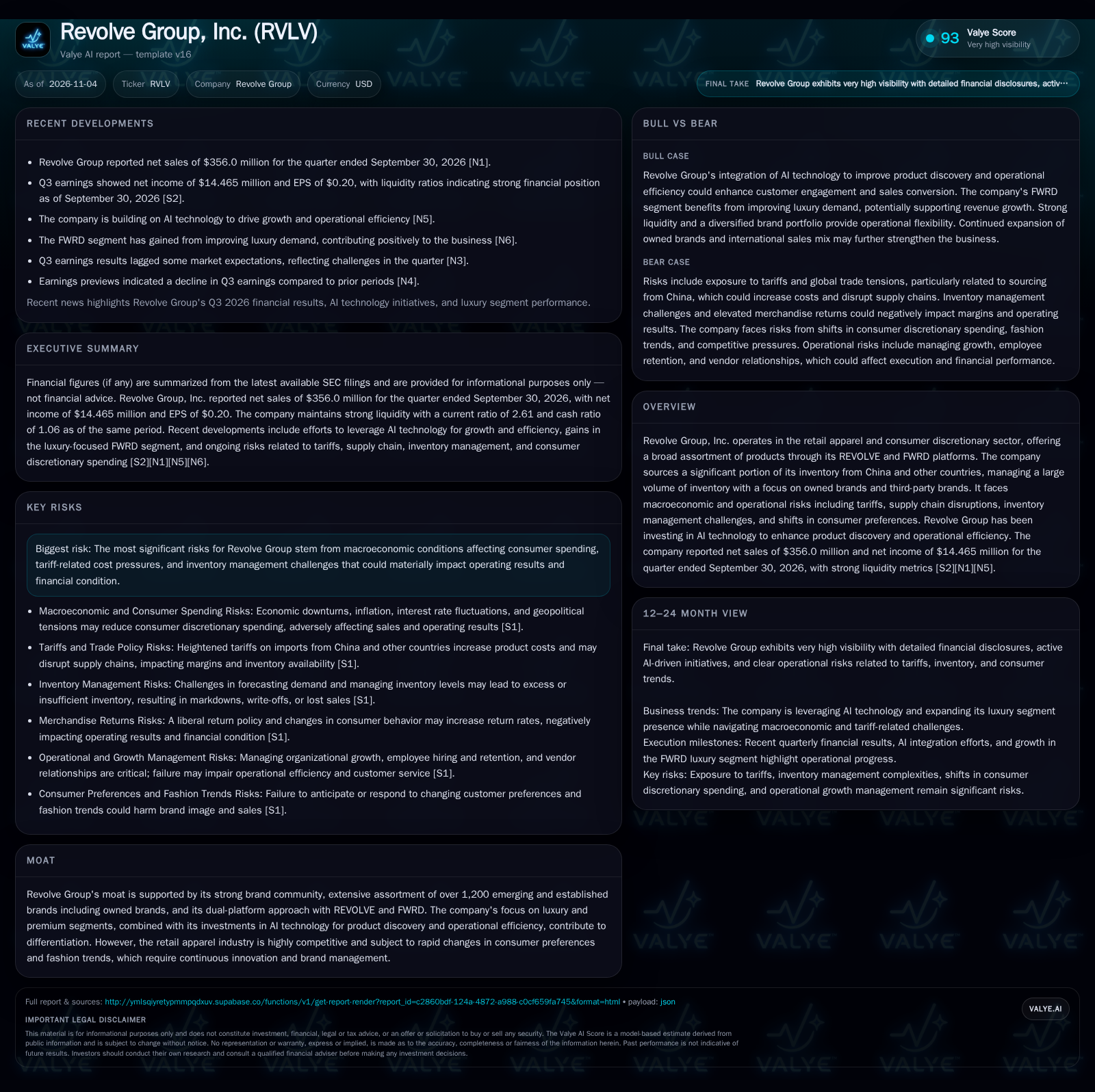
Revolve Group reported Q3 2026 net sales of $356.0 million and net income of $14.465 million, with reported liquidity position and a continued push into AI-driven efficiency. The luxury-focused FWRD segment benefited from rising high-end demand, but the company faces pressure from tariffs, inventory risks, and a competitive, fast-changing retail landscape. Execution around AI, inventory, and consumer engagement will define the company’s ability to sustain growth and margins in the coming quarters. [S2] [N1] [N5] [N6]
Revolve Group, Inc. enters the final quarter of 2026 amid a complex mix of opportunity and risk. The company’s dual-platform model—spanning its mainstream REVOLVE and luxury FWRD offerings—delivered $356 million in Q3 net sales and maintained profitability, with a reported liquidity position. Recent investments in AI technology and a shift toward higher-margin luxury categories aim to set Revolve apart in a highly competitive sector. However, the business remains exposed to macroeconomic swings, shifting consumer preferences, and the perennial challenges of inventory and return management. The next phase will test whether Revolve’s technology and brand strategies can offset intensifying operational and external pressures. [S2] [N1] [N5] [N6]
Recent Results Show Profitability and Liquidity, but Reveal Mixed Operating Signals
For the quarter ended September 30, 2026, Revolve Group reported net sales of $356.0 million and net income of $14.465 million, translating to basic and diluted EPS of $0.20 [S2] [N1]. These results confirm that the company remains profitable in a volatile apparel environment, though earnings reportedly lagged some analyst expectations and prior periods [N3] [N4].
As of quarter-end, Revolve held $284.64 million in cash and cash equivalents, with a current ratio of 2.61 and a cash ratio of 1.06 [S2].
The FWRD luxury segment showed improved performance, benefiting from stronger luxury demand [N6]. Meanwhile, the company continued to invest in AI-driven initiatives designed to enhance product discovery and operational efficiency [N5]. These efforts are intended to position Revolve favorably against both traditional and digital-native competitors, but their impact on future growth and margin expansion remains to be fully validated.
How Revolve’s Hybrid Model and AI Bets Could Shape Margin Structure
Revolve Group’s revenue is generated by selling a broad mix of owned and third-party apparel and accessories across its REVOLVE and FWRD platforms. The business model is fundamentally volume-driven, with revenue highly sensitive to consumer discretionary spending cycles and fashion trends. Margins are influenced by product mix (owned brands typically carrying higher gross margins), markdown and return rates, and supply chain costs—including tariffs on China-sourced inventory.
AI initiatives are being deployed to improve product curation, demand forecasting, and operational efficiency. If effective, these tools could lower working capital needs, reduce inventory obsolescence, and improve conversion rates, supporting both gross and operating margins. However, the apparel sector is notoriously vulnerable to fashion risk and return rates, and Revolve’s liberal return policy exposes it to margin volatility if return behavior worsens.
Operating leverage is present but limited by the necessity of ongoing investment in marketing, technology, and fulfillment. Fixed costs are significant in technology and logistics, but variable costs (inventory, returns processing, shipping) remain high. Capital needs are moderate, with most investment directed toward technology and inventory rather than heavy assets. The risk is that rising costs (tariffs, logistics, labor) could outpace efficiency gains, eroding the margin benefits of scale or AI.
Competing in a Saturated Market: Differentiation Through Brand, Tech, and Premiumization
Revolve Group operates in one of the most competitive segments of consumer discretionary retail, facing rivals ranging from fast-fashion giants to luxury e-commerce platforms and digitally native brands. The company’s competitive edge is partly built on its broad assortment—over 1,200 brands, including 28 owned brands and more than 500 luxury brands through FWRD—combined with a strong influencer and customer community.
The dual-platform approach allows Revolve to target both mass and premium consumers, with FWRD benefiting from recent luxury demand tailwinds [N6]. Investments in AI for product discovery and personalized marketing may improve customer engagement and retention if they deliver tangible results, but such technology is increasingly table stakes among leading digital retailers.
Switching costs for consumers remain low, as fashion shoppers can easily move between platforms. Revolve’s moat depends on maintaining trend leadership, effective marketing, and a seamless customer experience. The risk of substitution—whether from new digital upstarts, established luxury houses’ own e-commerce, or fast-fashion brands—remains high, and the company must continuously innovate to defend its position.
If AI and Luxury Expansion Drive Operating Leverage
A favorable scenario would see Revolve’s AI investments yielding measurable improvements in inventory turnover, customer conversion, and personalized shopping experiences. If the company can leverage these tools to reduce markdowns and returns while expanding its owned and luxury brand mix, gross margins could widen and operating leverage could increase despite sector headwinds.
Sustained demand in the FWRD luxury segment would further could support premium pricing and higher average order values, reinforcing profitability. International growth or further penetration of high-value customer segments could amplify these effects.
Evidence that would confirm this scenario includes a rising gross margin, declining inventory write-offs, improving return rates, and positive operating income trends. Accelerating revenue growth in premium and owned brands, alongside continued cash generation, would also support the bull case.
Steady Execution Amid Shifting Consumer and Cost Headwinds
The most plausible outcome is that Revolve continues to generate steady sales and modest profitability, with AI and luxury initiatives partially offsetting ongoing margin pressures from returns, tariffs, and marketing costs. Revenue growth may be moderate as consumer discretionary spending faces macroeconomic uncertainty.
The company likely maintains its liquidity buffer and operational flexibility but does not achieve a step-change in margin structure. Inventory and return management remain persistent challenges, and gains in the FWRD segment are balanced by competitive intensity and the need to invest in customer acquisition.
Confirmation would come from stable or slightly improving gross margins, consistent operating income, and continued investment in technology and brand marketing. Evidence of persistent high return rates, inventory write-downs, or rising SG&A as a percentage of sales would challenge the sustainability of this scenario.
Margin Compression from Tariffs, Returns, and Consumer Weakness
In a negative scenario, macroeconomic deterioration or a shift in consumer preferences leads to weaker sales and higher promotional activity. If tariff costs rise or supply chain disruptions worsen, Revolve could face a squeeze on gross margins, especially given its reliance on China-sourced inventory.
Elevated return rates—exacerbated by a liberal return policy and volatile fashion trends—could further erode profitability. Inventory mismanagement could lead to markdowns or write-offs, while operational cost escalation (shipping, labor, technology) outpaces revenue growth.
Confirmation would be visible in falling gross and operating margins, declining net income or operating losses, and cash burn. Rising inventory or accounts receivable balances relative to sales, or a sharp uptick in return rates, would also signal downside risk.
What Will Prove Revolve’s AI and Luxury Strategies in the Next Year?
Gross margin trends: Sustained improvement would indicate success in inventory and return management; deterioration may signal cost or promotional pressure.
Return rate trajectory: An increase in merchandise returns could pressure margins and signal consumer dissatisfaction or operational friction; a decrease would be a positive indicator.
FWRD segment revenue and margin: Continued outperformance would validate the luxury expansion strategy; stagnation or reversal would challenge the thesis.
AI-driven efficiency metrics: If disclosed, improvements in inventory turnover, demand forecasting accuracy, or customer conversion rates would test the impact of technology investments.
Inventory write-downs or markdown levels: Persistent or rising markdowns would signal demand forecasting or inventory risk.
SG&A as a percentage of revenue: Escalation could indicate rising cost pressure or inefficiency; stable or declining ratios would support the operating leverage case.
International sales mix and growth: Expansion outside the U.S. would demonstrate geographic diversification and incremental growth potential.
Tariff and supply chain cost disclosures: Material increases would pressure margins; stability or reduction would alleviate a major risk.
Disclaimer: This is research-only, informational analysis and not investment advice. It may include AI-generated interpretation and general industry context. Always verify important details using primary sources.

Comments