
Pacific Health Care Organization: Workers’ Comp Cost Containment, Margin Pressures, and the Limits of Scale
The question is whether disciplined cost control and specialized service offerings can offset inflationary pressures and competitive bundling by larger claims administrators.
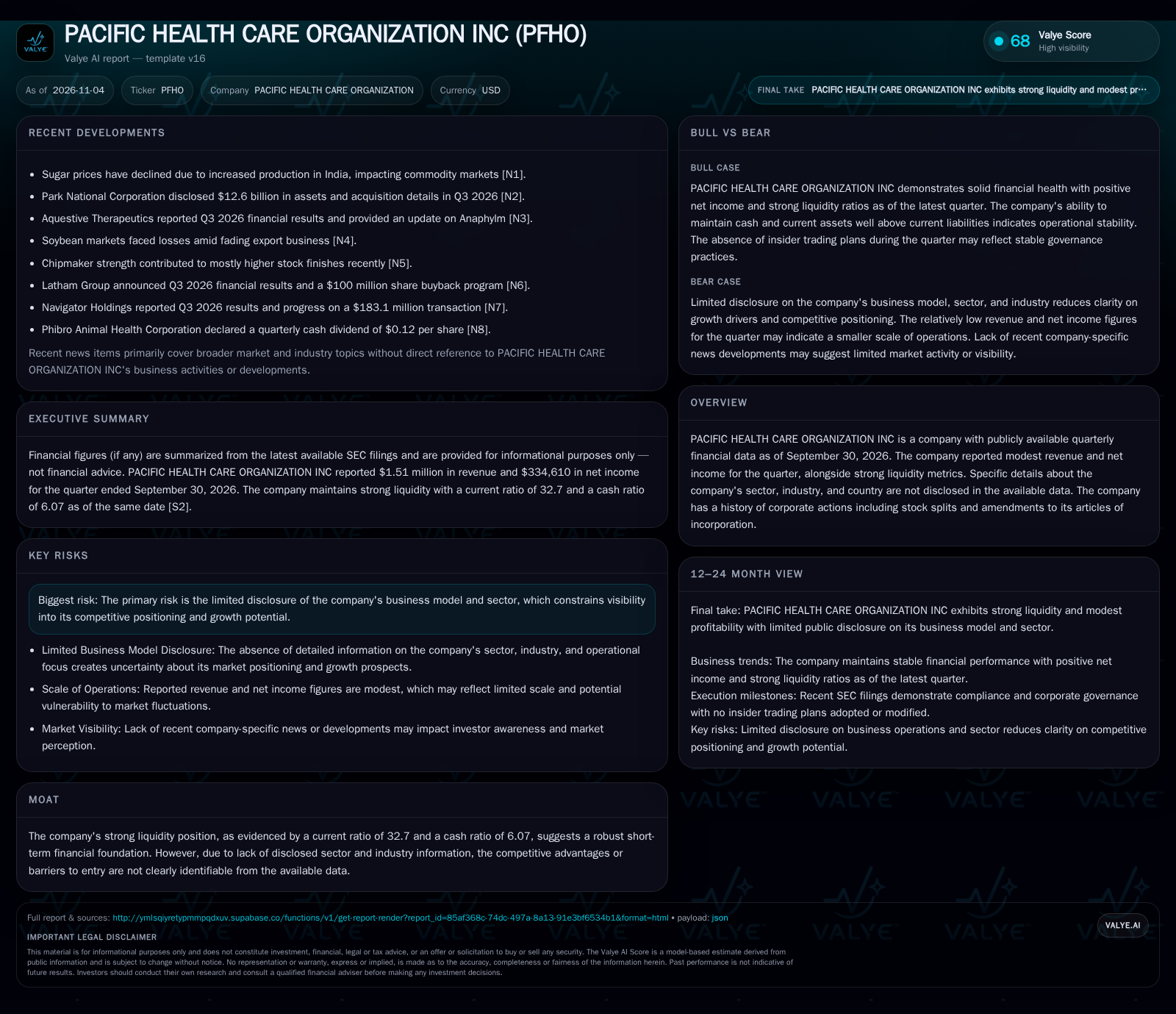
Pacific Health Care Organization (PFHO) delivers workers’ compensation cost-containment services primarily to California employers and claims administrators.As of September 30, 2026, the company reported $1.51 million in quarterly revenue and $334,610 in net income, supported by a reported current ratio of 32.7 and a cash ratio of 6.07. The company’s ability to maintain profitability amid competitive pricing and limited market visibility will likely determine future value creation. [S2]
Pacific Health Care Organization (PFHO) exemplifies the niche, service-driven economics of the workers’ compensation cost-containment industry. Reporting reported liquidity position and modest but positive profitability for the quarter ended September 30, 2026, PFHO’s financials reflect a disciplined approach to cost management. Yet, the company’s limited disclosure on sector specifics, small revenue base, and exposure to contract-driven pricing highlight both its strengths and vulnerabilities. The central tension is whether specialization and operational discipline can sustain margins in the face of competitive and inflationary headwinds.
Recent Financials Highlight Stability—But Also Scale Constraints
For the quarter ended September 30, 2026, Pacific Health Care Organization reported $1,512,564 in revenue and $334,610 in net income, with both basic and diluted EPS at $0.03. The company’s current assets stood at $14.3 million against current liabilities of just $437,488, resulting in a strikingly reported current ratio of 32.7 and a cash ratio of 6.07. These metrics point to reported liquidity position and operational stability. However, the modest revenue base underscores the company’s limited scale, raising questions about its ability to absorb shocks or invest for growth without diluting returns. No insider trading plans were adopted or modified during the quarter, and there were no recent company-specific news developments, suggesting governance stability but also limited external visibility. [S2]
While PFHO’s reported liquidity ratios are notably strong, it is essential to consider the qualitative aspects of this financial position. Extremely high current and cash ratios can sometimes indicate underutilized capital or conservative working capital management, which, while reducing financial risk, may also imply limited reinvestment into growth initiatives or technology upgrades. In a sector where scale and technological integration increasingly dictate competitive positioning, the balance between liquidity preservation and strategic investment becomes critical. The company’s ability to deploy capital efficiently to enhance service offerings or expand market reach will be a key determinant of its long-term viability and resilience against sector consolidation.
Revenue Model, Margins, and the Pressures of a Contract-Driven Niche
PFHO’s business revolves around providing cost-containment services for workers’ compensation programs—primarily managing Health Care Organizations (HCOs), Medical Provider Networks (MPNs), utilization review, bill review, and medical case management for California employers and claims administrators. Revenue is likely generated through a mix of per-case fees, administrative charges, and fixed-price contracts, particularly with public sector entities. The company discontinued its lien representation business in 2023, indicating a willingness to drop low-demand or low-margin services.
While the company’s cost structure is not fully disclosed, the predominance of contract-based revenue with public entities—often at fixed prices over contract terms—suggests limited pricing flexibility. Inflationary pressures on labor, benefits, and facility leases can erode margins, especially if contract rates are locked for multiple years. The company reported cash and liquidity metrics for the period; these figures do not by themselves establish operating runway, investment capacity, financial flexibility, or financing capacity.
Given the contract-driven nature of PFHO’s revenue, the company’s margin profile is inherently sensitive to the timing and terms of contract renewals. Fixed-price contracts, while providing predictable revenue streams, can become a liability if cost inflation outpaces negotiated rates, especially in labor-intensive service components. Additionally, the discontinuation of certain service lines suggests a strategic focus on core competencies but may reduce revenue diversification. This concentration increases operational risk if key contracts or customer segments experience downturns. A more granular understanding of contract duration, renewal frequency, and penalty clauses would help assess the company’s flexibility to adjust pricing or service mix in response to market dynamics.
Specialization Versus Scale: Competitive Dynamics in Workers’ Comp Services
PFHO operates in a sector where scale and integration can be significant competitive advantages. Larger insurance carriers and third-party administrators frequently bundle claims administration with managed care and cost-containment services, offering discounts or one-stop solutions that are attractive to cost-conscious customers. PFHO’s differentiation likely rests on specialized expertise in California regulatory frameworks, nimbleness, and the ability to customize solutions for smaller employers or public entities that may not be served well by standard bundled offerings.
However, customer switching costs in this segment are generally low unless the provider delivers exceptional outcomes, technology integration, or regulatory compliance support. The discontinuation of low-demand services (like lien representation) may improve focus, but also signals limits to organic growth opportunities. Without significant investment in technology or unique data-driven insights, PFHO risks being outcompeted by larger, better-resourced firms or technology-enabled new entrants.
The competitive dynamics in workers’ compensation cost containment increasingly favor providers that can integrate data analytics and automation to streamline claim processing and reduce administrative costs. PFHO’s specialization in California’s regulatory environment is a competitive advantage that may insulate it from some national players; however, without significant investment in technology or proprietary data, the company risks commoditization of its services. Moreover, the relatively low switching costs for customers mean that PFHO must continuously demonstrate superior outcomes or compliance expertise to retain clients. Strategic partnerships or incremental technology adoption could enhance customer stickiness and create barriers to entry for less specialized competitors.
Margin Resilience and Niche Expansion Could Drive Outperformance
A favorable scenario for PFHO would involve leveraging its reported liquidity position and disciplined cost management to weather inflationary pressures, while selectively expanding higher-margin services within its existing customer base. If the company can deepen relationships with public entities and claims administrators—potentially by offering value-added analytics, compliance tools, or technology integrations—it could justify modest price increases or win new contracts even in a competitive environment.
Upside would be confirmed by sustained or rising net income margins, incremental revenue growth without proportional expense increases, and evidence of new or renewed multi-year contracts with public sector customers. Expansion into adjacent geographies or service lines—if disclosed—would also signal the ability to scale profitably.
Steady-State Profitability Amid Margin Pressures and Modest Growth
The most plausible path for PFHO is continued modest profitability, with revenues largely flat or growing slowly in line with inflation and incremental contract wins. Incremental improvements in cost discipline or selective service enhancements may offset some inflationary headwinds, but significant growth or operational leverage appears unlikely without a step-change in scale, product mix, or customer acquisition.
Base-case confirmation would include stable net income, maintenance of high liquidity ratios, and consistent contract renewals with existing clients. Falsification would come from declining margins, revenue contraction, or evidence that contract losses are not being offset by new business.
Contract Losses and Inflation Could Squeeze Margins to Unsustainable Levels
The primary risk is that PFHO’s limited scale and exposure to inflation-sensitive costs—especially labor and benefits—outpace its ability to renegotiate contract rates or win new business. If larger administrators intensify price competition or customers consolidate spend with bundled providers, PFHO could face contract churn or be forced to discount prices, compressing already modest margins.
Downside confirmation would be visible in sequential revenue declines, net income turning negative, or a marked reduction in contract wins or renewals. If the company is forced to dip into its liquidity reserves to cover operating losses, or if it loses a significant public entity contract, the business could quickly become subscale.
Milestones That Will Test PFHO’s Specialty Services Thesis
Quarterly revenue growth or contraction—especially sequential trends—would help test the company’s ability to win new business or offset contract losses.
Net income margin trends: Sustained or rising margins would suggest effective cost management and pricing discipline; declining margins could indicate inflationary pressures or increased competition.
Disclosure of new, renewed, or lost contracts—particularly with public sector customers—would clarify customer concentration risk and revenue visibility.
Any announced expansion into new geographies or adjacent service lines would signal growth ambition and potential for operating leverage.
Breakdown of revenue by service type (if disclosed) would shed light on margin mix and dependency on individual offerings.
Updates on operating expense categories—especially labor and benefits—would illuminate the impact of inflation on profitability.
Evidence of technology investments or partnerships that could increase switching costs or create new value-added services.
Disclaimer: This is research-only, informational analysis and not investment advice. It may include AI-generated interpretation and general industry context. Always verify important details using primary sources.

Comments