
Voyager Technologies: Starlab Ambitions, Defense Integration, and the Tension Between Scale and Profitability
Voyager Technologies is betting on the convergence of defense, AI, and commercial space infrastructure—most notably through the Starlab project—to carve out a durable position in a capital-intensive, highly competitive landscape. Execution risk, competitive scale, and persistent losses will shape the next phase.
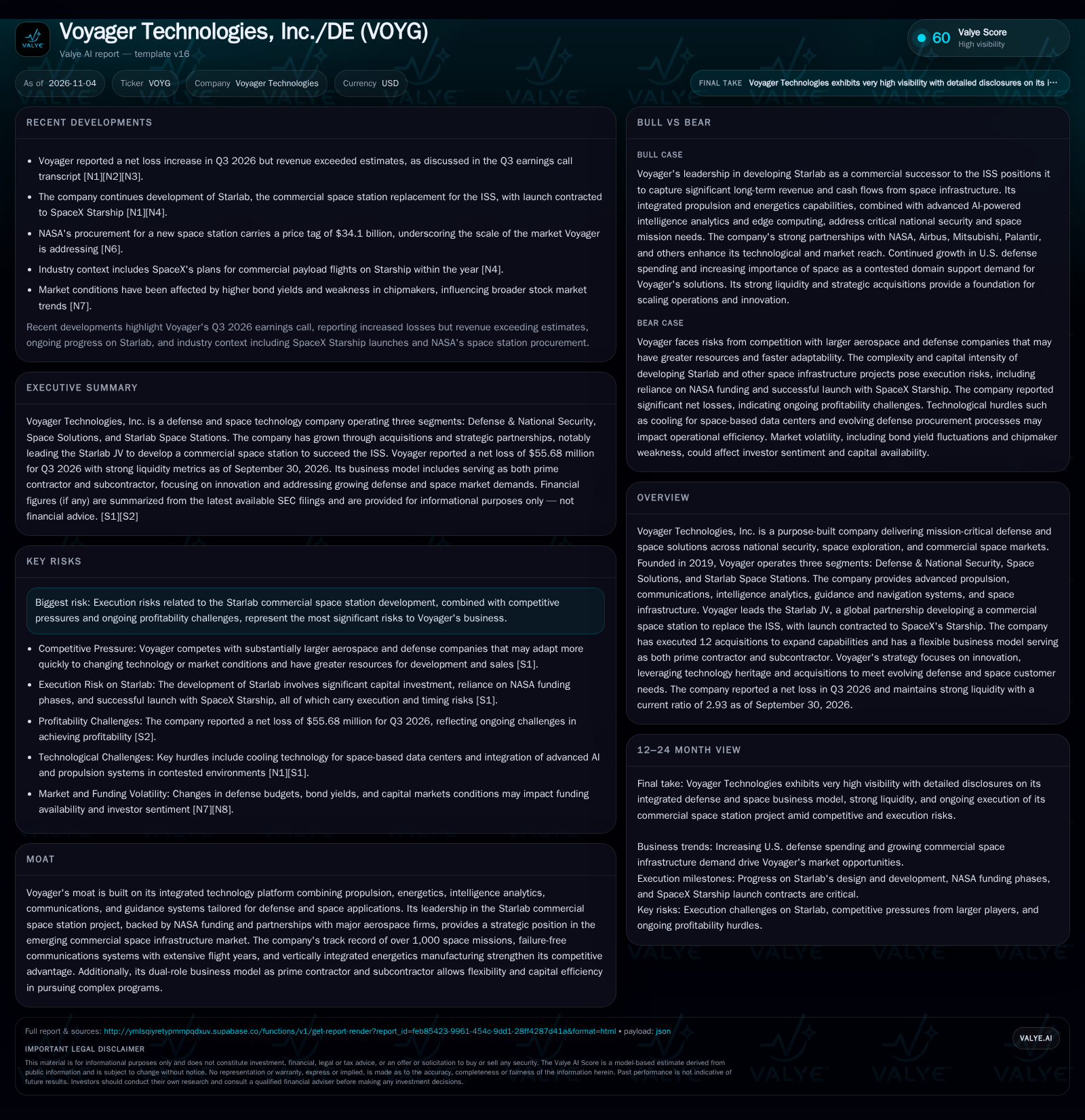
Voyager Technologies is advancing the Starlab commercial space station in partnership with major aerospace players and has reported increased Q3 2026 losses despite exceeding revenue expectations. Its integrated offerings in defense, AI analytics, and space infrastructure target growing U.S. defense and space markets, but execution risk, reliance on NASA funding, and sustained unprofitability remain core challenges. The next 12–24 months hinge on Starlab development milestones, NASA funding, and Voyager's ability to convert innovation into sustainable economics. [S1] [S2] [N1] [N2] [N3]
Voyager Technologies stands at the intersection of defense modernization and commercial space expansion, with the Starlab space station project as its flagship initiative. Despite exceeding Q3 2026 revenue estimates, Voyager reported a substantial net loss, underlining the tension between growth ambitions and economic sustainability. As it consolidates capabilities through acquisitions, partnerships, and technology integration, Voyager’s challenge is to convert innovation and market opportunity into durable business advantage—especially in the face of formidable competitors and high-stakes execution risks. The next phase will reveal whether Voyager can achieve operational scale and profitability, or if its ambitions will be constrained by capital intensity and competitive realities. [S1] [S2] [N1] [N2] [N3]
Recent Losses, Starlab Progress, and the State of Liquidity
Voyager Technologies reported a Q3 2026 net loss of $55.68 million, an increase over prior periods, even as revenue exceeded analyst expectations. This signals that while the company is winning contracts and building top-line momentum, it has yet to translate growth into profitability. The Starlab commercial space station—developed in partnership and contracted for launch on SpaceX Starship—remains Voyager’s most visible growth engine and risk locus. [S2] [N1] [N2] [N3]
How Voyager’s Model Could Convert Innovation into Cash Flow
Voyager operates across three segments: Defense & National Security, Space Solutions, and Starlab Space Stations. Its revenue streams likely blend fixed-price and cost-plus contracts in defense, milestone-based payments for space infrastructure, and potentially recurring service or data revenues from future commercial space assets. The company’s dual role as both prime contractor and subcontractor provides flexibility to pursue a wide range of projects, but also exposes it to the margin compression and working capital demands typical of government and large aerospace contracting.
The economics of space infrastructure—especially a project as ambitious as Starlab—are inherently lumpy and capital intensive. Upfront R&D and integration costs dominate, with revenue recognition often back-weighted to development milestones and operational deployment. If Starlab achieves commercial operation, Voyager could benefit from recurring revenue streams via hosting, leasing, or data services to government and private customers, but these are contingent on successful deployment and customer adoption. Operating leverage is possible if Voyager can scale its technology platform across programs, but fixed costs and project risk are high until meaningful commercial utilization is achieved.
Voyager’s string of 12 acquisitions suggests an attempt to vertically integrate critical capabilities (propulsion, energetics, AI analytics), potentially capturing greater margin over time. However, integration costs and the challenge of harmonizing acquired operations may blunt near-term profitability. Capital needs will remain elevated as the company advances Starlab and invests in new technologies—external funding or milestone-based customer payments may be required to bridge negative free cash flow phases. [S1] [S2]
Can a Technology-Integrated Platform Hold Off Aerospace Giants?
Voyager’s moat rests on an integrated technology stack—combining propulsion, energetics, AI analytics, communications, and guidance—tailored for defense and space applications. This breadth enables Voyager to address complex, cross-domain mission needs, potentially differentiating it from more siloed competitors. The company’s leadership in Starlab, underpinned by partnerships with NASA, Airbus, Mitsubishi, and Palantir, provides a credible foothold in the emerging commercial space infrastructure market.
However, Voyager is up against much larger aerospace and defense incumbents with greater scale, customer entrenchment, and resources for R&D and business development. These players may adapt more quickly to shifting technology or procurement trends, and can absorb the costs of failed projects more easily. Voyager’s flexible prime/subcontractor model allows nimble participation in diverse programs, but may limit its ability to dictate program terms or pricing against better-capitalized peers.
Technology substitution risk is also present: advances in satellite constellations, competing space station initiatives, or alternative intelligence-gathering platforms could dilute demand for Voyager’s offerings, especially if Starlab or similar infrastructure faces delays or adoption hurdles. The company’s historical track record—over 1,000 space missions and failure-free communications systems—suggests operational credibility, but sustaining a competitive edge will require ongoing innovation and successful execution at scale. [S1]
If Starlab Achieves Operational Milestones and Commercial Demand Materializes
The most favorable outcome for Voyager hinges on Starlab meeting development and launch milestones—culminating in successful deployment via SpaceX Starship and transition to commercial operations. If the company can deliver a reliable, multi-tenant space station platform, it could attract recurring revenue from government agencies, research institutions, and commercial users seeking low Earth orbit (LEO) access. Strong demand for in-orbit manufacturing, science, and earth observation could drive utilization rates and margins, especially if Voyager’s integrated technology platform enables differentiated services (e.g., AI-powered intelligence analytics, secure communications, advanced propulsion modules).
Upside would be further supported if Voyager leverages its role in Starlab to cross-sell defense and intelligence solutions—expanding its share of U.S. and allied space budgets as space becomes a more contested domain. Confirmation of this scenario would require evidence of: (1) Starlab meeting or exceeding key NASA and partner milestones; (2) signed commercial customer commitments or anchor tenants for the station; (3) positive free cash flow from space infrastructure operations; and (4) expansion of high-margin services leveraging Voyager’s proprietary technology.
Most Likely: Incremental Progress and Ongoing Losses as Execution Risk Persists
The most plausible path for Voyager is continued incremental progress on Starlab and other programs, but with ongoing net losses and periodic capital needs. Revenue growth may outpace the sector average due to new contract wins and the ramp-up of space infrastructure work, yet negative operating leverage could persist as R&D, integration, and project execution costs outweigh near-term revenue gains.
Voyager’s diversified business model—serving as both prime and subcontractor—should provide some buffer against project-specific setbacks, but the company will remain exposed to defense budget cycles, NASA funding phases, and the risk of delays in major space initiatives. Confirmation of this scenario would be: (1) regular achievement of incremental Starlab milestones without major delays; (2) continued net losses quarter-over-quarter, with gross margin improvement lagging revenue growth; and (3) maintenance of liquidity via working capital management, external financing, or milestone payments. Falsification would occur if Voyager achieves sustained profitability or if Starlab faces a major program halt.
When Execution Stalls and Competitive Pressures Accelerate
A negative scenario would unfold if Voyager encounters significant execution setbacks on Starlab—such as technical delays, cost overruns, or loss of NASA funding support. This could trigger liquidity strain, especially if milestone payments are withheld or additional capital is required to complete development. If larger aerospace competitors accelerate their own commercial space initiatives or undercut Voyager on defense/space contracts, Voyager’s addressable market could shrink.
Profitability could deteriorate further if integration costs from past acquisitions remain high or if Voyager fails to achieve operational synergies. External shocks—such as defense budget cuts, bond yield spikes impacting capital markets, or a failed SpaceX Starship launch—would amplify downside risk. Confirmation would be: (1) public disclosure of material Starlab delays or cost overruns; (2) failure to secure additional funding or customer commitments; (3) a sharp drop in backlog or new contract wins; and (4) forced asset sales or restructuring to preserve liquidity.
What Could Validate or Break the Starlab Thesis for Voyager
Starlab development milestones: On-time achievement of NASA and partner-defined design, integration, and testing phases will indicate execution strength.
Commercial customer commitments: Evidence of signed anchor tenants, pre-leasing, or service contracts for Starlab would validate commercial demand.
Free cash flow trends: Tracking operating and free cash flow (if disclosed) will clarify whether Voyager is converting growth into sustainable economics.
Gross margin and operating leverage: Improvements in margin profile, especially in the Space Solutions and Starlab segments, would signal scalable economics.
NASA and government funding continuity: Monitoring for any changes in NASA funding phases or federal space infrastructure budgets is critical.
Competitive contract wins or losses: Announcements of major contract awards or losses to larger competitors would test Voyager’s market position.
Integration cost management: Disclosure of acquisition integration costs and realization of expected synergies (if disclosed) would help test scalability.
Disclaimer: This is research-only, informational analysis and not investment advice. It may include AI-generated interpretation and general industry context. Always verify important details using primary sources.

Comments