
Calix’s AI Platform Ambitions: Navigating Non-Recurring Revenue and Supply Chain Volatility
Calix’s latest AI-driven broadband innovations and managed services aim to reposition its platform for communications service providers, but persistent non-recurring revenue, supply chain exposure, and component price volatility complicate margin visibility and long-term growth prospects.
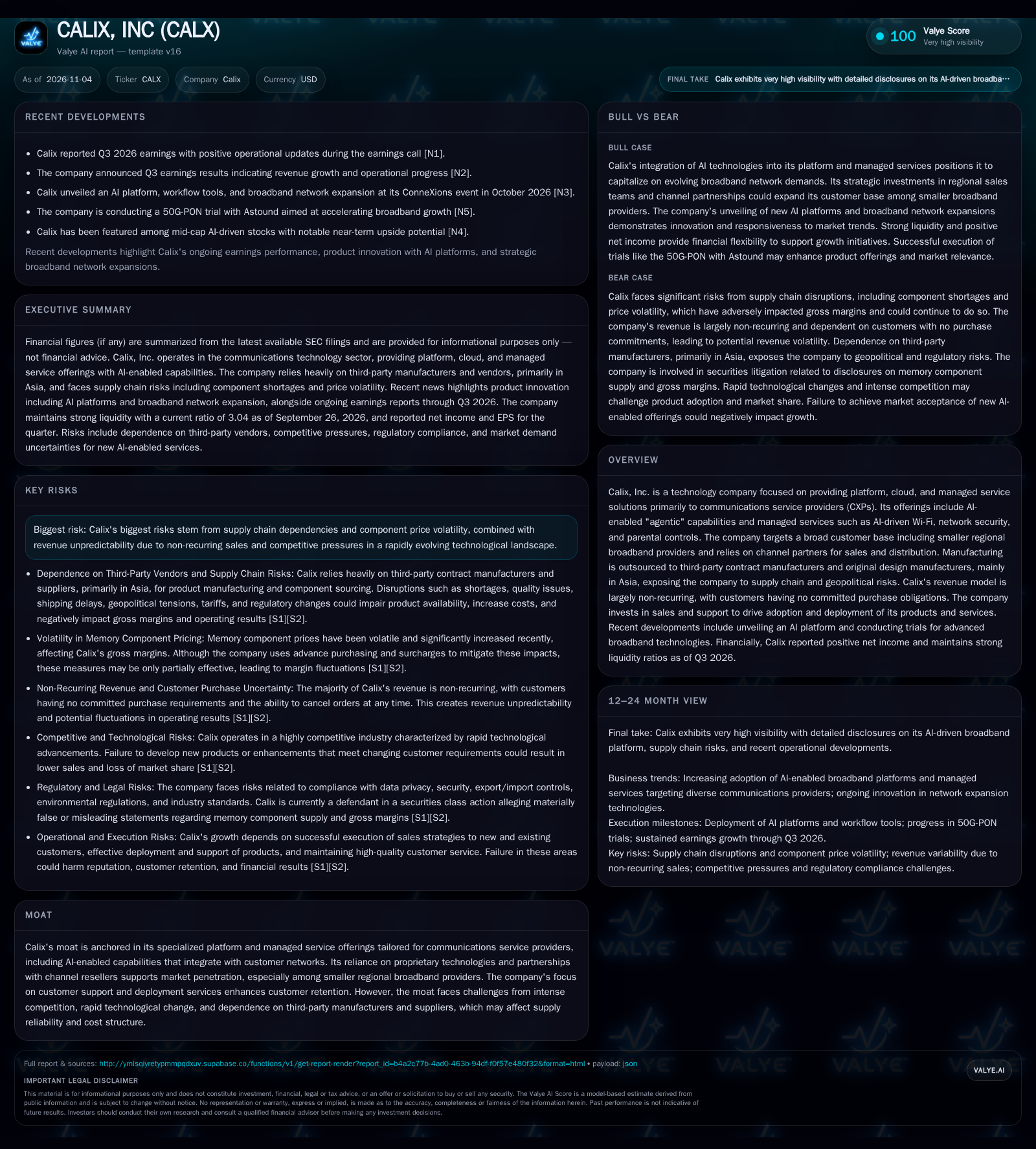
Calix reported positive Q3 2026 net income, expanded its AI-enabled platform offerings, and is trialing advanced broadband technologies. However, its non-recurring revenue model and exposure to memory component cost spikes and supply chain disruptions create ongoing risks to gross margin and growth predictability. The company’s future hinges on successful adoption of its AI-driven services and its ability to mitigate supply chain pressures.[S2] [N3] [N5]
Calix is repositioning itself at the intersection of AI, broadband network infrastructure, and managed services, targeting a fragmented market of communications service providers with its latest AI-driven platform and workflow offerings. Financially, the company is generating positive net income, but faces persistent challenges: its revenue base is non-recurring and unpredictable, and it remains exposed to supply chain risks and component price volatility that have already pressured margins. The company’s ability to turn innovation into durable, higher-margin growth will depend on execution in customer adoption, supply chain management, and sustaining technological differentiation in a competitive landscape.[S2] [N3] [N5]
Recent Developments Reshape the Strategic Landscape
The company reported a current ratio of 3.04 for the period. [S2]
The company unveiled an AI platform, workflow tools, and broadband expansion initiatives at its ConneXions event in October 2026, underscoring a push to embed AI-enabled managed services deeper into its broadband offerings.[N3]
Calix is also conducting a 50G-PON broadband trial with Astound, seeking to accelerate next-generation broadband adoption and potentially expand its addressable market among communications service providers.[N5]
Despite operational progress, Calix faces margin pressure from rising memory component costs and is defending against a securities class action alleging misleading disclosures about supply chain impacts on gross margins.[S2]
How Calix’s Platform Economics Depend on Volume, Mix, and Margin Discipline
Calix’s business model is characterized by platform, cloud, and managed services sold primarily to communications service providers (CXPs), including smaller regional broadband providers. Its solutions, which now feature AI-driven managed Wi-Fi, security, and workflow automation, are intended to create incremental value for customers and deepen engagement.
However, the revenue model is largely non-recurring: customers have no purchase commitments, can cancel orders at any time, and are not locked into multi-year contracts.[S1] [S2] This limits revenue visibility and increases exposure to fluctuations in both customer budgets and macroeconomic cycles.
Gross margin is vulnerable to volatile memory component costs, which have recently spiked. Calix attempts to mitigate this through advance purchasing and surcharges, but these efforts only partially offset cost increases, and the risk of further shocks remains.[S2]
Manufacturing is outsourced to contract manufacturers and original design manufacturers, mainly in Asia, which keeps fixed costs lower but exposes Calix to logistics, regulatory, and geopolitical risks that can cascade into both cost and delivery disruptions.
Competing for the Next-Gen Broadband Edge: Advantages and Threats
Calix’s differentiation is rooted in its AI-enabled platform, integration with third-party services (e.g., Arlo, Bark), and a customer support emphasis targeting smaller and regional CXPs underserved by larger legacy vendors.[S1] [N3]
The company’s channel-driven sales approach and regional sales investments may help it reach fragmented broadband markets, where direct sales by larger competitors may be less effective.
However, Calix faces intense competition from incumbent network equipment providers, specialist managed service vendors, and emerging cloud-native networking solutions. Technological substitution is a constant threat: rapid advancements in open-source networking, cloud-managed platforms, and AI-enabled orchestration could erode Calix’s differentiation if it fails to keep pace.
Switching frictions for CXPs are moderate—while integration and support services may create some stickiness, the absence of multi-year purchase commitments and the ability for customers to cancel orders at any time reduces Calix’s pricing power and customer lock-in.
If AI-Driven Managed Services Gain Traction, Margin Expansion Follows
If Calix successfully drives broad adoption of its AI-enabled managed services—such as SmartLife’s managed Wi-Fi, security, and parental controls—across its CXP customer base, it could shift its revenue profile toward higher-margin, more predictable subscription-like streams. This would create operating leverage by spreading support and R&D costs over a larger, stickier customer base.
A favorable causal chain would involve rapid uptake of the new AI platform and workflow tools, successful scaling of 50G-PON deployments, and evidence that these innovations are driving both new customer wins and deeper wallet share with existing customers.[N3] [N5]
Confirmation would come from disclosures of recurring revenue growth, higher average revenue per user (ARPU), improved gross margin trends despite component price volatility, and customer retention rates stabilizing at high levels (if disclosed).
Falsification would be indicated by persistently lumpy revenue, stagnant managed service adoption, or continued gross margin pressure from component costs that is not offset by pricing power or volume growth.
Most Likely: Incremental Gains Offset by Supply Chain and Revenue Volatility
The most plausible near-term scenario is that Calix continues to grow its footprint in the CXP market, with AI-enabled platform and managed service adoption advancing gradually but not fundamentally transforming the revenue model in the next 12–24 months.
AI platform launches and 50G-PON trials generate customer interest and incremental sales, but most revenue remains non-recurring, with order timing and volume subject to CXP capital spending cycles and macroeconomic factors. Supply chain pressures, especially memory cost volatility, continue to create margin headwinds that are only partly mitigated by surcharges and purchasing strategies.[S2]
Gross margin improvement is modest and episodic, depending on component price trends and the effectiveness of Calix’s mitigation tactics. Legal risks, including the ongoing securities class action, remain a distraction but do not materially impair operations unless adverse outcomes emerge.[S2]
This scenario would be confirmed by continued positive, but uneven, net income and cash flow, ongoing product innovation, but no pronounced shift in revenue mix or margin profile.
Supply Chain Shocks and Weak Managed Service Uptake Erode Value
A negative scenario would see memory component prices remain elevated or spike further, overwhelming Calix’s ability to mitigate costs via surcharges or advance purchases, leading to sustained gross margin compression and potential operating losses.
Revenue volatility could be exacerbated if CXP customers delay or cancel orders due to industry budget pressures, slower government broadband funding, or dissatisfaction with new AI-enabled offerings. In this environment, Calix’s lack of recurring revenue contracts would magnify the impact of lost business.
Additional risks include escalation of geopolitical or regulatory tensions affecting manufacturing partners in Asia, resulting in shipment delays, lost sales, or increased costs. An adverse legal outcome in the securities class action could further strain resources or erode customer and investor confidence.[S2]
Confirmation would appear as several quarters of declining gross margin, negative net income, cash burn, or order cancellations/disappointing managed service adoption rates.
Testing the Calix Thesis: Concrete Triggers and Evidence to Track
Gross margin trends, particularly the impact of memory component cost surges and the effectiveness of mitigation strategies, should be monitored each quarter.
Adoption rates and revenue contribution from AI-enabled managed services and workflow tools—disclosures on recurring revenue, ARPU, or customer retention would help test the stickiness of the new offerings if disclosed.
Order activity and revenue volatility: frequency and scale of order cancellations or delays by CXP customers, especially during macro or industry downturns.
Updates on the 50G-PON trial with Astound and subsequent commercial deployments or customer wins in next-generation broadband.
Legal developments and potential settlements or adverse rulings in the ongoing securities class action regarding supply chain disclosures and margin impacts.
Changes in component sourcing strategy or geographic diversification of manufacturing partners in response to supply chain or geopolitical risks.
Any shift toward multi-year contracts, subscriptions, or other revenue models that could materially increase revenue visibility and predictability.
Disclaimer: This is research-only, informational analysis and not investment advice. It may include AI-generated interpretation and general industry context. Always verify important details using primary sources.

Comments