
WSFS Financial: Profitable Growth, Disclosure Gaps, and the Next Phase of Regional Banking Strategy
The company’s next leg may depend on its ability to navigate regulatory headwinds, sustain margin strength, and clarify its competitive edge as a regional financial institution.
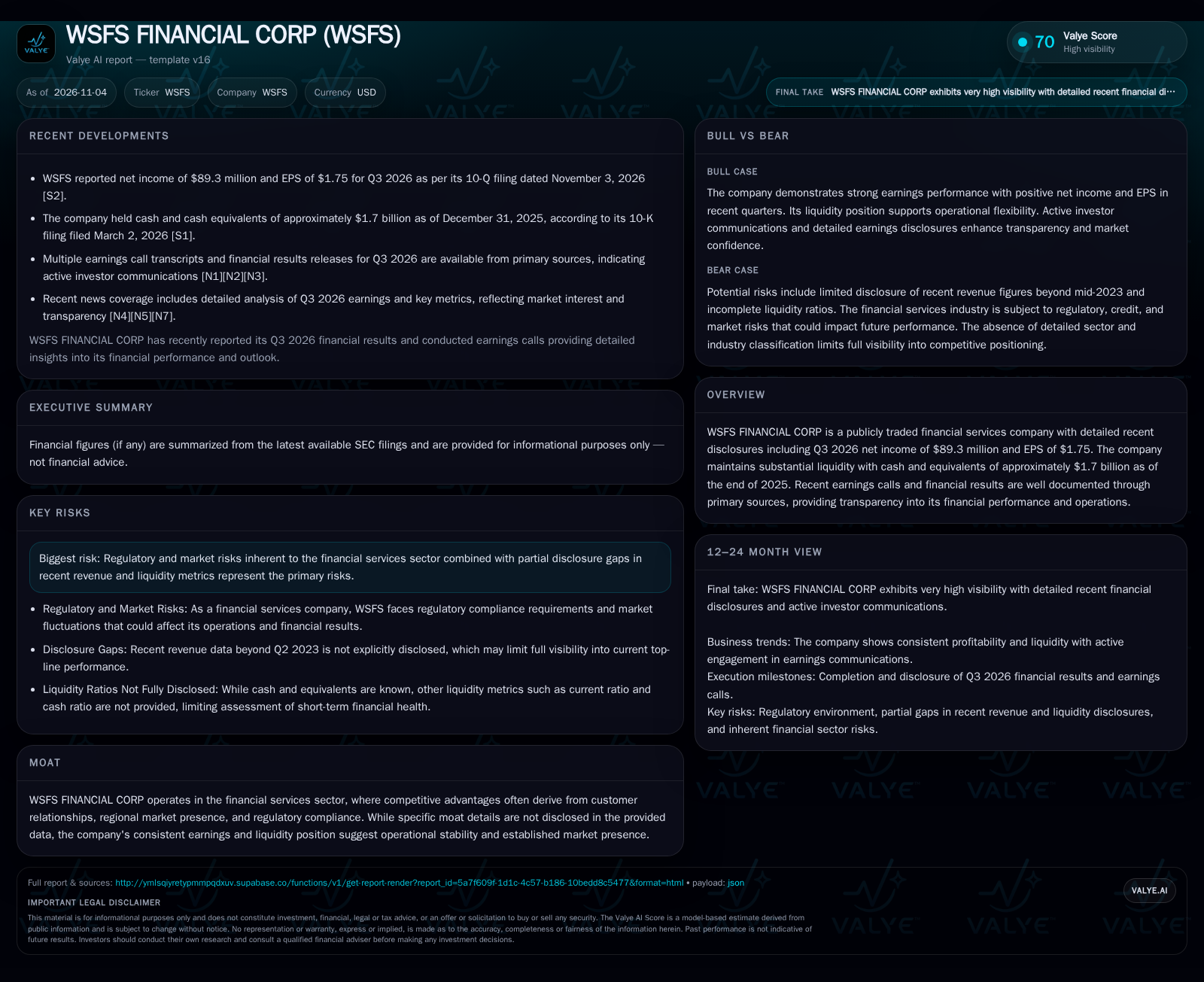
WSFS Financial delivered $89.3 million in net income and $1.75 EPS in Q3 2026, underscoring operational profitability and liquidity with $1.7 billion in cash and equivalents at year-end 2025. The company’s core challenge is to maintain earnings resilience and market relevance amid evolving regulatory, market, and competitive pressures.
WSFS Financial Corp’s most recent disclosures show a profitable Q3 2026 and a strong year-end 2025 cash balance, placing the company on solid operational footing relative to many regional peers. Yet, the lack of current revenue data and incomplete liquidity metrics complicate the narrative, leaving investors to weigh the company’s apparent earnings momentum against the backdrop of sector-wide regulatory pressures and incomplete financial visibility. The critical question is whether WSFS can translate its earnings consistency and liquidity into durable value creation amid a shifting financial services landscape.
Recent Profitability and Liquidity: A Double-Edged Signal
WSFS Financial Corp reported net income of $89.3 million and earnings per share of $1.75 for Q3 2026, according to its most recent 10-Q filing [S2]. This level of profitability suggests robust core operations and effective cost control. [S1] However, the latest revenue figure available is from Q2 2023, and other liquidity ratios (such as current or quick ratios) have not been recently disclosed. This gap in reporting clouds the ability to assess current revenue momentum and near-term risk, particularly in a sector where asset quality and funding costs can change rapidly. Active investor communications and earnings calls indicate a commitment to transparency, but the absence of fully up-to-date financial metrics creates room for uncertainty in evaluating the company’s operational trajectory.
Beyond the immediate profitability snapshot, the interplay between liquidity levels and asset quality warrants closer scrutiny. High liquidity, while generally positive, can also signal cautious asset deployment in uncertain environments, potentially limiting growth opportunities. Understanding the strategic intent behind liquidity management would help assess whether WSFS is positioning itself for opportunistic lending growth or primarily focusing on capital preservation amid market volatility.
Earnings Drivers and the Levers of Regional Banking Economics
WSFS Financial’s core business model likely centers on generating interest income from loans and investments, complemented by fee-based services—a typical structure for regional banks. Net interest margin (NIM) and loan growth traditionally drive top-line expansion, while non-interest income (such as deposit fees, wealth management, or transaction services) can diversify revenue streams and cushion against margin compression.
Fixed costs—branch networks, regulatory compliance, and technology—create operating leverage: incremental revenue growth can disproportionately boost earnings if expenses are controlled. Conversely, rising funding costs, credit losses, or regulatory burdens can erode profitability quickly.
Capital requirements, loan loss provisioning, and regulatory capital ratios are central to the bank’s risk management and growth capacity. If WSFS maintains strong capital buffers and prudent underwriting, it could absorb shocks and pursue growth. However, the lack of current detail on these metrics means future capital allocation and risk appetite remain open questions.
The sensitivity of WSFS’s earnings to interest rate fluctuations is a critical dynamic in regional banking economics. If the company’s asset-liability management effectively hedges against rate volatility, it can sustain net interest margins despite macroeconomic shifts. However, an overreliance on short-term funding or fixed-rate assets could expose margins to compression in a rising rate environment. Additionally, the balance between core deposit stability and wholesale funding influences funding cost volatility, which directly impacts profitability. A nuanced understanding of the funding mix and interest rate risk profile would clarify the resilience of WSFS’s earnings under different rate scenarios.
Regional Market Dynamics and the Struggle for Share
WSFS operates in a competitive regional banking environment, where advantages are typically built on customer relationships, localized knowledge, and reputation for service. Larger national banks may wield scale advantages in technology and product breadth, while fintech entrants threaten to erode fee income and disrupt traditional deposit-gathering channels.
The durability of WSFS’s competitive position may rest on its ability to differentiate through service quality, niche market focus, or superior underwriting. Regulatory compliance and local brand strength can provide some insulation, but these moats are not unassailable. Digital transformation is an increasingly important battleground: if WSFS lags in digital offerings, it risks losing share to both larger incumbents and agile fintechs.
With incomplete disclosure on customer retention, digital adoption, or market share, it is difficult to gauge how WSFS stacks up against peers. The company’s consistent profitability and liquidity suggest operational discipline, but the true test will be maintaining relevance and margin as customer preferences and competitive dynamics evolve.
The evolution of customer expectations in digital banking creates a dual challenge for regional banks like WSFS: maintaining personalized service while scaling technology investments. If WSFS can leverage its local market knowledge to tailor digital solutions that enhance customer experience without sacrificing operational efficiency, it may strengthen its competitive moat. However, the capital intensity of digital transformation and the rapid pace of fintech innovation require disciplined prioritization and clear strategic focus. The ability to integrate digital channels with traditional relationship banking could determine whether WSFS sustains or loses relevance in an increasingly technology-driven marketplace.
Unlocking Value Through Sustained Margin Expansion and Strategic Clarity
If asset quality remains high and credit losses are contained, operating leverage could drive further EPS growth.
Confirmation of this scenario would come from renewed revenue disclosures showing top-line expansion, stable or improving NIM, and growth in non-interest income. Additional evidence would include disclosures of loan portfolio quality, deposit growth, and digital transformation initiatives that enhance customer retention or acquisition. If WSFS can demonstrate that its earnings are not merely the product of transient rate moves but reflect underlying business expansion and operational excellence, market confidence and valuation could improve.
Falsification would occur if future filings show stagnating or declining revenues, margin compression, or a spike in credit losses—suggesting that the recent profit levels are unsustainable.
Maintaining Profitability Amid Disclosure Gaps and Sector Headwinds
The most plausible near-term path is one where WSFS continues to deliver stable, moderate profitability, supported by its liquidity and disciplined cost structure, but with limited revenue growth due to sectoral headwinds and rising competition. Without up-to-date revenue and loan/deposit growth data, investors may assume that earnings are being maintained more through expense management or favorable funding conditions than through robust business expansion.
This scenario would be confirmed if future earnings reports continue to show positive net income and stable EPS, but with little evidence of significant top-line or loan book growth. Persistent gaps in financial disclosure or lack of detail on digital initiatives, customer retention, or market share would reinforce the perception of a conservatively managed, but not rapidly growing, regional bank.
The scenario would be falsified by either a marked acceleration in revenue and loan growth (suggesting a more bullish trajectory) or by signs of deteriorating asset quality, higher credit costs, or compressed margins (indicating downside risk).
Earnings Under Pressure: Regulatory, Credit, and Disclosure Risks
A negative outcome would be driven by a combination of regulatory tightening, rising credit losses, and competitive encroachment. Should economic conditions deteriorate or interest rate volatility persist, WSFS could face higher loan defaults and compressed net interest margins.
This scenario would be confirmed by subsequent filings that reveal a decline in net interest income, rising non-performing assets, or the need for higher loan loss provisions. If new competitors or fintechs erode fee income or deposit share, WSFS’s profitability could come under sustained pressure.
The thesis would be falsified if the company maintains stable asset quality, grows its loan book prudently, and demonstrates resilience in net interest and fee income despite sectoral shocks.
Testing WSFS’s Resilience: What Will Determine Future Value Creation?
Disclosure of current and forward revenue, NIM, and loan/deposit growth would help clarify top-line momentum and core profitability.
Updates on asset quality metrics—such as non-performing asset ratios and loan loss provision trends—would signal credit risk management effectiveness.
Breakdown of non-interest income and changes in fee-based business lines (if disclosed) would indicate revenue diversification progress.
Digital banking adoption rates and related technology investment details would reveal WSFS’s competitive positioning against fintechs and larger banks.
Details on capital ratios, risk-weighted assets, and regulatory capital adequacy would illuminate growth capacity and resilience to shocks.
Management commentary on deposit trends, funding costs, and competitive pressure in earnings calls or filings would help assess margin sustainability.
Evidence of customer retention, cross-selling, or market share gains (if disclosed) would support the durability of the company’s local franchise.
Disclaimer: This is research-only, informational analysis and not investment advice. It may include AI-generated interpretation and general industry context. Always verify important details using primary sources.

Comments