
Jackson Financial’s Structural Leverage: Regulation, Risk Transfer, and the Shifting Economics of Annuities
The company’s ability to balance actuarial precision, capital discipline, and risk transfer will define its path in a maturing annuities market.
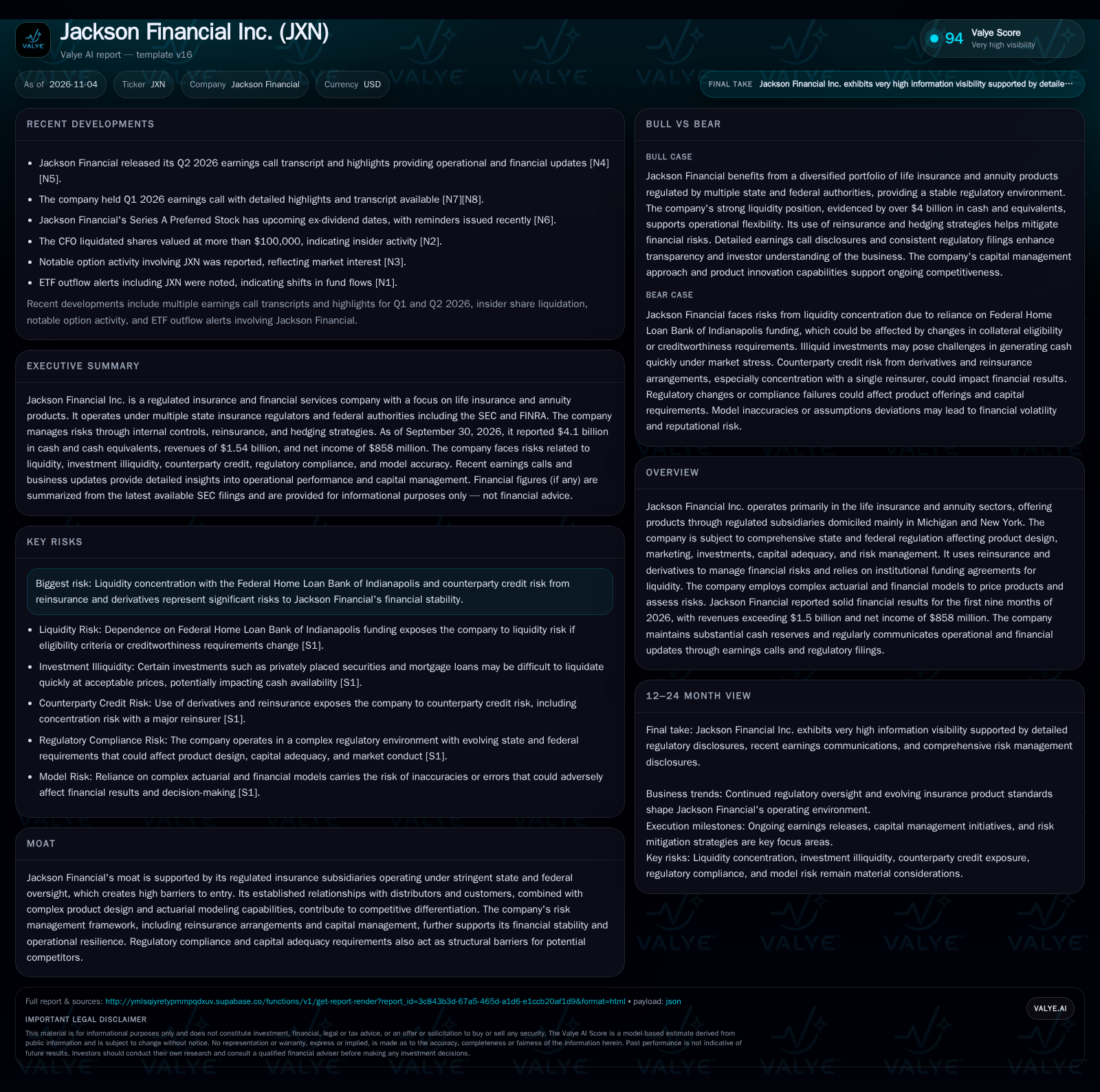
Jackson Financial reported $858 million in net income for the first nine months of 2026 and holds $4.1 billion in cash, reflecting robust profitability and liquidity [S2]. However, its reliance on Federal Home Loan Bank of Indianapolis funding and concentrated reinsurance exposures introduce structural risks. The company’s future trajectory depends on its ability to manage these risks, maintain regulatory compliance, and adapt to evolving market and actuarial conditions.
Jackson Financial Inc. stands out for its robust earnings and substantial liquidity, but the durability of its business model is shaped by deeper structural dependencies. The interplay between regulatory oversight, risk transfer mechanisms, and capital management will be critical as the company navigates a changing insurance environment.
Jackson Financial’s Recent Financial Trends and Exposure Overview
For the nine months ended September 30, 2026, Jackson Financial reported revenues of $1.542 billion and net income of $858 million, with basic earnings per share of $12.40 and diluted EPS of $12.37 [S2]. The company held $4.101 billion in cash and cash equivalents at quarter-end [S2]. These figures reflect continued profitability and a substantial liquidity buffer. However, Jackson’s liquidity model is closely linked to institutional funding agreements with the Federal Home Loan Bank of Indianapolis, introducing a single-source concentration risk [S1]. Additionally, the company’s use of reinsurance—particularly its large exposure to Athene for fixed and fixed index annuities—consolidates credit risk with a single counterparty [S1]. Recent insider share liquidation by the CFO and ETF outflow alerts indicate that the market is attentive to these underlying exposures [N1] [N3].
Return Generation Through Product Mix, Risk Transfer, and Capital Efficiency at Jackson Financial
Jackson Financial’s core economics are driven by the spread between the yield earned on invested assets and the rates credited to policyholders. In the annuity business, profitability hinges on both the volume of new premiums and the effectiveness of risk management, including asset-liability matching, hedging, and reinsurance. The company’s portfolio includes life insurance and a range of annuity products, which typically carry long liability durations and require sophisticated actuarial modeling for pricing and reserving.
A significant portion of the company’s investment portfolio is allocated to illiquid assets such as privately placed fixed maturity securities, mortgage loans, and alternative investments [S1]. While these can enhance yield, they also increase liquidity and valuation risk, particularly under stressed market conditions. Fixed costs are high due to regulatory compliance, actuarial staff, and capital requirements, but the business can achieve meaningful operating leverage at scale if new premium flows remain robust and claims experience is favorable.
Funding agreements with the Federal Home Loan Bank of Indianapolis provide cost-effective institutional liquidity, but this reliance could become a liability if eligibility or collateral rules change [S1]. The use of derivatives for hedging introduces both cost and counterparty credit risk, while reinsurance arrangements transfer certain risks but create dependencies on external counterparties’ solvency and risk appetite [S1].
Competitive Landscape and Entry Barriers in the Annuities Market
Jackson Financial’s moat is shaped by the regulatory intensity of the life insurance and annuities industry, where state and federal oversight enforces high capital, disclosure, and product design standards. These requirements create significant barriers for new entrants. Additionally, the company’s established distribution relationships and actuarial expertise support its ability to design and price complex products.
However, the industry is marked by ongoing competition from other large insurers, asset managers entering the retirement space, and fintech firms offering alternative retirement solutions. The commoditization of certain annuity products and the growing demand for lower-cost, more flexible retirement vehicles have pressured margins across the sector. Technology-driven competitors could potentially disrupt traditional distribution and servicing models.
Jackson’s reliance on reinsurance and institutional funding, while efficient, is not unique and could dilute any cost-of-capital or risk-transfer advantage if competitors secure similar arrangements. The company’s ability to maintain a differentiated product mix, pricing discipline, and risk management sophistication will determine its competitive staying power.
Outperformance Potential from Consistent Spread Management and Regulatory Predictability
If Jackson Financial continues to effectively manage investment yields relative to credited rates, while maintaining disciplined product pricing and underwriting standards, it could preserve or even expand its net interest margins. Regulatory stability—particularly around capital adequacy and product standards—would further support planning and allow the company to deploy surplus capital toward shareholder returns or modest acquisitions.
A favorable causal chain would see continued robust premium inflows, stable claims experience, and no major disruptions in reinsurance or institutional funding markets. The company could also benefit from rising demand for annuities as demographic shifts boost retirement planning needs.
Evidence supporting this scenario would include continued growth in net premiums, stable or improving net interest margins, low reinsurance costs, consistent regulatory capital ratios, and positive operating leverage.
Navigating Complexity Within a Mature, Highly Regulated Industry
The most plausible trajectory is that Jackson Financial maintains steady profitability, with periodic earnings volatility driven by market conditions, claims experience, and regulatory changes. Premium growth may remain modest as the annuities market matures and faces increased competition from alternative retirement products.
Investment yields could gradually compress if interest rates soften or credit spreads tighten, requiring ongoing expense discipline and careful management of illiquid asset exposure. The company’s risk transfer mechanisms—reinsurance and derivatives—will continue to play a pivotal role in managing capital and smoothing results, but could also amplify volatility if counterparties face stress.
Confirmation of this scenario would come from stable revenue and net income trends, continued adherence to regulatory capital standards, and absence of major negative surprises in reinsurance recoveries or liquidity events. Evidence to the contrary would include a sharp drop in premium inflows, sudden regulatory changes affecting product economics, or a material counterparty default.
Implications of Disruptions in Funding and Reinsurance for Jackson Financial
A sharp change in Federal Home Loan Bank of Indianapolis eligibility rules or a downgrade in Jackson’s creditworthiness could abruptly curtail access to low-cost institutional funding, forcing asset sales or more expensive financing. Simultaneously, a material adverse event at a major reinsurer—particularly Athene—could trigger significant reinsurance recoverability issues, requiring Jackson to absorb losses or increase capital reserves.
If market stress makes illiquid investments difficult to sell at reasonable prices, Jackson could face a liquidity crunch or be forced to realize losses. Errors in actuarial or financial modeling could exacerbate these challenges, leading to reserve shortfalls or mispriced products. Regulatory intervention or product restrictions could further limit flexibility.
Evidence of downside realization would include a sudden spike in funding costs, regulatory action, missed dividend payments, restatements of financials, or a sharp deterioration in capital ratios. Early warning signs might be found in management commentary, changes to reinsurance terms, or negative rating agency actions.
Factors Influencing Jackson Financial’s Risk and Return Outlook
Net premium inflows and surrenders: A useful metric would be quarterly trends in new premium sales versus policy surrenders/lapses, as this reveals organic growth and customer retention.
Reinsurance counterparty concentration: Disclosure of the proportion of annuity risk ceded to Athene and other major reinsurers, as well as any changes in reinsurance pricing or terms, would help test the concentration risk thesis.
Federal Home Loan Bank funding access: Updates on Jackson’s eligibility, collateral requirements, and cost of funding agreements with the FHLBI would indicate liquidity flexibility or emerging constraints.
Portfolio liquidity and asset mix: Quarterly disclosure of the proportion of investments in illiquid assets (privately placed securities, mortgage loans, alternatives) versus liquid bonds or cash equivalents would clarify stress resilience.
Regulatory capital ratios (RBC, statutory surplus): Continued compliance and trends in key capital adequacy metrics would confirm the company’s buffer against shocks.
Derivative and hedging program performance: If disclosed, effectiveness of hedging strategies and any realized/unrealized losses or counterparty issues would be important to monitor.
Insider transactions and management commentary: Ongoing insider selling, especially by senior executives, and tone in earnings calls or regulatory filings could signal management’s risk appetite or emerging concerns.
Disclaimer: This is research-only, informational analysis and not investment advice. It may include AI-generated interpretation and general industry context. Always verify important details using primary sources.

Comments