
Navitas Semiconductor: AI Power Ambitions, Legal Hurdles, and the Next Phase of GaN/SiC Integration
Navitas Semiconductor has reported 38% year-over-year revenue growth for Q3 2026 and secured a $531.5 million cash position, while deepening its AI data center focus through the Claros acquisition and a partnership with NVIDIA.
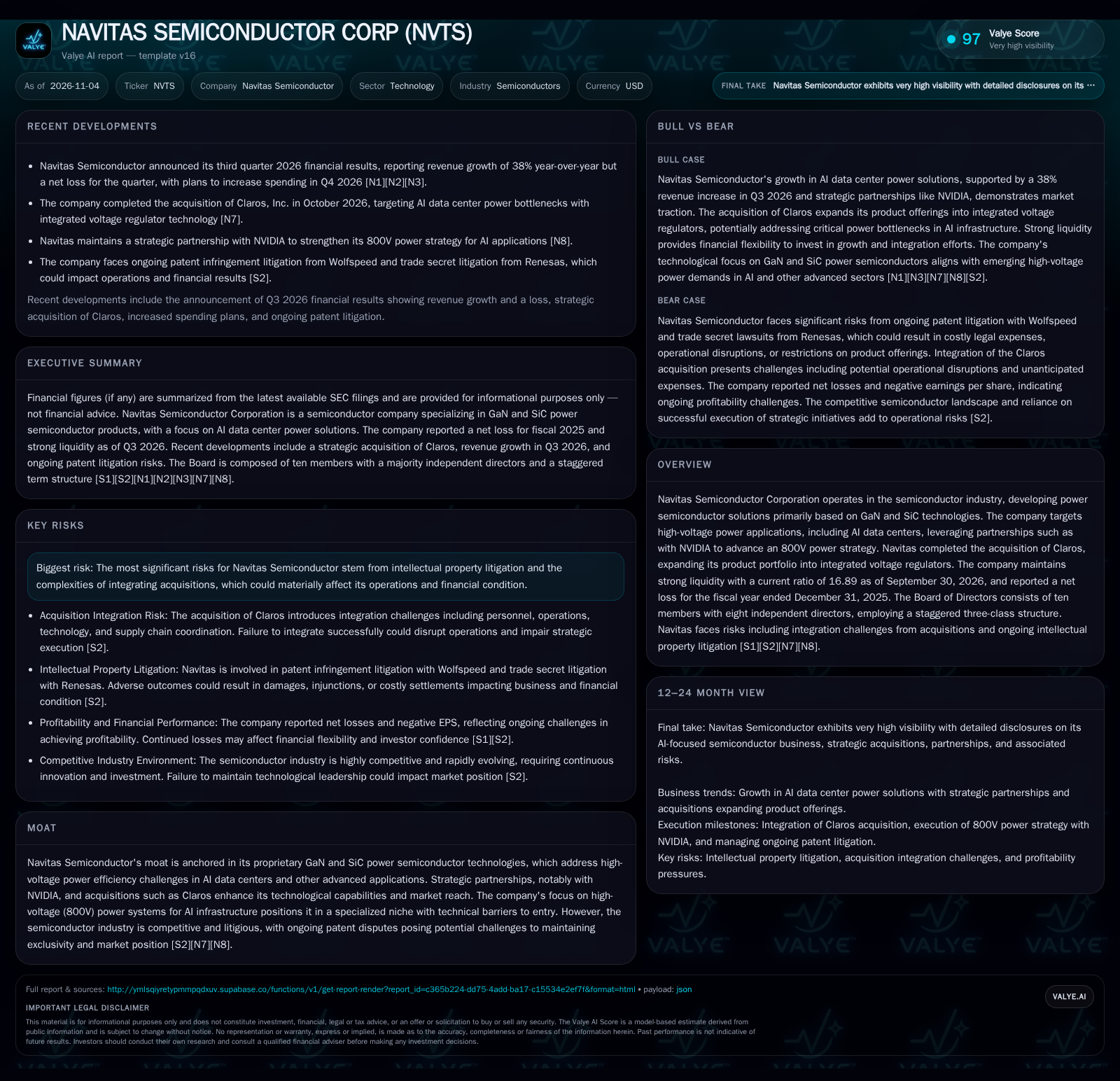
Navitas Semiconductor has reported 38% year-over-year revenue growth for Q3 2026 and secured a $531.5 million cash position, while deepening its AI data center focus through the Claros acquisition and a partnership with NVIDIA. However, ongoing IP litigation and persistent net losses underscore significant execution and legal risks as the company works to carve out a durable niche in high-voltage power semiconductors for next-generation AI infrastructure. [S2] [N1] [N3] [N7] [N8]
Navitas Semiconductor is positioning itself at the intersection of next-generation power electronics and the accelerating demands of AI infrastructure, reporting robust revenue growth and a fortified balance sheet as of Q3 2026. The company’s recent acquisition of Claros and an expanded partnership with NVIDIA signal a strategic commitment to solving high-voltage power bottlenecks in AI data centers. Yet, as Navitas pushes for greater technical and commercial relevance, it must navigate a minefield of legal disputes and the perennial challenge of achieving profitability in a capital-intensive, innovation-driven semiconductor sector.
Recent Developments Redefine Navitas's Strategic Trajectory
Navitas Semiconductor reported a 38% year-over-year revenue increase for Q3 2026, reflecting accelerating market traction in its target segments, particularly AI data center power solutions. Despite top-line growth, the company recorded a net loss of $116.95 million for the 2025 fiscal year and negative EPS for Q3 2026, signaling ongoing profitability hurdles. The acquisition of Claros, completed in October 2026, brings integrated voltage regulator technology directly aimed at addressing power delivery bottlenecks in AI data centers, while a strategic alliance with NVIDIA enhances Navitas’s 800V power platform ambitions. However, the company faces ongoing patent and trade secret litigation from Wolfspeed and Renesas, respectively, introducing significant legal and operational uncertainties. [S2] [N1] [N3] [N7] [N8]
Powering AI: How Navitas’s Business Model Could Scale or Stall
Navitas’s revenue model hinges on the commercialization of GaN and SiC power semiconductor devices—technologies known for their efficiency and compactness in high-voltage, high-frequency applications. The company’s focus on AI data centers positions it to benefit from surging demand for power-efficient, high-voltage components as AI workloads drive up energy densities and thermal challenges. If Navitas can secure design wins and ramp volumes, the business could benefit from favorable operating leverage: most semiconductor manufacturing costs are fixed, so incremental revenue at scale can lead to higher gross margins.
However, the path to profitability is complicated by the need for sustained investment in R&D, litigation defense, and post-acquisition integration. The recently completed Claros acquisition could enhance Navitas’s ability to offer integrated solutions—potentially raising average selling prices and increasing customer stickiness, but also adding integration complexity and execution risk. Market adoption in the AI and high-power sectors often involves long sales cycles and rigorous qualification processes, which can delay volume ramp and cash conversion. Pricing power may be attainable if Navitas’s technology demonstrably improves data center efficiency or total cost of ownership, but price competition remains fierce in the broader power semiconductor market.
Technical Edge or Temporary Lead? Navitas in the Semiconductor Race
Navitas operates in a fiercely competitive environment dominated by incumbent power semiconductor manufacturers and a growing cohort of GaN/SiC-focused specialists. Its technical differentiation rests on proprietary GaN and SiC architectures optimized for high-voltage, high-frequency, and high-efficiency applications. The strategic partnership with NVIDIA could grant Navitas early access to cutting-edge AI data center requirements, potentially enabling co-development or preferred supplier status. The integration of Claros’s voltage regulator technology further strengthens the company’s system-level value proposition, addressing a critical bottleneck for large-scale AI deployments.
However, these same advantages are under threat from ongoing IP litigation—a hallmark risk of the semiconductor industry. Patent disputes with Wolfspeed and trade secret litigation with Renesas could lead to injunctions, royalty obligations, or costly settlements, eroding any near-term competitive edge. Furthermore, the pace of innovation in power semiconductors is relentless, and larger rivals may be able to match or surpass Navitas’s technical advances through parallel development or acquisition. The company’s ability to maintain a defensible position will depend on the efficacy of its IP portfolio, the success of integration efforts, and its capacity to demonstrate superior total system value to hyperscale data center and AI infrastructure customers. [S2] [N7] [N8]
Integrated AI Power Solutions Drive Accelerated Adoption and Margin Expansion
In a favorable scenario, Navitas leverages its Claros acquisition and NVIDIA partnership to deliver integrated, high-voltage GaN/SiC power solutions that become the potentially leading standard for next-generation AI data centers. The company secures major design wins with hyperscale customers, leading to rapid volume growth and margin expansion as fixed costs are leveraged across a broader revenue base. The technical superiority of its integrated offerings—demonstrating tangible reductions in data center power losses or total cost of ownership—could enable premium pricing and long-term customer lock-in.
Evidence confirming this scenario would include: significant new customer announcements or design wins with leading cloud or AI infrastructure providers; a sharp acceleration in revenue from the AI data center segment; higher gross margins reflecting improved product mix or pricing power; and resolution or favorable outcomes in pending litigation, clearing the path for unfettered commercialization. Additionally, successful integration of Claros technology into flagship products and visible joint initiatives with NVIDIA would reinforce Navitas’s ecosystem credibility. [N7] [N8]
Sustained Growth Amid Execution and Litigation Headwinds
The most plausible path forward is one of continued revenue growth in AI and high-power markets, but tempered by persistent net losses, ongoing legal expenses, and integration hurdles. Navitas continues to benefit from secular demand for efficient power semiconductors in AI data centers, but faces slow customer adoption cycles and pricing pressure from both established competitors and new entrants. The Claros integration delivers incremental product value but takes time to realize full commercial impact, while the NVIDIA partnership raises Navitas’s profile but does not immediately translate into major design wins.
This scenario would be confirmed by steady, but not exponential, revenue growth; continued operating losses as investment in R&D, litigation, and integration remains high; and incremental, rather than transformative, customer traction announcements. [S2] [N1] [N3] [N7] [N8]
Litigation, Integration Failures, and Competitive Pressure Derail Momentum
In a negative outcome, Navitas faces adverse rulings in its IP litigation with Wolfspeed or Renesas, resulting in injunctions, royalty burdens, or exclusion from key markets. Integration of the Claros acquisition falters, leading to operational disruptions, delays in product launches, or customer attrition. Competitors—either traditional power semiconductor giants or other GaN/SiC innovators—outpace Navitas in technology, scale, or customer penetration, eroding its market share and pricing power.
Evidence supporting this scenario would include: material legal settlements or injunctions restricting product sales; missed integration milestones or negative feedback from customers relating to product delays or reliability; stagnation or decline in revenue; and a rapid drawdown of the company’s cash reserves due to escalating legal and operational costs. Failure to convert the NVIDIA partnership into commercial wins, or public loss of major customers, would further undermine the company’s prospects. [S2]
What Will Determine Navitas’s Position in AI Power Semiconductors?
Progress on resolving or mitigating patent and trade secret litigation with Wolfspeed and Renesas—any court rulings, settlements, or licensing agreements would materially affect operational flexibility and financial outcomes. [S2]
Demonstrated integration of Claros technology into Navitas’s core product lines, with specific customer or product launch milestones, would help test the thesis that acquisition synergies are being realized. [N7] [S2]
Announcement of major design wins or commercial orders in the AI data center market, especially with hyperscale or high-profile customers, would signal traction in the company’s target vertical.
Trends in gross margin and operating expenses—if disclosed—will indicate whether scale and integration are driving improved economics or if cost pressures persist.
Updates on the NVIDIA partnership, including joint product announcements or reference designs, would provide evidence that the alliance is translating into commercial outcomes. [N8]
Customer concentration metrics—if disclosed—would reveal susceptibility to the loss of key accounts or pricing pressure.
Disclaimer: This is research-only, informational analysis and not investment advice. It may include AI-generated interpretation and general industry context. Always verify important details using primary sources.

Comments