
Flux Power: Strategic Independence Meets Liquidity Strain as Power Solutions Business Seeks a Sustainable Path
The company's ability to translate sector momentum into sustainable growth will hinge on navigating competitive pressures and securing adequate funding or cash flow improvements.
The company's ability to translate sector momentum into sustainable growth will hinge on navigating competitive pressures and securing adequate funding or cash flow improvements. [S1] [S2] [N1] [N2] [N4]
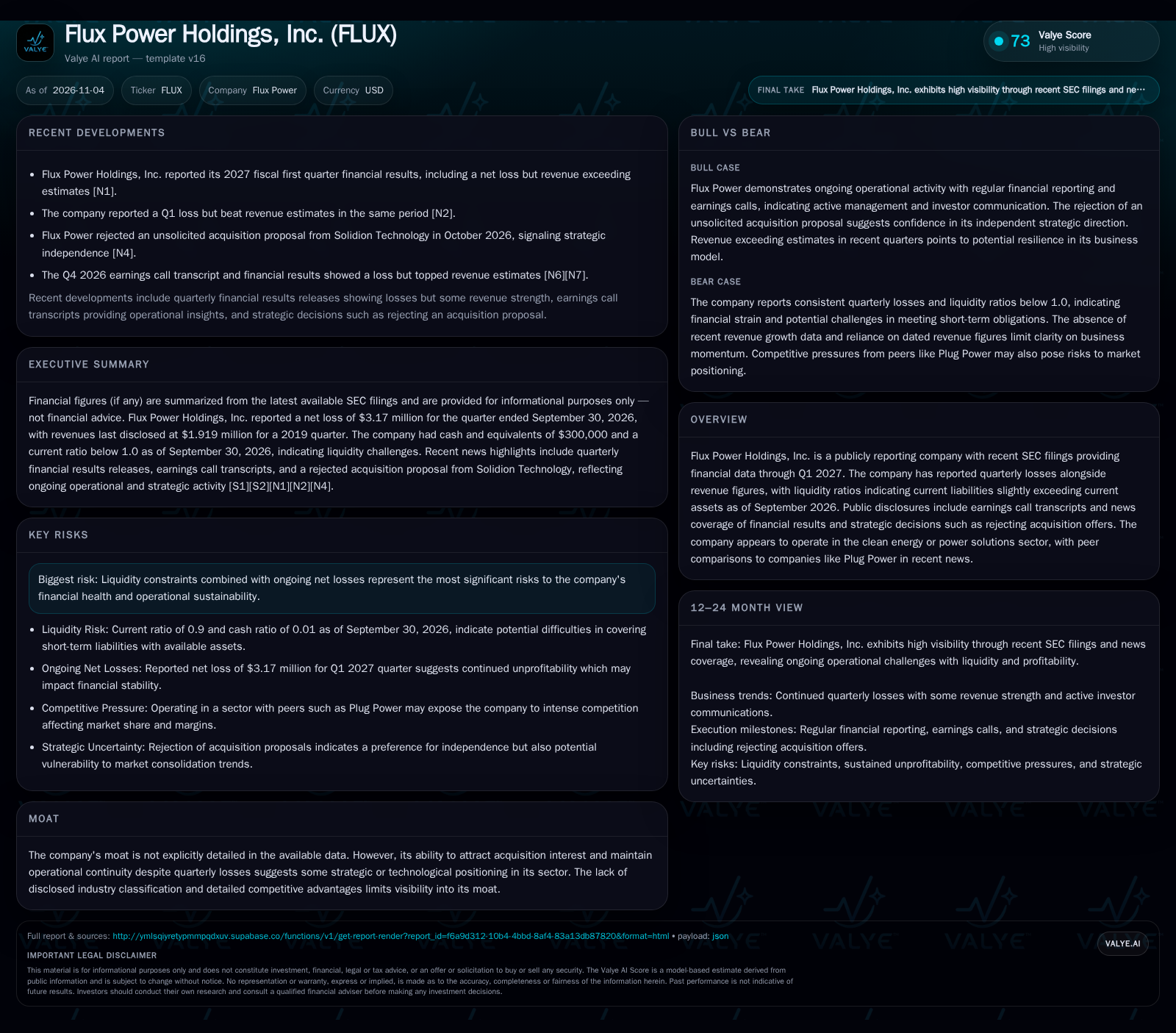
Flux Power Holdings, Inc. stands at a crossroads defined by both ambition and constraint. While recent quarters have shown the company exceeding revenue expectations and making the strategic choice to remain independent by rejecting an unsolicited acquisition offer, its balance sheet tells a more urgent story: cash reserves have dwindled to $300,000 against $22.6 million in current liabilities, and quarterly net losses persist. [S2] [N1] [N2] [N4]
Liquidity Squeeze and Strategic Autonomy: The Present Reality
As of September 30, 2026, Flux Power reported a net loss of $3.17 million for the quarter and held only $300,000 in cash and cash equivalents. Despite this, Flux Power rejected an unsolicited acquisition proposal from Solidion Technology in October 2026, reinforcing a commitment to remain independent even under financial pressure. The company’s revenue in recent quarters reportedly exceeded estimates, but no current revenue figure is available in the latest SEC snapshot. This combination of operational activity and acute financial stress defines the company’s immediate context. [S2] [N1] [N2] [N4]
How Flux Power’s Business Model Could Scale—Or Stall
Flux Power operates in the clean energy or power solutions space, likely focusing on battery systems or energy storage given peer comparisons. In this sector, revenue is typically generated through the sale of hardware (e.g., battery packs, power modules), with potential for follow-on service, maintenance, or software integration revenue streams. Pricing tends to be competitive, especially as customers—often industrial or commercial users—seek to optimize total cost of ownership.
The company’s persistent net losses and reported cash balance suggest that fixed costs (such as R&D, manufacturing overhead, and SG&A) currently outstrip gross profit generation. Operating leverage could be significant if sales volumes rise, as incremental hardware sales and associated services could spread fixed costs over a larger base. However, without clear evidence of recurring revenue, the business likely faces lumpy order cycles and margin pressure from price-sensitive buyers.
If the company cannot secure new capital or improve cash conversion from operations, ongoing losses may force it to curtail R&D, slow growth initiatives, or reconsider its independent stance.
A critical factor in scaling Flux Power's business model lies in its ability to transition from primarily hardware sales to a more balanced mix including recurring revenue streams such as service contracts, software subscriptions, or performance-based agreements. Such diversification could enhance revenue predictability and reduce exposure to cyclical capital expenditures by customers. However, this shift requires upfront investment in capabilities and customer education, which may further strain liquidity in the near term. The timing and pace of this transition will likely depend on market acceptance, competitive positioning, and the company's operational bandwidth to deliver quality ongoing service.
Competing for Share in a Crowded Clean Energy Arena
Flux Power’s sector is characterized by rapid innovation, shifting regulatory incentives, and aggressive competition from both established giants and nimble upstarts. Peer companies such as Plug Power, along with other battery and energy storage solution providers, are actively investing in technology differentiation, cost reduction, and expanded distribution.
Potential sources of advantage for Flux Power could include proprietary battery management systems, integration with customer workflows, or superior cycle life and safety features. However, without explicit disclosure of technological or cost advantages, it is unclear whether Flux Power enjoys meaningful differentiation or pricing power. The company’s ability to attract acquisition interest suggests some perceived strategic value, but persistent losses and liquidity constraints may erode negotiating leverage and customer confidence over time.
Customers in this space typically face moderate switching costs—driven by compatibility, reliability, and service relationships—but can be quick to shift toward more reliable or better-capitalized suppliers if continuity appears threatened. As a result, Flux Power’s financial fragility could become a competitive liability unless shored up through funding or rapid operational improvement.
If Revenue Acceleration Meets Funding, Value Creation Could Follow
A favorable scenario emerges if Flux Power can translate recent momentum—evidenced by revenue exceeding estimates—into sustained top-line growth, while simultaneously securing new funding to alleviate liquidity stress. This could allow the company to scale production, invest in product development, and capture greater share in a growing clean energy market.
Further evidence would include customer wins with multi-year commitments, expanding order backlog, and progress toward break-even or positive operating cash flow.
Falsification of the upside would occur if new capital proves elusive, revenue growth stalls or reverses, or if margin pressures intensify—forcing retrenchment or renewed M&A discussions under duress.
Operational Continuity Amid Financial Headwinds Remains the Likely Course
The most plausible near-term outcome is that Flux Power continues to operate as an independent entity, maintaining active customer engagement and periodic revenue outperformance, but remains hampered by ongoing net losses and liquidity constraints. In this scenario, the company may secure only modest funding, sufficient to preserve operations but insufficient to drive step-change growth or R&D investment.
Supporting evidence would include continued quarterly losses, flat or only modestly growing revenue, and incremental fundraising efforts (such as small equity offerings or short-term debt). Conversely, a rapid deterioration in liquidity, missed payroll, or abrupt management departures would challenge this scenario’s plausibility.
Acute Liquidity Shortfall Forces Restructuring or Loss of Independence
Should Flux Power fail to raise new capital or improve cash generation quickly, it risks breaching obligations to suppliers or employees, triggering an operational crisis. In this event, the company may be forced into emergency asset sales, a distressed merger, or even insolvency proceedings. Customer and partner confidence could rapidly erode, shrinking the pipeline and further weakening negotiating leverage.
Confirmation of this scenario would come from disclosures of covenant breaches, missed payments, workforce reductions, or a formal review of strategic alternatives.
What Will Decide Flux Power’s Next Chapter?
Disclosure of current and next-quarter revenue, gross margin, and order backlog—if available—would help clarify commercial momentum and margin trajectory.
Announcements regarding new funding (equity, debt, or strategic investment) or credit facility expansions would signal progress on the liquidity front.
Quarterly updates on operating cash flow and burn rate would reveal whether losses are narrowing or accelerating.
Evidence of customer wins, contract renewals, or new multi-year agreements would test the durability of commercial relationships and product-market fit.
Product development milestones or new solution launches—if disclosed—would indicate whether R&D investment is continuing despite financial strain.
Management commentary on capital allocation priorities and potential willingness to revisit M&A discussions if financial pressure persists.
Changes in competitive positioning, such as new partnerships or shifts in customer mix, would help gauge Flux Power’s ability to differentiate and retain share.
Disclaimer: This is research-only, informational analysis and not investment advice. It may include AI-generated interpretation and general industry context. Always verify important details using primary sources.

Comments