
TXO Partners: Volatility, Liquidity Constraints, and the Commodity Price Lever
The company’s performance is shaped by commodity price swings, asset sales, and hedging strategies, leaving its near-term trajectory highly sensitive to both operational execution and external price environments.
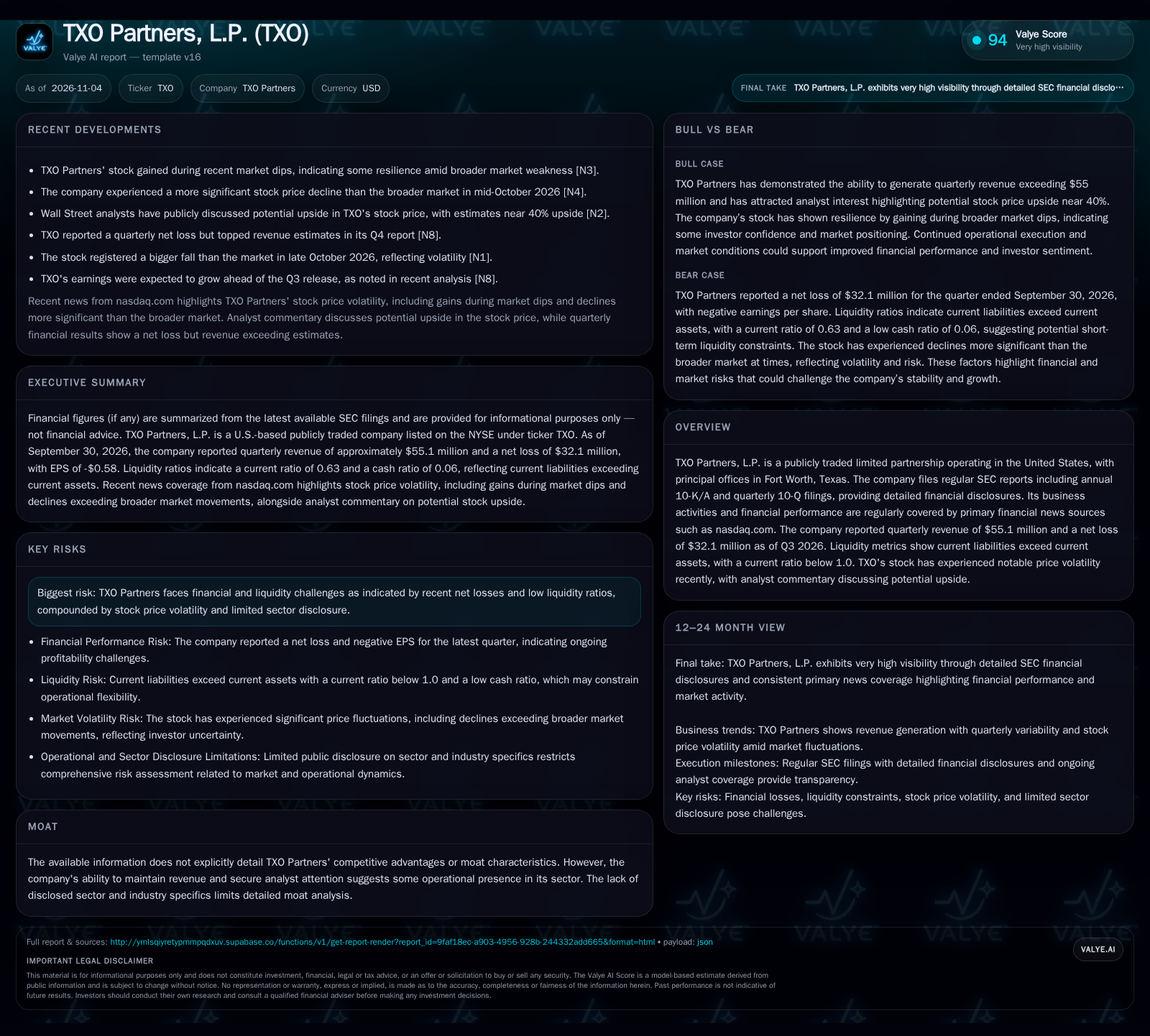
TXO Partners reported $55.1 million in Q3 2026 revenue but a net loss of $32.1 million, with current liabilities far outstripping current assets and a cash ratio of just 0.06. Asset sales and hedging are important levers, but underlying profitability remains challenged. [S2] [N2]
TXO Partners, L.P.—a U.S.-listed oil and gas operator focused on mature basins—sits at the intersection of substantial revenue generation and persistent financial stress. Its latest quarter saw $55.1 million in revenue but a net loss of $32.1 million, with liquidity stretched as current liabilities significantly exceed current assets. Recent asset sales and hedging activities are critical to cash management, but sustained profitability remains elusive. The business is highly exposed to commodity price swings and market volatility, with analyst attention reflecting both potential upside and significant risk. The next phase for TXO hinges on its ability to improve operational efficiency, secure liquidity, and navigate volatile energy markets. [S2] [N2]
Liquidity Squeeze and Losses Dominate the Recent Quarter
TXO Partners reported $55.1 million in revenue for the quarter ending September 30, 2026, but this was eclipsed by a net loss of $32.1 million and negative EPS of -$0.58. The balance sheet reveals a cash and cash equivalents position of just $8.63 million, with current assets ($95.5 million) well below current liabilities ($151.7 million), resulting in a current ratio of 0.63 and a cash ratio of 0.06. The company reported cash and liquidity metrics for the period; these figures do not by themselves establish operating runway, investment capacity, financial flexibility, or financing capacity. Recent asset sales, such as the Cross Timbers Energy transaction, provided some cash inflows but have not fundamentally shifted the company’s underlying operating deficit. [S2]
Operating Leverage and Commodity Exposure Shape the Financial Model
TXO Partners’ economics are primarily driven by the acquisition, optimization, and exploitation of oil, natural gas, and NGL reserves across major U.S. basins. The business is capital-intensive, requiring ongoing investment in drilling, production, and asset maintenance. Revenue is highly sensitive to commodity prices—swings in oil and gas benchmarks directly impact realized sales and cash flow. The company’s cost structure features significant fixed components (depreciation, depletion, and amortization of reserves; lease operating expenses), making operating leverage a double-edged sword: price upswings can rapidly improve margins, whereas downturns exacerbate losses.
To partially mitigate price volatility, TXO employs hedging through futures, swaps, and collars. These strategies can smooth cash flows in the short term but may limit upside if prices rise sharply. Asset sales, such as the recent Cross Timbers Energy deal, provide non-recurring cash infusions but reduce future production and revenue base. The persistent net losses and negative operating cash flow suggest that the current asset base and cost structure are not generating sufficient returns absent higher commodity prices or significant cost restructuring.
How Basin Location and Asset Mix Influence Competitive Standing
TXO operates in some of North America’s most prolific oil and gas basins—the Permian, San Juan, and Williston. These regions offer mature infrastructure and established service ecosystems, but also attract intense competition from larger, better-capitalized E&P companies and regional independents. The company’s competitive position is shaped by its reserve quality, cost of extraction, and ability to manage decline rates. In such basins, scale and access to capital can drive meaningful cost advantages and operational flexibility.
TXO’s lack of scale relative to the largest basin operators may constrain its bargaining power with service providers and midstream partners, as well as its ability to weather commodity downturns. Technology adoption (such as advanced reservoir management and digital optimization) could improve cost efficiency, but the company’s capital constraints may limit such investments. Substitution risk from renewable energy remains low in the near term for these legacy basins, but long-term structural shifts in energy demand could eventually pressure margins and asset values.
Commodity Price Recovery and Cost Discipline Could Reverse Fortunes
If oil and gas prices rebound meaningfully, TXO’s high operating leverage could translate into rapid margin expansion and a move toward profitability. Successful execution of additional asset optimization or cost-reduction programs would further amplify the benefit of higher realized prices. The company’s hedging program could provide a floor during price dips while still allowing for some upside capture.
Confirmation of this scenario would come from sequential improvement in cash flow from operations, narrowing or reversing net losses, and stabilization or growth in production volumes despite asset sales. Upward revisions to reserve estimates or successful new well completions would further support the thesis. Conversely, if commodity prices remain flat or decline, or if cost reductions fail to materialize, the upside scenario would be invalidated.
Navigating Persistent Volatility with Asset Sales and Hedging
The most plausible outcome is a continuation of quarterly volatility in both operating results and stock price, driven by fluctuating commodity prices and ongoing efforts to manage liquidity. TXO is likely to lean heavily on asset sales, hedging strategies, and incremental cost control to bridge cash flow gaps. While these tactics can delay acute distress, they do not fundamentally resolve the profitability challenge if commodity prices remain range-bound.
Evidence supporting this view would include continued variability in quarterly revenue and net income/loss, further non-core asset divestitures, and stable or modestly declining production volumes. If the company is unable to execute asset sales at favorable prices or if hedging costs rise, downside risks would intensify.
Liquidity Stress Escalates into Restructuring or Forced Asset Sales
If commodity prices weaken further or operational setbacks occur, TXO’s reported cash balance and sub-1.0 current ratio could force the company into distressed asset sales, dilutive equity raises, or even restructuring. High fixed costs and debt service obligations would make it difficult to quickly align expenses with shrinking cash inflows. In this scenario, value erosion could accelerate as asset sales occur at disadvantageous terms and production base contracts.
This scenario would be confirmed by rapid draws on remaining cash, inability to refinance short-term obligations, or covenant breaches—if disclosed. A sharp drop in reported production, negative working capital trends, or management signaling going-concern risks would also substantiate this outcome.
What Could Change for TXO: Metrics and Events to Track Next
Quarterly cash flow from operations: Sustained positive cash flow would indicate improving core economics and reduce liquidity risk.
Production volumes by basin: Stable or growing output would suggest operational stability, while declines would highlight asset attrition or underinvestment.
Net debt and upcoming maturities: If disclosed, shifts in net debt or new financing arrangements would illuminate runway and creditor confidence.
Asset sale proceeds and frequency: Increased reliance on asset sales may signal short-term liquidity needs but longer-term asset base erosion.
Hedging coverage and realized prices: Changes in hedge positions or realized price differentials would directly affect near-term earnings sensitivity.
Cost per BOE (barrel of oil equivalent): Improvements here would demonstrate progress on cost control and operational efficiency.
Management commentary on liquidity and capital allocation: Explicit disclosures or guidance shifts would provide early signals of strategic pivots or distress.
Reserve estimate revisions: Upward or downward adjustments would impact asset values and future cash flow expectations.
Disclaimer: This is research-only, informational analysis and not investment advice. It may include AI-generated interpretation and general industry context. Always verify important details using primary sources.

Comments