
Independence Realty Trust: Portfolio Scale Meets Cost Pressures Amid Shifting Multifamily Dynamics
Independence Realty Trust’s Q3 2026 results highlight the steady growth potential of scaled multifamily REITs, but rising expenses, capital allocation decisions, and economic sensitivity will determine whether modest revenue gains translate into durable shareholder value.
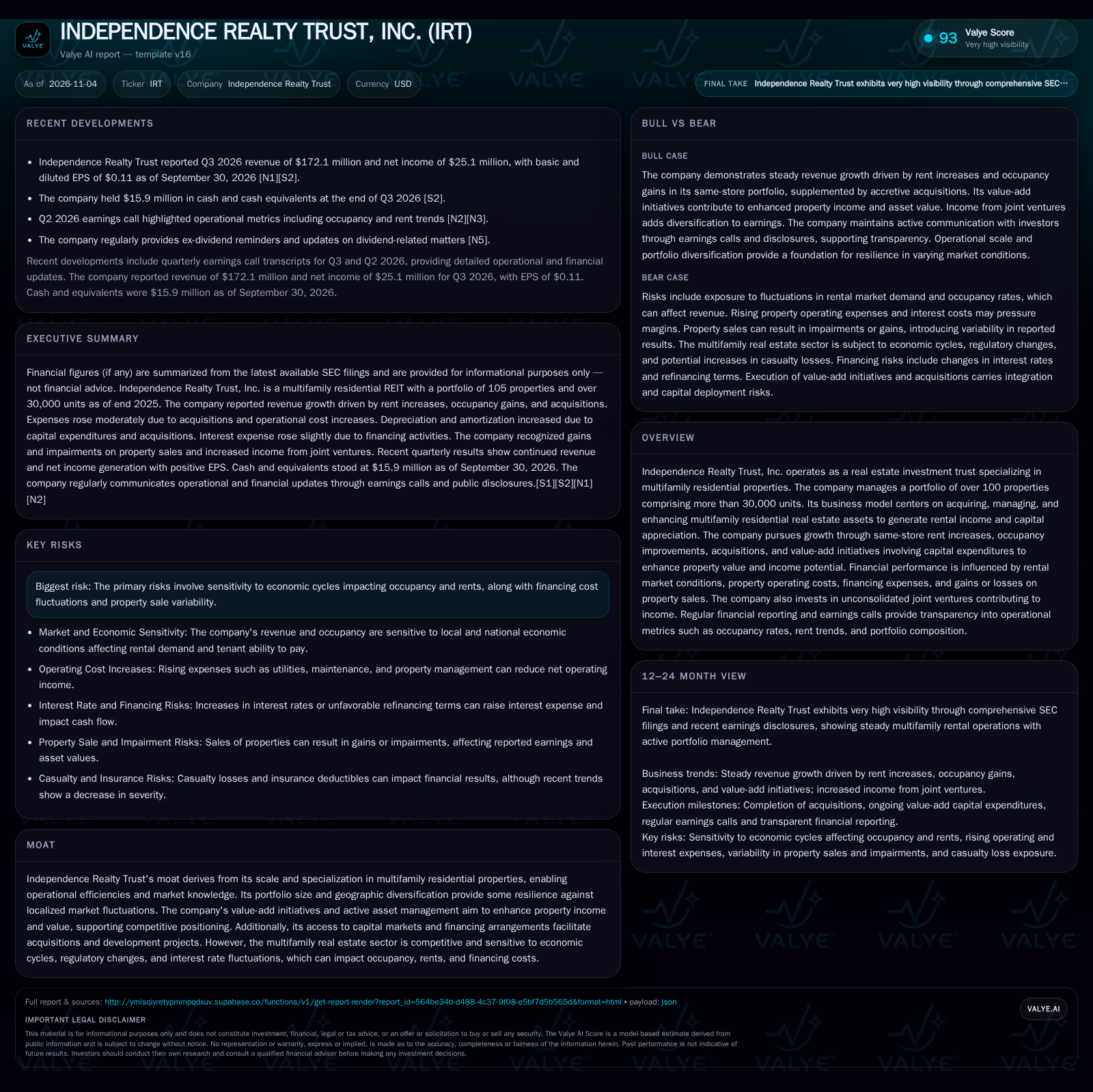
Independence Realty Trust reported Q3 2026 revenue of $172.1 million and net income of $25.1 million, continuing a pattern of moderate growth driven by rent increases, occupancy gains, and acquisitions. However, property operating costs and interest expense are rising alongside capital expenditures. The company’s ability to sustain margin improvement will depend on its execution of value-add initiatives, resilience to rental market shifts, and prudent financial management in a competitive, rate-sensitive sector. [S2] [N1]
Independence Realty Trust, a multifamily REIT with over 30,000 units across 105 properties, continues to deliver incremental revenue growth through a mix of rent increases, occupancy improvements, and strategic acquisitions. While Q3 2026 results reflect ongoing profitability and operational scale, rising property operating costs and higher interest expenses are compressing margins and heightening the importance of disciplined capital allocation. As the multifamily sector grapples with changing rental demand, rate volatility, and competitive pressures, IRT’s next phase will be defined by its ability to translate operational initiatives into sustainable cash flow and defend against economic and cost headwinds. [S2] [N1]
Recent Performance: Growth Steady, But Expense Pressures Mount
Independence Realty Trust reported Q3 2026 revenue of $172.1 million and net income of $25.1 million, with basic and diluted EPS of $0.11, continuing a pattern of moderate top-line and bottom-line growth. For the full year 2025, rental and other property revenue rose 2.7% to $656.5 million, with same-store rent increases and higher occupancy rates accounting for much of the gain. This growth was complemented by new acquisitions and incremental income from joint ventures. However, property operating expenses climbed by $3.6 million in 2025, reflecting cost inflation in advertising, contract services, and utilities, partially mitigated by lower insurance and payroll outlays. Interest expense also rose to $79.0 million, primarily due to higher amortization of deferred financing costs and lower capitalized interest. The company recognized both gains and impairments from property sales, highlighting the ongoing role of portfolio optimization in reported results. As of September 30, 2026, cash and equivalents stood at $15.9 million, underscoring the need for continued capital market access and prudent liquidity management. [S1] [S2] [N1]
How Scale and Value-Add Capital Shape IRT’s Cash Flow Potential
Independence Realty Trust’s core business model monetizes multifamily residential assets through rental income, with portfolio scale enabling potential efficiencies in property management, procurement, and marketing. Revenue growth is driven by a blend of organic levers—rent increases and occupancy gains—and inorganic expansion via accretive acquisitions. The company’s value-add initiatives, involving targeted capital expenditures to upgrade properties, are designed to support above-market rent growth and asset appreciation, though these projects require upfront investment and can temporarily suppress margins. Operating leverage is present but constrained by the high fixed-cost base of property ownership, including maintenance, taxes, and depreciation.
Variable costs—such as utilities, contract services, and turnover expenses—can fluctuate with portfolio size, market conditions, and inflationary pressures, as seen in the recent uptick in operating expenses. Interest expense is a key swing factor, as REITs typically rely on a mix of secured and unsecured debt to fund acquisitions and renovations. Rising rates or less favorable refinancing terms can quickly erode free cash flow. Gains from property sales and joint ventures can provide episodic boosts to earnings but are inherently less predictable and not a substitute for stable, recurring cash flow. Ultimately, the path to sustainable value creation rests on the company’s ability to achieve rent growth and margin expansion that outpaces cost inflation and interest burden.
Market Positioning: Advantages of Scale Versus Multifamily Headwinds
IRT’s competitive positioning is built on geographic and portfolio scale, which can confer modest cost advantages and risk diversification across local markets. Larger portfolios may also provide negotiating leverage with vendors and greater access to acquisition opportunities. The company’s focus on value-add strategies—upgrading existing properties to attract higher-paying tenants—offers a path to differentiate from commodity apartment operators, but these efforts are widely adopted across the sector and do not guarantee outperformance.
The broader multifamily REIT sector is highly competitive, with public and private operators vying for similar acquisition targets and tenant pools. Substitute risks stem from new housing supply, alternative rental models, or shifts in consumer preferences, particularly in response to macroeconomic stress or regulatory interventions (such as rent controls). While IRT’s joint venture strategy diversifies income streams and spreads risk, it also introduces additional complexity and potential for misalignment. The company’s access to capital markets, while a potential advantage, can become a vulnerability if credit conditions tighten or equity valuations compress.
Unlocking Margin Expansion Through Successful Value-Add and Portfolio Optimization
A favorable scenario for IRT would see the company successfully executing its value-add initiatives, delivering renovations and amenity upgrades that allow for outsized rent increases and improved tenant retention. If these investments result in rent growth that meaningfully exceeds local market averages, while occupancy remains high, operating leverage could drive margin expansion even as some costs rise. Additional upside could come from accretive acquisitions at cap rates above IRT’s cost of capital, further scaling the platform and enabling cost synergies.
The scenario would be confirmed by sustained same-store net operating income growth, a widening EBITDA margin, and evidence of premium rent achievement at renovated properties. Lower turnover costs and improved tenant satisfaction would support the thesis. Gains from selective property sales and continued growth in joint venture income would further boost reported earnings and capital recycling capacity. The scenario could be falsified by a failure to deliver rent premiums post-renovation, cost overruns on capital projects, or a deterioration in occupancy relative to peers.
Incremental Gains as Cost and Rate Pressures Offset Organic Growth
The most plausible trajectory for IRT is one of steady but modest revenue growth, with rent and occupancy improvements largely balanced by rising property operating expenses and a persistent interest burden. While value-add projects and selective acquisitions may provide incremental upside, cost inflation in utilities, contract services, and insurance—as well as continued wage pressures—will likely constrain margin expansion. Episodic gains from property sales and joint ventures will continue to introduce some volatility, but are not expected to drive core earnings growth.
Confirmation for this scenario would come from continued low-single-digit same-store revenue growth, relatively stable occupancy rates, and operating margins that fluctuate within a narrow band. Any material divergence—such as accelerating expense growth, a sharp rise in interest rates, or a sudden drop in occupancy—would challenge the base case and shift the risk profile.
Economic Downturn or Cost Shocks Erode Earnings Stability
A more adverse scenario for IRT would involve a macroeconomic slowdown that depresses rental demand and occupancy rates, particularly in key markets. This could force more aggressive rent concessions or increase turnover, reducing net operating income. Simultaneously, if inflation in property operating expenses outpaces the company’s ability to raise rents, margin compression would accelerate.
The scenario would be confirmed by declining same-store revenue, falling occupancy, a sharp rise in operating or interest expenses, and impairment charges from forced property sales. Failure of value-add initiatives to produce expected rent premiums, or tenant defaults and delinquencies, would further strain financial performance. In this environment, the company might be forced to slow capital deployment, sell assets at unfavorable prices, or raise equity on dilutive terms.
What Will Determine Independence Realty Trust’s Resilience and Value Creation?
Sustained same-store net operating income growth, particularly the ability to achieve rent increases above inflation and maintain high occupancy, would help validate the company’s operational strategy—if disclosed.
Trends in property operating expenses per unit, especially in categories like utilities, contract services, and insurance, will be critical in assessing margin risk and cost discipline.
Progress and return on investment from value-add initiatives, including achieved rent premiums versus renovation costs, would clarify whether capital expenditures are accretive or dilutive—if disclosed.
Acquisition activity, cap rates on new purchases, and integration outcomes will reveal whether external growth is value-creative or simply adds scale without improving returns.
Interest expense trends and refinancing terms, especially in a volatile rate environment, will determine the durability of free cash flow and dividend capacity.
Net gains or losses from property sales and joint ventures, and the degree to which these are recurring or one-off, will shape reported earnings volatility.
Portfolio occupancy rates and tenant turnover metrics, particularly relative to local market averages, would indicate competitive health and tenant retention effectiveness—if disclosed.
Disclaimer: This is research-only, informational analysis and not investment advice. It may include AI-generated interpretation and general industry context. Always verify important details using primary sources.

Comments