
Stoke Therapeutics: RNA Therapeutics Advance, But Dravet Data and Financial Durability Remain Decisive
However, persistent net losses and the binary nature of clinical-stage biotech mean future value depends on pivotal data, regulatory outcomes, and Stoke’s ability to transition from development to commercial operations.
Yet, with recurring quarterly losses and no approved product, the company’s future hinges on forthcoming clinical results and regulatory progress. Watchpoints include trial outcomes, cash burn, and the evolution of its partnership model.
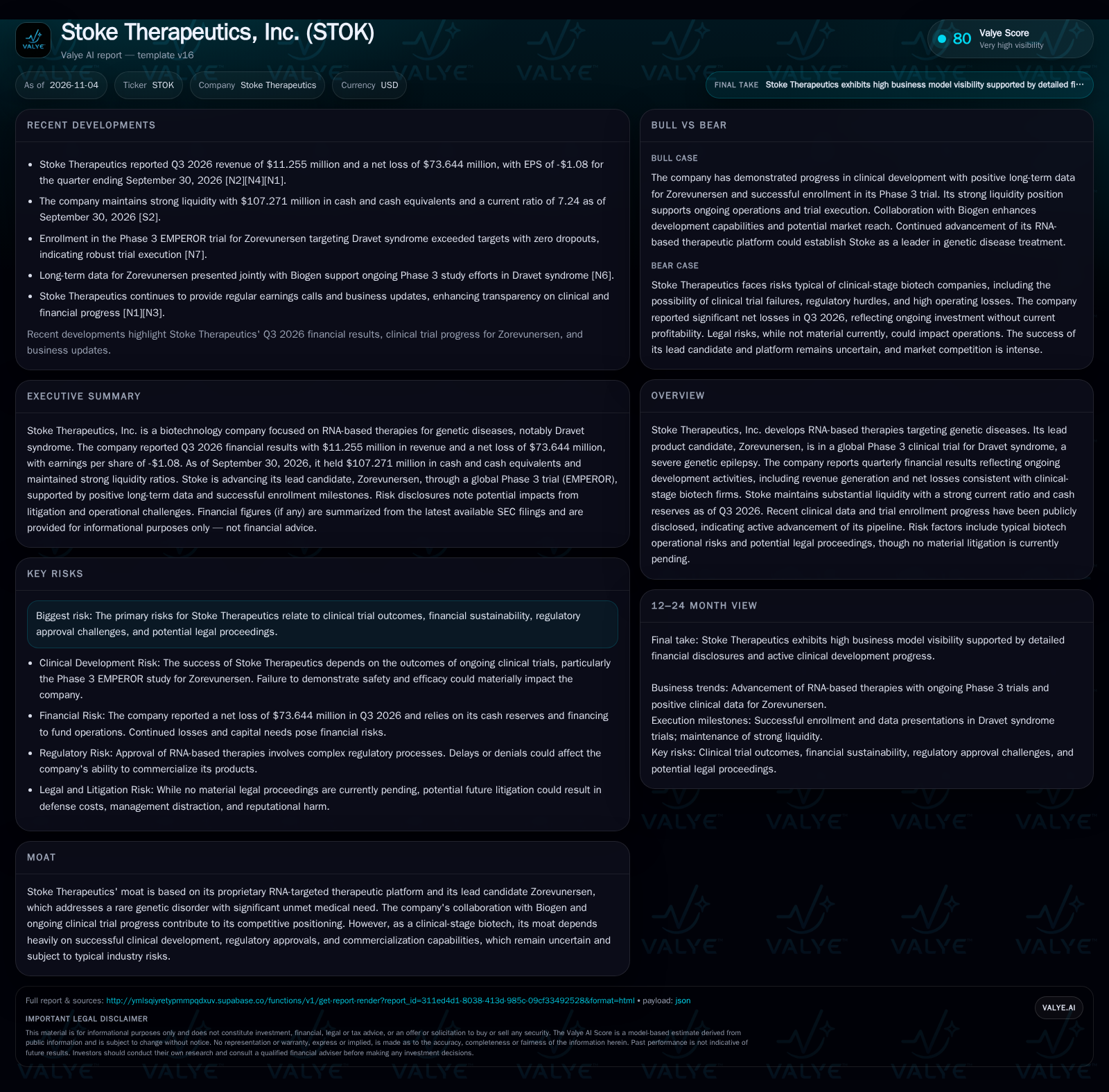
Stoke Therapeutics stands at a pivotal moment as its lead RNA-based therapy for Dravet syndrome advances through late-stage clinical development. The company’s operational execution—evidenced by exceeding Phase 3 trial enrollment targets with no dropouts—demonstrates its ability to manage complex studies in rare diseases. However, as with most clinical-stage biotechs, its investment case remains binary: near-term success or setback will be defined by pivotal trial results, regulatory decisions, and ultimately, its ability to move from science to sustainable business.
Recent Milestones Define Stoke’s Near-Term Operating Reality
[S2] This financial position underpins ongoing clinical operations and provides a buffer against short-term setbacks. The company’s most notable operational achievement is the successful enrollment of its Phase 3 EMPEROR trial for Zorevunersen in Dravet syndrome, which not only exceeded target numbers but also reported zero patient dropouts—a rare and positive indicator for both trial integrity and future regulatory submissions [N7]. Despite these positives, Stoke reported continued net losses in Q3 2026, consistent with its development-stage status [S2]. While no material litigation is pending, the company highlights legal risk as a potential future drag on resources [S2].
Development-Stage Biotech Economics: High Burn, High Stakes
Stoke’s revenue, as with most clinical-stage biotechnology firms, is currently modest and non-recurring, potentially stemming from collaborations, grants, or milestone payments rather than product sales. The cost structure is heavily weighted toward R&D and G&A expenses, with quarterly net losses such as the $73.644 million reported in Q3 2026 [S2]. These losses reflect the capital-intensive nature of late-stage clinical trials, where fixed costs (e.g., trial sites, regulatory filings) are high and variable costs (e.g., per-patient expenses) only decrease with scale post-approval. Fixed costs may rise further as Stoke approaches potential commercialization, with pre-launch investments in manufacturing, salesforce buildout, and market access infrastructure.
Operating leverage, a key feature in biotech, only materializes if Stoke achieves successful regulatory approval and launches its lead therapy. At that point, incremental revenue from drug sales—especially in rare diseases with premium pricing—could outpace the relatively slower growth of fixed costs. Until then, Stoke is reliant on existing cash, future equity/debt raises, or partnership funding.
An important consideration in Stoke's financial dynamics is the timing and scale of capital raises relative to clinical milestones. Given the binary nature of clinical trial outcomes, investor appetite can fluctuate sharply, impacting the company's ability to secure favorable financing terms. If pivotal data are positive, Stoke may access capital at higher valuations, reducing dilution. Conversely, negative or ambiguous results could constrain financing options or increase cost of capital.
Moreover, the pathway to commercialization introduces operational complexity beyond clinical development. Transitioning from a research-focused organization to a commercial entity requires building infrastructure for manufacturing scale-up, regulatory compliance, distribution logistics, and payer engagement. Each of these areas entails upfront investment and ongoing fixed costs, which may compress margins until product uptake reaches a sustainable level. The timing of these investments relative to revenue generation is crucial; premature scaling can exacerbate cash burn, while delayed investment risks missing market opportunities or competitive positioning.
RNA Platform Promise and the Challenge of Differentiation
Stoke’s competitive position is anchored in its proprietary RNA-targeted therapeutics platform, with Zorevunersen targeting Dravet syndrome—a rare epileptic disorder with significant unmet need. The company’s moat, if realized, would derive from first-mover advantage, clinical efficacy, and the complexity of RNA therapeutic design and delivery. However, the rare disease space is crowded with established and emerging players, including companies developing gene therapies, small molecules, and other RNA-based approaches.
Switching costs in rare disease markets can be high for approved therapies due to payer access, specialist physician inertia, and patient advocacy, but Stoke must first clear regulatory and commercial hurdles. Larger competitors may have greater resources for commercialization, while platform risk remains if Stoke cannot demonstrate differentiated efficacy or safety. Partnerships, such as the previously disclosed collaboration with Biogen, could enhance distribution and development scale, but their commercial structure and persistence are not guaranteed absent further disclosures.
The competitive landscape for RNA therapeutics in rare diseases is evolving rapidly, with platform versatility and pipeline breadth becoming differentiators. Stoke's ability to leverage its RNA platform beyond Dravet syndrome could enhance its strategic positioning by diversifying risk and creating multiple value inflection points. However, platform scalability depends on reproducibility of delivery mechanisms, target engagement, and safety profiles across indications. Failure to demonstrate consistent platform advantages may limit Stoke's ability to attract partnerships or justify premium valuations, especially as competitors advance alternative modalities such as gene editing or antisense oligonucleotides.
Additionally, payer dynamics in rare disease markets are complex and can significantly influence commercial success. Even with regulatory approval, reimbursement negotiations hinge on demonstrating meaningful clinical benefit relative to existing therapies and cost-effectiveness. Stoke's pricing strategy must balance recouping R&D investments with payer willingness to cover high-cost treatments in small patient populations. Early engagement with health technology assessment bodies and incorporation of real-world evidence could be critical to securing favorable access and minimizing reimbursement delays, thereby impacting revenue trajectory and return on investment.
Pivotal Data and Regulatory Success Could Transform Stoke’s Trajectory
If Zorevunersen delivers positive pivotal data—showing clear efficacy and safety in the completed Phase 3 Dravet syndrome trial—Stoke could rapidly progress toward regulatory filings and, if approved, commercialization. In this scenario, the company’s rare-disease focus may allow for premium pricing and rapid uptake in a concentrated prescriber base, with limited direct competition in the initial indication. Strong clinical results would also validate Stoke’s RNA platform, increasing the value of its broader pipeline and partnership potential.
Confirmation of this scenario would come from: (a) statistically significant, clinically meaningful efficacy and safety results presented at major conferences or in regulatory filings; (b) regulatory acceptance for review (e.g. Conversely, delays in data readout, ambiguous efficacy, or safety signals would weaken this scenario.
Managing Uncertainty: Progress With Persistent Financial Strain
The most plausible near-term outcome is that Stoke continues its clinical execution, maintaining operational discipline as it awaits pivotal Zorevunersen trial readouts. The company is likely to experience ongoing net losses and periodic capital raises, with its cash position gradually declining as trials progress and pre-commercial investments rise. Regulatory filings may follow in the next 12-24 months if data are supportive, but timelines and outcomes remain uncertain.
Evidence supporting this scenario would include continued detailed financial disclosures, updates on trial progress and regulatory interactions, and incremental partnerships or non-dilutive financings. Falsifying evidence would be any material clinical or regulatory setback, cash burn acceleration without new funding, or an adverse legal event.
Clinical Setbacks or Regulatory Delays Could Force Tough Choices
Should Zorevunersen encounter efficacy or safety issues in Phase 3, or if regulatory agencies delay or deny approval, Stoke would likely see its market value and funding options contract sharply. In this scenario, the company may need to downsize, reprioritize pipeline assets, or seek strategic alternatives such as partnerships, asset sales, or even a sale of the company. Litigation or unexpected legal costs could further strain resources.
This scenario would be confirmed by: (a) public disclosure of negative or inconclusive pivotal data; (b) regulatory rejection or requests for additional studies; (c) rapid deterioration of the cash position without new capital raised; and (d) any announcement of layoffs, pipeline reprioritization, or restructuring.
Milestones That Will Shape Stoke’s Investment Thesis
Final pivotal data readout for Zorevunersen in Dravet syndrome—efficacy, safety, and dropout rates compared to previous disclosures.
Timing and outcome of regulatory filings (e.g., FDA or EMA submission and acceptance) for Zorevunersen.
Disclosure of new or extended strategic partnerships, including any revenue or funding terms, if announced.
Quarterly cash burn and updated cash runway projections as reported in financial results.
Pipeline progress beyond Dravet syndrome—new INDs, trial initiations, or expansion into additional indications, if disclosed.
Changes in legal risk profile, including any updates on litigation or material legal proceedings.
Evolution of the company’s commercialization strategy—salesforce buildout, market access plans, or early launch preparations, if disclosed.
Any changes in the competitive landscape—new approvals or advances by rival RNA, gene therapy, or rare disease companies.
Disclaimer: This is research-only, informational analysis and not investment advice. It may include AI-generated interpretation and general industry context. Always verify important details using primary sources.

Comments