
Sotera Health: Integrated Sterilization Platform Faces Supply Chain Complexity and Technology Substitution Risks
Sotera Health’s unique integration of global sterilization services, Co-60 isotope supply, and lab testing underpins its high customer retention and revenue visibility. Yet, supply chain fragility and emerging sterilization technologies introduce real risks to its durable but capital-intensive model.
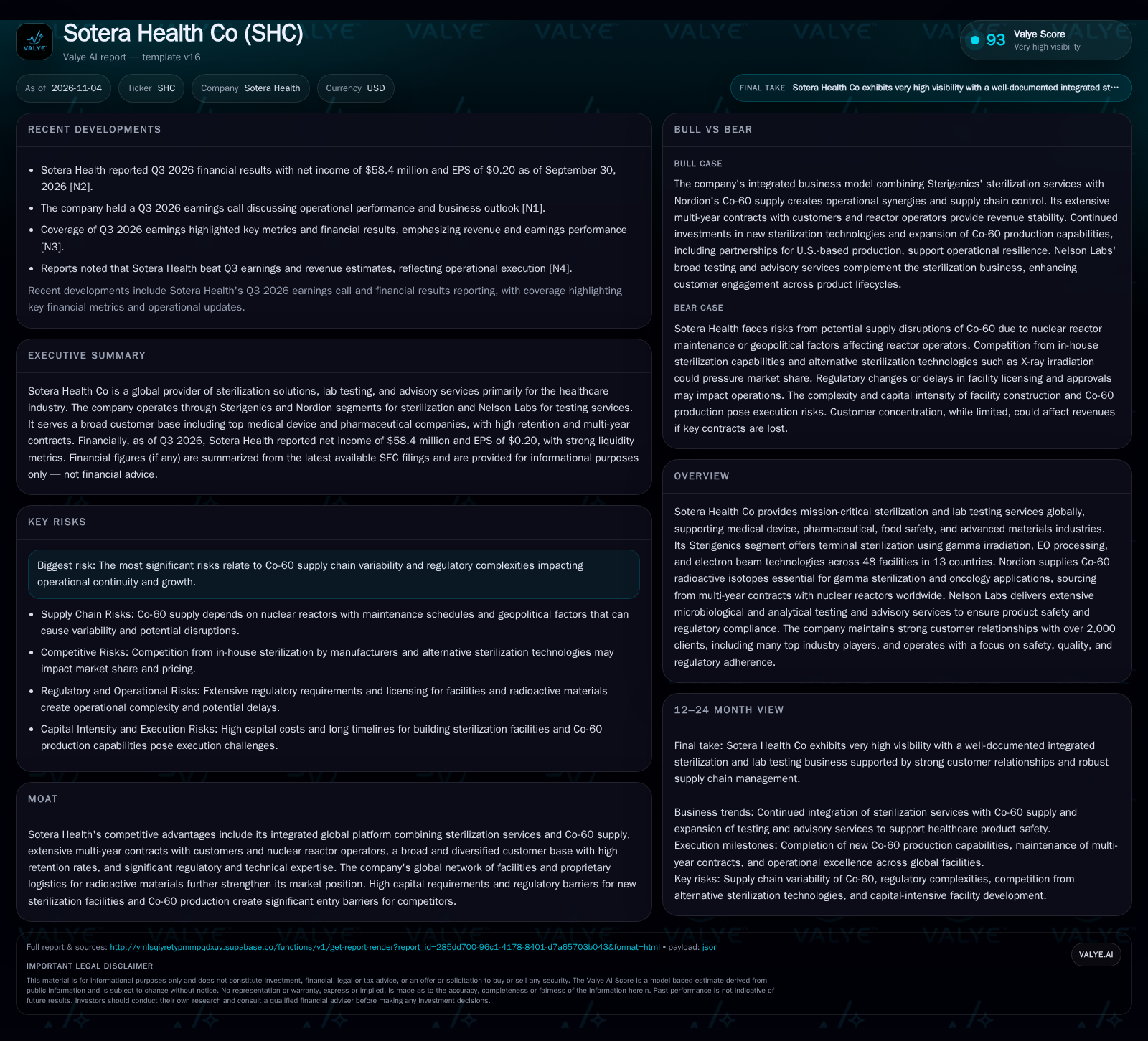
Sotera Health combines outsourced sterilization, critical isotope supply, and lab testing for healthcare and industrial customers, generating stable revenues via multi-year contracts and a global facility network. While Q3 2026 results confirm ongoing profitability and reported liquidity position, the business’s reliance on long-cycle nuclear supply chains and regulatory complexity remains a structural vulnerability. The key questions: Can Sotera sustain its moat as technology and regulatory dynamics shift, and how will it mitigate supply chain and capital intensity risks going forward? [S1] [S2] [N2]
Sotera Health Co occupies a structurally important niche in the healthcare value chain by providing outsourced sterilization, radioactive isotope supply, and lab testing to a broad set of medical device, pharmaceutical, and food safety customers. Yet, this same integration exposes Sotera to capital intensity, supply chain fragility, and technology substitution risks. The company’s ability to manage these trade-offs will determine whether its competitive advantages prove durable in a changing regulatory and technological landscape. [S1] [S2] [N2]
How Q3 2026 Results and Contract Structure Shape the Investment Debate
Sotera Health reported Q3 2026 net income of $58.4 million and basic and diluted EPS of $0.20, with cash and equivalents of $412 million and a current ratio of 3.13 as of September 30, 2026. These figures indicate continued profitability and substantial short-term liquidity. [S2] [N2]
Operationally, over 90% of Sotera’s revenue is secured by multi-year contracts, serving more than 2,000 customers across healthcare, pharma, and advanced industries. This high contract coverage underpins revenue visibility and client retention, but also reflects the mission-critical nature of its services. [S1]
Nordion’s Co-60 isotope supply, crucial for gamma sterilization, is locked in through long-term agreements with nuclear reactor operators worldwide, some extending to 2064. This provides supply assurance but also creates exposure to nuclear industry cycles, maintenance, and geopolitical risks. [S1]
Dissecting Sotera’s Margin Structure: Contracted Revenues vs. Capital and Regulatory Load
Sotera Health’s economics are shaped by a high proportion of contracted, recurring revenues, which dampens revenue volatility and supports margin stability. The company’s extensive use of multi-year agreements with both customers (for sterilization/testing services) and suppliers (for Co-60 isotope sourcing) reduces demand uncertainty, enabling more efficient capacity planning and asset utilization. [S1]
However, these benefits come with substantial fixed costs. Sterilization facilities—especially those using gamma irradiation—require significant upfront capital investment, ongoing regulatory compliance, and specialized logistics for handling radioactive materials. This capital intensity creates operating leverage: incremental sterilization or testing volumes can drive outsized profit growth once fixed costs are covered, but it also means underutilization can quickly erode margins.
Nelson Labs’ testing and advisory services likely carry higher variable costs and lower capital intensity than sterilization, offering some diversification. Still, the overall business model remains exposed to the pace of facility buildout, regulatory approval cycles, and the durability of long-term supply contracts for Co-60.
Integrated Platform vs. Technology Substitution and In-House Threats
Sotera’s integrated platform—combining Sterigenics’ global sterilization footprint, Nordion’s control of Co-60 supply, and Nelson Labs’ regulatory testing expertise—creates switching frictions for customers and a formidable moat for new entrants. The breadth of its global network and proprietary radioactive materials logistics further raises entry barriers. [S1]
Yet, the landscape is evolving. Large medical device and pharma manufacturers may explore in-house sterilization to reduce costs or control supply chains, particularly as alternative sterilization technologies (such as X-ray and e-beam) mature. These methods may offer lower regulatory hurdles and avoid the supply chain fragility associated with nuclear-sourced isotopes.
Competitors include regional sterilization outsourcers, specialty labs, and technology disruptors developing new sterilization modalities. The key question is whether Sotera’s scale, regulatory expertise, and integrated supply chain can continue to justify premium pricing and contract stickiness as alternatives proliferate.
Unlocking Value Through Facility Utilization, U.S. Co-60 Expansion, and Regulatory Tailwinds
The most favorable outcome for Sotera Health involves sustained growth in healthcare device volumes, continued outsourcing of sterilization, and successful ramp-up of new Co-60 production—particularly in the U.S.—to insulate the supply chain from international risks. If the company can drive higher utilization across its 48 global sterilization facilities while expanding Nelson Labs’ testing services, operating leverage could deliver outsized earnings growth.
Regulatory shifts that favor outsourced sterilization or impose stricter safety/testing requirements could further entrench Sotera’s role as a trusted partner. Successful execution of U.S.-based Co-60 production would reduce dependency on foreign reactors and enhance supply security, supporting long-term contract renewals.
Evidence to confirm this scenario would include rising facility utilization rates (if disclosed), new customer wins or contract extensions, successful completion of domestic isotope production projects, and margin expansion driven by operating leverage.
What Stable Growth Looks Like Amid Supply, Regulatory, and Technology Crosscurrents
The most plausible trajectory for Sotera Health is one of steady, contracted revenue growth, supported by ongoing demand for sterilization and testing services in regulated healthcare markets. Facility utilization and contract renewal rates remain high, but the company must contend with periodic supply chain disruptions (e.g., reactor outages or geopolitical events affecting Co-60 supply) and rising customer interest in alternative sterilization technologies.
Margins are protected by the stickiness of multi-year contracts and limited substitution risk in the near term, but incremental growth in newer modalities (X-ray, e-beam) begins to erode pricing power at the margin. Capital expenditures remain elevated as Sotera invests in facility upgrades, regulatory compliance, and domestic isotope capabilities.
This scenario would be confirmed by stable to modestly growing revenue and earnings, continued high contract coverage, and manageable supply chain incidents without major customer attrition.
How Supply Chain Shocks and Rapid Tech Substitution Could Disrupt the Model
The most adverse scenario would see Sotera Health hit by a combination of severe Co-60 supply disruptions—caused by nuclear reactor maintenance, geopolitical strife, or regulatory changes—leading to sterilization facility underutilization and potential contract penalties. At the same time, rapid adoption of alternative sterilization technologies by major customers could accelerate pricing pressure and revenue attrition.
If regulatory timelines for new facility or isotope production approvals slip, or if capital costs for expansion projects outpace returns, the company could face margin compression and reduced cash flow, despite high contract coverage. Customer concentration risk could materialize if a top client insources sterilization or switches to a competing provider.
Evidence for this scenario would include reported supply interruptions, declining facility utilization (if disclosed), loss of major contracts, or margin contraction despite stable or rising revenues.
Benchmarks for Testing Sotera Health’s Moat and Resilience
Facility utilization rates by sterilization technology and region—if disclosed—would clarify operating leverage and exposure to underutilization risk.
Progress on U.S.-based Co-60 production initiatives, including milestone completions, regulatory approvals, and cost updates.
Contract renewal rates and the proportion of revenue under multi-year agreements, especially with top 10 customers.
Incidence and severity of supply chain disruptions (e.g., reactor outages, geopolitical events) affecting Co-60 availability.
Customer adoption rates of alternative sterilization modalities (e.g., X-ray, e-beam) and any resulting impact on Sotera’s volumes or pricing.
Capital expenditure trends versus planned facility expansions or upgrades, and realized returns on those projects.
Margin trends in Nelson Labs and evidence of cross-selling or integration benefits across business segments.
Regulatory developments that could alter the economics of outsourced sterilization or introduce new entry barriers.
Disclaimer: This is research-only, informational analysis and not investment advice. It may include AI-generated interpretation and general industry context. Always verify important details using primary sources.

Comments