
Vertex Pharmaceuticals: High-Visibility CF Franchise Faces Margin Pressures and the Critical Test of Pipeline Diversification
Vertex Pharmaceuticals remains anchored by its cystic fibrosis (CF) drug portfolio, which continues to generate robust revenues but exposes the company to concentration risk.
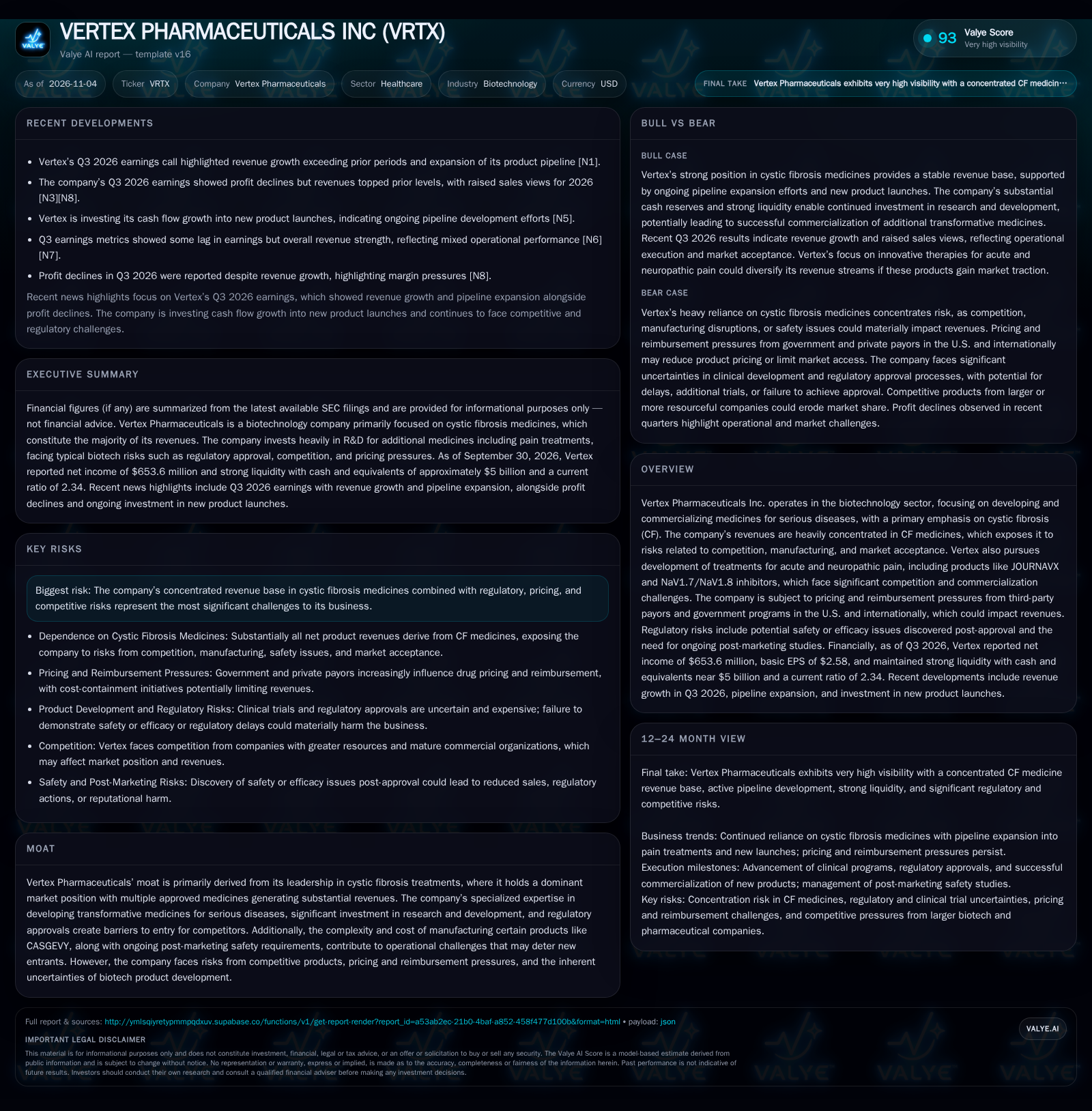
Vertex Pharmaceuticals reported Q3 2026 revenue growth and raised its full-year sales outlook, but profits declined amid margin pressures. The CF franchise still drives the vast majority of revenue, creating both stability and risk. Management is deploying significant resources to expand the pipeline—especially in acute and neuropathic pain—yet faces formidable regulatory, commercialization, and competitive headwinds. Watch for clinical milestones, regulatory decisions, and early commercial indicators from non-CF assets to determine if Vertex can mitigate its single-franchise dependence. [S2] [N1] [N3] [N5] [N8]
Vertex Pharmaceuticals enters late 2026 with its cystic fibrosis franchise still generating the vast majority of revenue, providing a stable—but highly concentrated—foundation for the business. The next 12-24 months will be critical in testing whether Vertex can translate its pipeline into sustainable, diversified growth. [S2] [N1] [N3] [N5] [N8]
CF Franchise Delivers Revenue Growth but Margins Compress as Investment Rises
Vertex’s Q3 2026 results underscore the company’s duality: net income was $653.6 million on higher revenues, with EPS of $2.58, but profit margins declined due to increased investment in new product launches and pipeline activities. The company raised its full-year sales guidance, reflecting continued demand for its cystic fibrosis (CF) therapies, which remain the backbone of its revenue. However, nearly all product revenue still flows from CF, amplifying the company’s vulnerability to any competitive disruption, pricing change, or regulatory challenge in this therapeutic area. This mix of dependable top-line growth and margin compression highlights the company’s current inflection: robust performance from legacy assets, but increasing pressure to deliver on pipeline promises and diversify the revenue base. [S2] [N1] [N3] [N5] [N8]
The interplay between sustained revenue growth and margin compression also reflects broader industry dynamics where innovation cycles necessitate upfront capital deployment before returns can be realized. Vertex’s decision to increase investments during a period of strong legacy product performance indicates a deliberate trade-off: accepting near-term margin pressure to potentially secure long-term competitive advantage through pipeline maturation. This approach underscores the importance of timing and execution risk, as prolonged investment without commensurate pipeline success could strain potential financial flexibility. Moreover, the company must navigate evolving payer expectations, which increasingly demand demonstrable value and real-world outcomes, potentially constraining pricing power even for established therapies.
How Vertex’s Economic Engine Depends on CF and the High Cost of Diversification
Vertex’s business model is defined by the economics of high-value specialty drugs for rare diseases, with CF therapies commanding premium pricing and significant gross margins. The fixed cost base—primarily R&D and regulatory compliance—creates operating leverage as long as CF volumes remain stable or grow. However, the company’s expansion into new therapeutic areas, especially acute and neuropathic pain, introduces both higher variable costs (e.g., complex manufacturing for cell and gene therapies like CASGEVY) and substantial upfront investment in clinical development and launches. While the CF franchise generates strong cash flows that fund these initiatives, the transition to a multi-franchise model could dilute margins if new products require higher commercial spend, face lower pricing power, or achieve slower adoption. The economics of future growth will depend on Vertex’s ability to secure favorable reimbursement, demonstrate clinical differentiation, and scale manufacturing efficiently—none of which are assured given the competitive and regulatory landscape.
A critical consideration in Vertex’s diversification strategy is the scalability of its commercial infrastructure beyond CF. The specialized sales and marketing model that supports rare disease treatments may require significant adaptation to address larger or more heterogeneous patient populations in pain or other indications. This transition could entail higher customer acquisition costs and longer sales cycles, impacting the return on investment for new launches. Additionally, manufacturing complexity and supply chain robustness become more pronounced when introducing novel modalities such as cell and gene therapies, which often involve intricate logistics and stringent quality controls. Success depends not only on clinical efficacy but also on operational excellence and cost containment to preserve margins amid diversification.
Market Leadership in CF and the Challenge of Defending—and Expanding—the Moat
Vertex’s prominent position in CF is underpinned by multiple approved therapies and deep clinical expertise. This has created high barriers to entry in CF, as rivals must overcome established efficacy, entrenched payor relationships, and the company’s ongoing R&D investment. However, the landscape is shifting: competitors in the broader rare disease and pain markets—including large pharmaceutical companies with greater resources and mature commercial infrastructures—are targeting both CF and Vertex’s pipeline indications. Furthermore, pricing and reimbursement pressures from payors, as well as the threat of biosimilars or new modalities (such as gene editing or RNA-based therapies), could erode Vertex’s market share or compress margins. The company’s success in new areas will depend on its ability to replicate the clinical and commercial advantages it enjoys in CF, while defending its core franchise against both direct competitors and disruptive therapeutic approaches.
Defending Vertex’s market leadership also hinges on its ability to anticipate and respond to technological disruption. Emerging modalities like gene editing and RNA therapeutics could redefine treatment paradigms, potentially rendering current CF therapies less relevant over time. Vertex’s internal R&D pipeline and external collaborations must therefore balance incremental innovation with transformative approaches to maintain relevance. Furthermore, payor dynamics increasingly favor outcomes-based contracting and value-based pricing, requiring robust evidence generation and patient engagement strategies. The company’s agility in adapting to these shifts will influence its capacity to sustain pricing power and market share in both its core and emerging franchises.
Pipeline Wins and New Launches Could Transform Vertex’s Revenue Mix
If Vertex achieves pivotal clinical successes in its pain programs (such as JOURNAVX and NaV1.7/NaV1.8 inhibitors), and secures timely regulatory approvals with broad reimbursement, the company could rapidly diversify its revenue base. A successful commercial launch in a large addressable market—especially if paired with premium pricing and strong differentiation over existing treatments—would reduce dependence on CF and unlock operating leverage as fixed costs are spread across a larger portfolio. Confirmation would come from positive late-stage clinical trial readouts, regulatory approvals, early adoption metrics, and evidence of meaningful revenue contribution from non-CF assets. This scenario would likely be accompanied by stabilization or expansion of profit margins as the business scales, and could also improve Vertex’s competitive position by demonstrating platform value beyond its legacy franchise.
CF Franchise Remains Dominant While Pipeline Progress Is Incremental
The most plausible outcome is that Vertex continues to generate the vast majority of its revenues from CF medicines over the next 12-24 months, with pipeline assets in pain and gene editing advancing but not yet contributing meaningfully to the top line. Margins may remain pressured as launch and R&D spend persists, and pricing/reimbursement headwinds offset some CF volume growth. Evidence supporting this scenario would include steady or modestly growing CF sales, incremental clinical progress (such as trial initiations or mid-stage data) in new indications, and ongoing—but not transformative—investment in pipeline development. Falsification would require either a significant competitive shock to CF or a rapid, unexpected commercial success in a new therapeutic area.
CF Concentration Risks Materialize: Competitive, Regulatory, or Pricing Shock Hits Revenue
Vertex’s heavy reliance on CF exposes it to the risk that a single adverse development—such as the approval of a superior competitor therapy, negative post-marketing safety findings, or aggressive reimbursement cuts—could lead to a rapid revenue and earnings decline. In this scenario, pipeline assets may be delayed or fail to achieve approval, and investment in new launches becomes a drag on profitability rather than a source of future growth. Confirming evidence would include a steep drop in CF sales, negative regulatory or safety headlines, or the emergence of a disruptive competitor. Falsification would require continued CF dominance and visible progress toward commercial diversification.
Milestones to Gauge Vertex’s Ability to Escape Single-Franchise Dependency
Late-stage clinical trial results for JOURNAVX and NaV1.7/NaV1.8 inhibitors in pain—if disclosed—would directly test the pipeline’s potential for near-term diversification.
Regulatory decisions and FDA/EMA feedback on non-CF assets, including potential approval timelines and post-marketing requirements.
Quarterly revenue contribution from non-CF products (if disclosed), as a sign of successful commercial launches beyond the legacy franchise.
Any significant shifts in CF product volume, pricing, or reimbursement—especially updates from major payors or government programs.
Progress and outcomes in ongoing post-marketing safety studies for CASGEVY and other advanced therapies.
Updates on competitive product launches in CF or pipeline indications, especially from larger pharmaceutical peers.
Trends in R&D and SG&A spending as a percentage of revenue, which would indicate the sustainability of Vertex’s current investment pace.
Disclaimer: This is research-only, informational analysis and not investment advice. It may include AI-generated interpretation and general industry context. Always verify important details using primary sources.

Comments