
UnitedHealth Group: Testing the Limits of Diversification as Cost Pressures and Strategic Investments Collide
UnitedHealth Group’s latest results spotlight a fundamental tension—robust earnings growth and strategic reinvestment in data analytics, set against rising cost pressures in its core insurance business and a liquidity profile that requires careful management. The company’s diversified model, spanning UnitedHealthcare and the Optum segments, remains both its shield and its primary operational challenge.
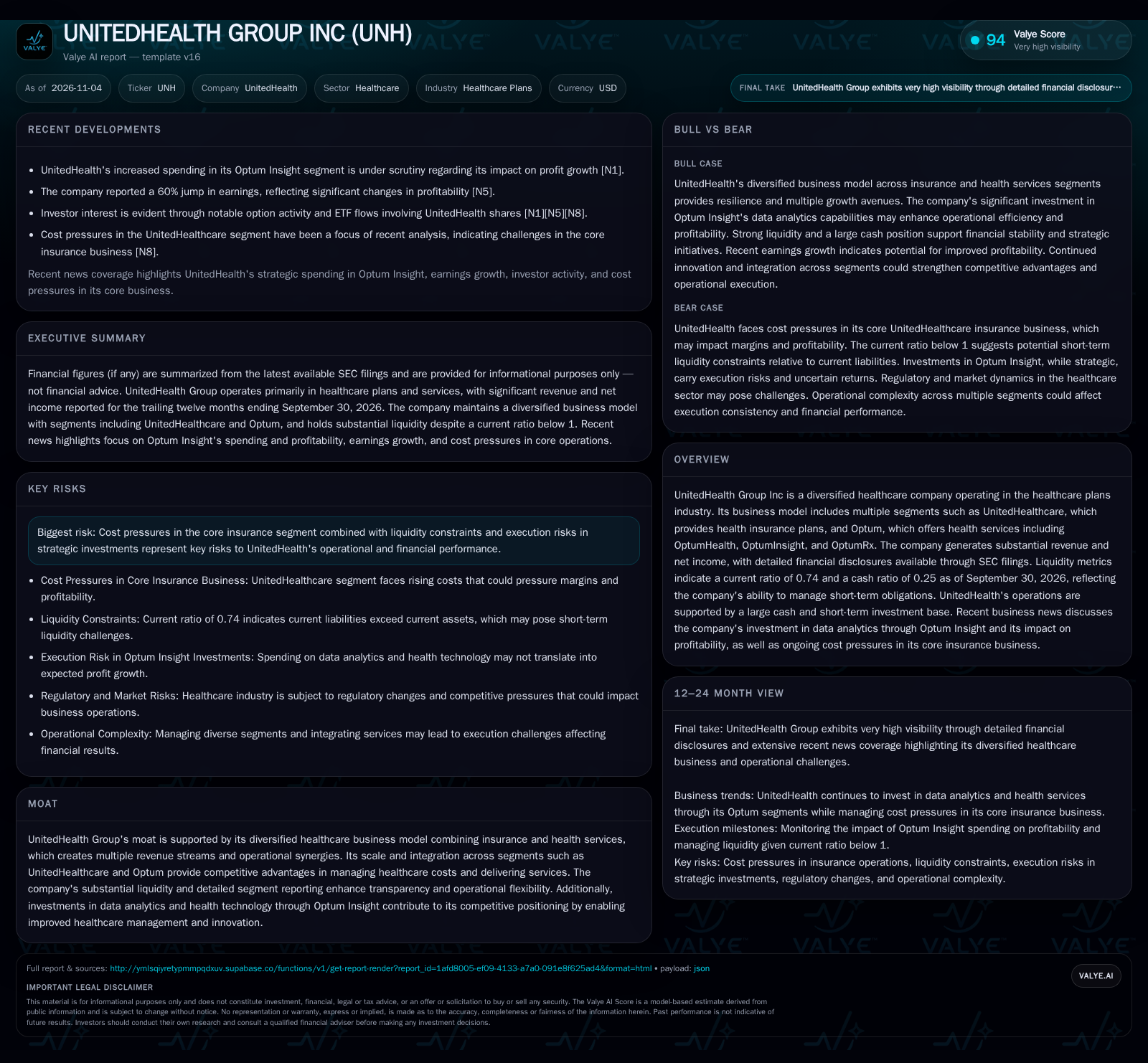
UnitedHealth Group reported $112.7 billion in revenue and $4.11 billion in net income for the trailing twelve months as of September 30, 2026, with a 60% increase in earnings highlighting recent profitability momentum. However, the company faces rising costs in its core insurance operations and is actively investing in Optum Insight’s data analytics capabilities. Liquidity metrics reveal a current ratio below 1, underscoring the importance of short-term financial management. UnitedHealth’s diversified business model offers resilience, but execution risks and operational complexity remain central watchpoints. [S2] [N1] [N5] [N8]
UnitedHealth Group’s most recent financial disclosures and news coverage reveal a company operating at the intersection of robust growth and rising complexity. While a 60% surge in earnings and a substantial cash balance highlight the benefits of scale and diversification, the company’s below-par current ratio and persistent cost pressures in its core insurance business introduce a note of caution. Strategic bets on data analytics through Optum Insight may unlock future efficiency and margin gains—but only if execution risks are managed and the investments translate into tangible returns. The next phase for UnitedHealth is not just about riding momentum, but about proving that its multi-segment model can deliver sustainable profit in the face of mounting sector challenges.
Recent Earnings Growth and Strategic Investments Define the Landscape
UnitedHealth Group reported trailing twelve-month revenue of $112.7 billion and net income of $4.11 billion as of September 30, 2026, with diluted earnings per share of $4.56 [S2]. This period was marked by a 60% jump in earnings, a notable acceleration that puts the company’s profitability in sharp focus [N5]. [S2] [N1] At the same time, cost pressures in the core UnitedHealthcare insurance business remain a structural concern [N8]. Together, these facts frame UnitedHealth’s present as one of high potential but also heightened operational and financial risk.
How UnitedHealth’s Revenue Engines Generate—and Deploy—Cash
UnitedHealth’s business model is built on dual pillars: UnitedHealthcare, which primarily sells health insurance plans, and the Optum segments (OptumHealth, OptumInsight, OptumRx), which deliver health services, prescription management, and data-driven solutions [S2]. Revenue is derived from premiums, service fees, and administrative contracts, with the insurance side typically operating on thin margins and high volumes, while Optum’s service and technology offerings potentially command higher margin profiles if efficiently scaled.
The company’s revenue mix provides some insulation from sector-specific shocks, but also complicates cost management and capital allocation. Fixed costs are significant in both insurance (claims processing, regulatory compliance, provider networks) and health services (technology investment, infrastructure, R&D). As UnitedHealth invests heavily in Optum Insight’s analytics, variable costs may rise in the short term, with the hope of future operating leverage if these platforms enable better claims management, care coordination, and administrative efficiency.
Funding needs are ongoing: despite holding $25.8 billion in cash and equivalents, UnitedHealth’s current liabilities outstrip current assets, as shown by its current ratio of 0.74 [S2]. This necessitates tight working capital management and may limit flexibility for major acquisitions or aggressive reinvestment without further financing. The company’s ability to convert segment investments into higher recurring revenue or lower per-member costs will be a central test of its economic model.
Scale, Integration, and the Challenge from Agile Competitors
UnitedHealth’s main competitive advantages are scale, integration, and data. Its size enables favorable contract negotiation with providers and suppliers, while the integration of insurance and health services creates opportunities for cross-segment synergies—such as using analytics to reduce fraud, optimize care pathways, or improve medication adherence.
However, these same strengths can become liabilities. Operational complexity increases execution risk, especially as new digital health entrants, specialty insurers, and pharmacy benefit managers seek to unbundle components of UnitedHealth’s value chain. Technology-driven competitors may be more agile in deploying analytics or care management tools, challenging UnitedHealth to realize returns on its Optum Insight investments before competitors erode its margin advantage.
Traditional peer groups include large national insurers and health services conglomerates, but the company also faces encroachment from technology firms aiming to disrupt healthcare administration and delivery. The question is whether UnitedHealth can maintain superior scale economics and integrate new technologies fast enough to offset margin compression and regulatory scrutiny.
If Data-Driven Investments Translate into Sustainable Margin Expansion
The bull case for UnitedHealth is that recent heavy investment in Optum Insight’s data analytics platforms leads to measurable improvements in claims management, fraud reduction, and patient outcomes. If these investments yield proprietary insights and workflow automation that lower medical loss ratios or administrative costs, the company could see sustainable margin expansion even as core insurance faces pricing pressure.
Confirmation would come from continued strong earnings growth, margin improvement in both UnitedHealthcare and Optum segments, and disclosure of cost savings or revenue synergies directly attributable to analytics-driven initiatives. Additional evidence would be Optum Insight’s revenue and profit outpacing its historical growth rates, and higher customer retention or new contract wins citing technology leadership.
Falsification would occur if Optum Insight’s spending fails to deliver improved segment margins, or if cost savings are offset by rising claim costs or regulatory headwinds, leaving group margins stagnant or declining.
Diversification Offsets but Does Not Eliminate Margin Pressure
The central scenario sees UnitedHealth’s diversified model providing a buffer against shocks in any one segment. Earnings growth moderates from the recent 60% jump as core insurance cost pressures persist, but Optum’s continued growth and incremental efficiency gains help maintain overall profitability.
Evidence supporting this outcome would be stable or gradually rising group margins, continued investment in Optum without major negative surprises, and a lack of significant regulatory or competitive disruption. Segment disclosures showing balanced performance between UnitedHealthcare and Optum, with neither dominating group results, would also confirm the thesis.
Falsification would come from a sharp deterioration in insurance margins not offset by Optum, or from a liquidity squeeze forcing asset sales, capital raises, or abrupt investment cuts.
When Cost Pressures and Liquidity Constraints Outpace Strategic Gains
The bear case is that cost inflation in the UnitedHealthcare segment—driven by higher medical claims, regulatory changes, or price competition—erodes group margins faster than Optum’s investments can compensate. If Optum Insight’s analytics initiatives fail to produce tangible savings or revenue growth, the company could face a double bind of rising costs and underperforming new ventures.
Operational complexity may further amplify execution risk, with integration challenges leading to cost overruns or service failures.
Downside confirmation would include declining group margins, missed earnings targets, negative cash flow from operations, or the need for emergency capital measures. Regulatory sanctions, large-scale contract losses, or reputational hits from failed technology rollouts would further exacerbate the risk.
What Will Determine Whether UnitedHealth’s Diversification Delivers Profitable Growth?
Margin trends by segment (UnitedHealthcare, OptumHealth, OptumInsight, OptumRx) in future disclosures—especially if Optum Insight’s profitability inflects upward or stalls.
Updates on the impact of Optum Insight’s analytics investments, including any disclosed cost savings, operational efficiencies, or customer wins directly tied to new technology.
Medical loss ratio (MLR) and claims cost progression in UnitedHealthcare—if disclosed, this would show whether cost pressures are being managed or worsening.
Liquidity management steps: changes in current ratio, cash and equivalents, or short-term borrowing activity in future filings.
Regulatory developments affecting reimbursement, plan pricing, or data privacy—any material changes could impact both insurance and health services economics.
Competitive developments—such as new digital health entrants, loss of major contracts, or evidence of customer churn in either insurance or Optum segments.
Execution milestones: any commentary or disclosure around integration of new technologies, segment leadership changes, or project delays/accelerations.
Disclaimer: This is research-only, informational analysis and not investment advice. It may include AI-generated interpretation and general industry context. Always verify important details using primary sources.

Comments