
Transcat’s Calibration Platform: Leveraging Accredited Service Depth and Distribution Breadth for Regulated Markets
Transcat’s dual-segment model—anchored by accredited calibration services and an expansive test equipment distribution network—positions the company to capture recurring demand from highly regulated industries, but integration risks and competitive pressures remain salient as recent acquisitions expand its operational footprint.
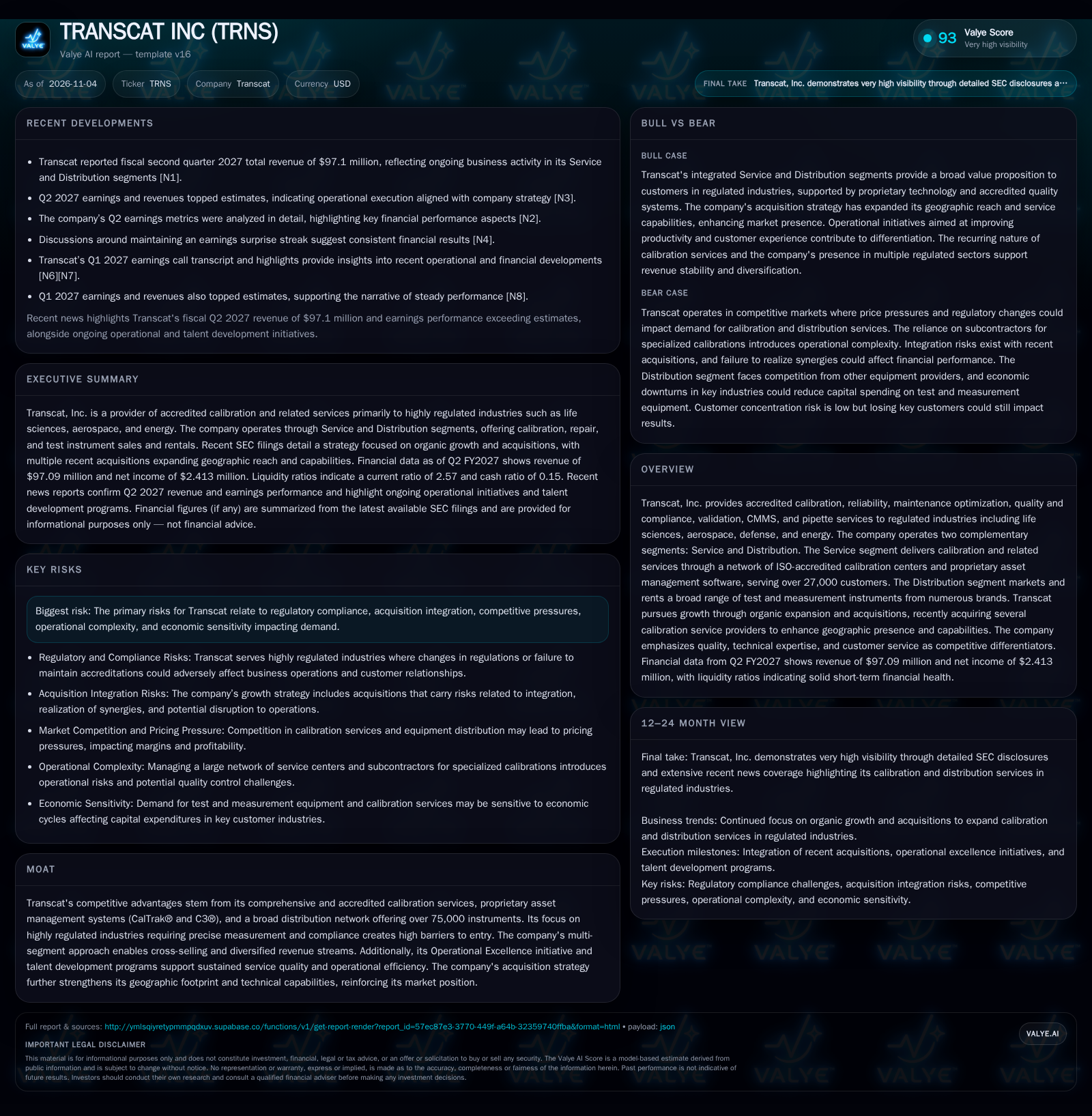
Transcat’s Q2 FY2027 results show continued revenue growth and profitability, underpinned by its Service and Distribution segments. Recent acquisitions extend its reach and technical capabilities, while operational initiatives aim to boost efficiency. The company’s business is diversified across 27,000 customers, with no major concentration risk. The main challenges ahead include integrating new acquisitions, maintaining regulatory compliance, and fending off pricing pressure in a competitive landscape. [S2] [N1] [N3]
Transcat, Inc. sits at the intersection of compliance-driven service and technical distribution, serving highly regulated sectors such as life sciences, aerospace, and energy. Its latest financials reveal ongoing growth and profitability, fueled by both organic initiatives and a steady stream of acquisitions. The company’s ability to cross-sell between its accredited calibration services and a vast catalog of test equipment enables diversified revenue streams and customer stickiness. However, as Transcat expands through new service centers and acquisition-led growth, the challenges of integration, operational complexity, and margin pressure are likely to intensify.
Recent Performance and Expansion: What’s Changed for Transcat in 2026
Transcat reported Q2 FY2027 total revenue of $97.09 million and net income of $2.413 million, demonstrating continued momentum in both its Service and Distribution segments. The company’s recent acquisition streak—including Essco Calibration Laboratory (2025), Martin Calibration (2024), Becnel Rental Tools (2024), and SCM Metrology and Laboratories in Costa Rica (2026)—has broadened its geographic and technical reach, directly contributing to its expanding operational footprint. As of September 2026, Transcat operated 33 calibration service centers across North America and Costa Rica, all ISO/IEC 17025:2017 accredited, and performed over 1.2 million calibrations annually, with 13–15% subcontracted for specialized disciplines. Notably, the company’s customer base is highly diversified, with no single client accounting for more than 3% of revenue, reducing exposure to concentration risk. [S2] [N1] [N3]
Decoding the Economics: Recurring Service, Distribution Margin, and Scale
Transcat’s revenue model hinges on two complementary engines: the Service segment, which delivers accredited, compliance-critical calibration and asset management services, and the Distribution segment, which sells and rents over 75,000 types of test and measurement instruments. Calibration services, especially for life sciences and aerospace, are fundamentally recurring—driven by regulatory mandates for periodic calibration and documentation. This dynamic introduces a degree of revenue predictability and stickiness, though price competition and the need for continual technical accreditation can compress margins.
The Distribution segment’s economics are more transactional and volume-driven, with margins sensitive to product mix (new, used, rental), pricing discipline, and inventory management. Cross-selling opportunities between the two segments may increase customer lifetime value and wallet share, particularly if Transcat can leverage its proprietary asset management platforms (CalTrak® and C3®) to deepen integration into clients’ compliance workflows.
Operating leverage is plausible as the company scales its service center network and integrates acquisitions—fixed costs (accreditation, facility overhead, proprietary software) are spread over a larger revenue base. However, integration costs, the need for specialized talent, and ongoing investments in quality systems moderate the pace of margin expansion. Capital outlays are likely to remain elevated as Transcat invests in new centers, technology, and post-acquisition integration.
How Transcat Stacks Up: Barriers, Substitutes, and the Shape of Competition
Transcat’s core competitive edge lies in its breadth of accredited services, robust proprietary technology (CalTrak®, C3®), and its ability to serve compliance-heavy sectors where calibration is non-negotiable. Accreditation and regulatory know-how create material barriers to entry for smaller or less specialized players, especially in life sciences and aerospace. The company’s geographic reach—now extending into Costa Rica and across North America—enables it to serve multinational clients and support biopharma supply chains.
However, the competitive landscape is fragmented. Niche local calibration providers, large industrial service firms, and global equipment distributors all contest for share. Price is a lever for customers, especially for less specialized calibrations. Technology substitution—a shift toward instrument self-calibration or more automated, digital-first compliance solutions—could gradually erode service demand or compress pricing. Transcat’s cross-segment model allows for some insulation via cross-selling and integration, but commoditization in the Distribution segment and the risk of regulatory or technological shifts remain persistent threats.
What Could Unlock Outperformance: Seamless Integration and Service-Driven Cross-Sell
Transcat’s most compelling upside scenario centers on the successful integration of recent acquisitions, allowing it to leverage scale for both cost efficiencies and expanded cross-selling. If the company can standardize processes across its expanded network—improving throughput, quality, and customer experience—margin expansion is plausible. The proprietary CalTrak® and C3® platforms could become embedded in more customer workflows, increasing switching costs and locking in multi-year service relationships.
This scenario would be confirmed by: accelerating organic revenue growth in the Service segment post-acquisition; rising gross and operating margins; increased attachment rates between Distribution and Service offerings; and customer retention or expansion in regulated sectors. Evidence of successful integration (e.g., cost synergies, unified IT systems, minimal customer disruption) and continued accreditations would further support this thesis.
Sustained Diversification and Steady Execution in a Competitive Market
The most plausible outcome is that Transcat maintains modest growth through a combination of recurring calibration services and steady, if competitive, equipment distribution. The company’s diversified customer base and broad service menu should limit volatility, even if price pressure in both segments persists. Operational Excellence and talent development initiatives may incrementally improve productivity and offset some wage and compliance cost inflation.
Confirmation of this scenario would come from stable revenue growth in both segments, continued profitability, and maintenance of high customer diversification. Margin trends would likely be flat to slightly up, with integration costs from acquisitions partly offset by scale benefits. Any signs of persistent regulatory compliance or integration issues would challenge this middle-path view.
Where It Could Go Wrong: Integration Friction, Margin Squeeze, or Regulatory Slip
The primary downside risks are failed or delayed integration of recent acquisitions, operational complexity overwhelming management bandwidth, or a material regulatory lapse affecting accreditation. Integration failures could lead to elevated costs, service disruptions, or loss of key personnel—undermining both customer trust and profitability. In the Distribution segment, intensifying price competition or a cyclical downturn in capital spending by regulated industries could drive down volumes and margins.
This scenario would be corroborated by: declining margins despite revenue growth; unusually high turnover or customer churn; loss of ISO/IEC 17025:2017 accreditation at major centers; or a spike in integration-related expenses without corresponding revenue uplift. Regulatory or reputational setbacks could also trigger contract losses, especially in life sciences and aerospace.
Milestones and Metrics That Will Shape Transcat’s Next Chapter
Organic revenue growth rate in the Service segment, particularly post-acquisition, as an indicator of integration effectiveness and underlying demand.
Gross and operating margin trends, especially whether margin expansion materializes as scale and efficiency initiatives are executed.
Attachment rates between Distribution and Service segments—i.e., growth in cross-sold contracts or bundled customer relationships, if disclosed.
Retention rates and expansion among regulated-industry customers, particularly in life sciences and aerospace.
Accreditation status and any regulatory findings for major service centers, as a litmus test for compliance discipline.
Integration cost disclosures and synergy realization updates following recent acquisitions.
Turnover or retention of key technical personnel, since talent depth is critical to service quality and accreditation.
Capital expenditure and investment intensity, as a signal of ongoing network expansion or technology upgrades.
Disclaimer: This is research-only, informational analysis and not investment advice. It may include AI-generated interpretation and general industry context. Always verify important details using primary sources.

Comments