
Versant Media Group: Independence, Digital Growth, and the Decline of Linear TV
Versant Media Group’s post-Comcast independence brings both operational challenges and digital opportunity. With declining linear revenues and new standalone costs, success will hinge on the pace of digital platform expansion and the company’s ability to offset core declines while managing the risks of separation.
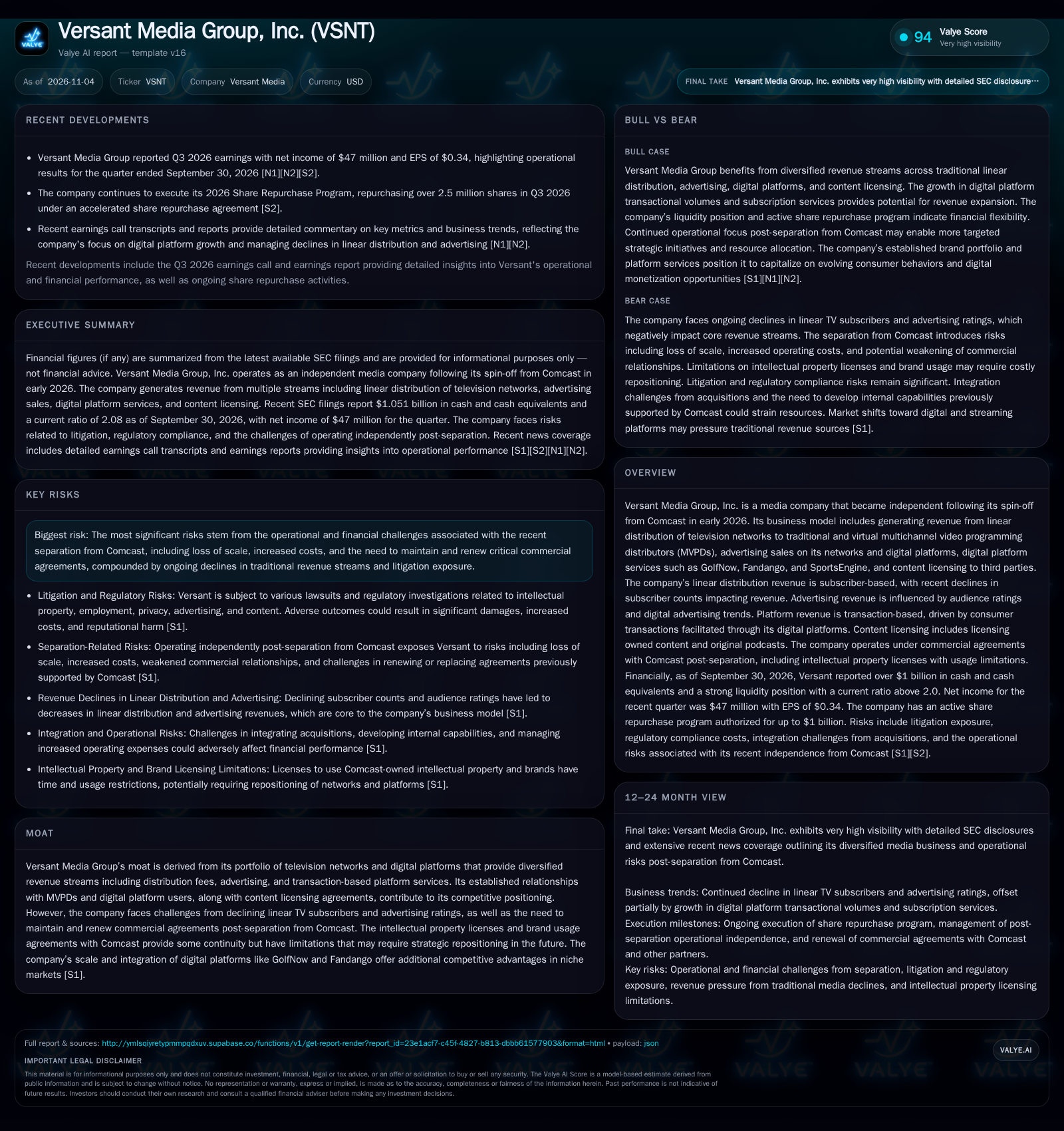
Versant Media Group, newly independent from Comcast, faces declining linear TV and advertising revenues but shows cash generation and digital growth. The company’s ability to expand platforms like GolfNow and Fandango, manage standalone costs, and renew critical agreements will determine whether digital momentum can outpace legacy erosion and separation-related risks [S1] [S2] [N1] [N2].
Versant Media Group’s emergence as a standalone entity after its 2026 spin-off from Comcast marks a pivotal transition for the storied media portfolio. While the separation brings new autonomy and capital allocation levers, it also exposes the company to the full brunt of secular linear TV declines, rising standalone costs, and the need to rapidly scale digital initiatives to plug the revenue gap. Versant’s Q3 2026 results reflect this tension: profitability and cash flow remain positive, but legacy businesses are eroding faster than digital platforms can compensate. The company’s next chapter will be defined by its ability to accelerate digital growth, manage separation risks, and maintain commercial relationships under new constraints [S1] [S2] [N1] [N2].
Versant’s Financial Health Post-Independence
As of September 30, 2026, Versant Media Group reported $1.051 billion in cash and cash equivalents, a current ratio of 2.08, and net income of $47 million for the quarter—down from $80 million a year earlier. Quarterly revenue was $1.59 billion, reflecting ongoing declines in linear distribution and advertising, only partially offset by digital platform growth [S2] [N1] [N2]. The company’s standalone status since January 2026 has introduced higher operating costs and a reliance on new commercial agreements with Comcast, including time-limited intellectual property licenses [S1]. Versant has also executed accelerated share repurchases, totaling over 2.5 million shares in Q3 2026 [S2]. These developments matter because they illustrate both the financial resilience provided by cash generation and the mounting headwinds from structural revenue declines and incremental standalone expenses.
Examining Revenue Streams and Digital Growth Challenges
Versant’s revenue model spans four segments: linear TV distribution fees, advertising (linear and digital), digital platform services (notably GolfNow, Fandango, and SportsEngine), and content licensing [S1]. Linear distribution remains material but is in secular decline, with revenue tied to per-subscriber fees and total MVPD subscriber counts—a headwind as cord-cutting accelerates. Advertising revenue is split between linear (dependent on ratings and CPMs, both under pressure) and digital, which is growing but from a smaller base.
Digital platform services operate on a transaction-fee basis, benefiting from volume growth in online bookings, ticketing, and youth sports sign-ups. These businesses typically feature higher gross margins and lower capital intensity compared to legacy TV, but require substantial investment in technology, marketing, and customer acquisition to scale. Content licensing provides some annuity-like revenue, but is subject to the vagaries of demand from streaming partners and the periodic renegotiation of rights.
The company’s cost structure has shifted post-spin: Versant now bears the full cost of corporate functions previously provided by Comcast, including IT, HR, legal, and finance, raising SG&A as a percentage of revenue [S2]. Operating leverage is thus challenged, with cost reductions in legacy businesses unlikely to keep pace with revenue loss. The question is whether digital growth can reach sufficient scale and profitability before legacy declines overwhelm group margins.
Brand Strength and Platform Uniqueness Amid Scale Pressures
Versant’s competitive position rests on its portfolio of recognized networks and digital platforms, longstanding relationships with MVPDs, and established digital brands in golf and entertainment [S1]. In the linear TV segment, the company faces entrenched competition from other cable network operators and must contend with growing consumer preference for direct-to-consumer streaming and on-demand content. Switching frictions for MVPDs are modest, as carriage negotiations increasingly hinge on ratings and unique content.
In digital platforms, Versant’s assets such as GolfNow and Fandango compete in niche verticals but must fend off both legacy competitors and digital-native startups. The company’s ability to cross-promote, leverage data, and offer integrated experiences could provide some moat, but these advantages are counteracted by the need to continually invest in user experience and platform reliability. Content licensing pits Versant against major studios and digital-first content creators—success depends on the distinctiveness and timeliness of its content library.
The expiration or limitation of intellectual property licenses from Comcast is a looming issue: if Versant cannot secure long-term rights to key brands or content, it may face costly rebranding or loss of audience trust. Overall, the company’s competitive advantages are real but eroding; long-term differentiation will depend on the speed of digital innovation and the stickiness of its platform services.
Potential for Digital Growth to Surpass Legacy Losses
A favorable scenario for Versant hinges on accelerating the growth of its digital platforms to the point where they not only offset legacy declines but drive overall revenue and margin expansion. If GolfNow, Fandango, and SportsEngine can consistently grow transaction volumes, improve take rates, and expand into new geographies or adjacent services, the company could achieve higher-margin, recurring revenue streams less vulnerable to secular TV trends.
Such a scenario would be confirmed by successive quarters of digital platform revenue growth outpacing the rate of linear and advertising decline, expansion in digital user metrics (e.g., monthly active users, bookings, ticket sales), and improving group EBITDA margins even as linear shrinks. Evidence would include successful renegotiation or extension of key intellectual property licenses, the launch of new digital products, and the ability to attract new advertising partners to digital inventory.
Falsification of this scenario would come from stagnating or declining digital platform metrics, inability to renew critical content rights, or persistent group margin compression despite digital efforts.
Expected Trends in Revenue and Market Position
The most plausible scenario for Versant over the next 12-24 months is gradual erosion of group profitability and cash flow as legacy TV and advertising revenues decline faster than digital can grow. Digital platforms will likely provide some offset, but not enough to fully replace lost high-margin linear dollars in the near term. Operating costs will remain elevated due to standalone corporate expenses and the need for continued investment in digital capabilities.
This scenario would be confirmed by continued, but moderate, digital revenue growth alongside steady declines in subscriber-based and linear ad revenue, with group EBITDA margins compressing but remaining positive. Key evidence would include stable or slightly declining cash flow from operations, ongoing share repurchases (signaling management’s belief in underlying value), and partial renewal of commercial agreements with Comcast and other partners.
Falsification would require either a sharp reversal in digital momentum, a major cost shock from litigation or regulatory issues, or an unexpected recovery in linear TV economics—which appears unlikely.
Risks from Separation and Digital Strategy Execution
In a more adverse scenario, Versant could face accelerating declines in linear and advertising revenue without sufficient digital growth to compensate. If digital platforms plateau or face new competitive threats, and the company struggles to renew or extend key intellectual property and brand licenses from Comcast, Versant could be forced into costly rebranding or lose customer relationships.
Standalone cost inflation, integration missteps, or adverse outcomes in litigation or regulatory matters could further erode profitability. The most severe risk is a negative feedback loop: declining revenues force cost cuts that undermine digital product quality, leading to further user attrition and competitive losses. Liquidity could become constrained if cash flow turns negative and share repurchases continue unabated.
Evidence confirming this scenario would include several quarters of accelerating revenue decline, margin compression to breakeven or loss, negative cash flow from operations, and negative news on litigation, regulatory, or IP renewal fronts. Falsification would require stabilization in core revenues or a surprising acceleration in digital platform growth.
Indicators of Versant’s Ability to Counter Legacy Declines
Quarterly revenue breakdown among linear distribution, advertising (linear vs digital), platform services, and content licensing; digital growth rate vs. legacy decline would help test the offset thesis.
Trends in digital platform user metrics—monthly active users, transactions/bookings, and take rates for GolfNow, Fandango, and SportsEngine (if disclosed)—to assess digital scale and engagement.
Progress on renewal or extension of key intellectual property and brand licenses from Comcast, including any disclosures on timing, cost, and restrictions.
Updates on the share repurchase program: pace, total shares repurchased, and management commentary on capital allocation priorities.
Cash flow from operations and changes in working capital, to evaluate underlying business health amid revenue mix shifts.
Litigation and regulatory developments, particularly any material settlements or new investigations that could impact financials or strategic focus.
Any disclosures on SG&A trends, standalone cost management, or restructuring charges as the company adapts to life outside Comcast.
Material digital product launches, partnerships, or acquisitions that could accelerate platform growth or diversify revenue streams.
Disclaimer: This is research-only, informational analysis and not investment advice. It may include AI-generated interpretation and general industry context. Always verify important details using primary sources.

Comments