
Summit Hotel Properties: Dividend Strategy and Leadership Transition in a Volatile Hotel REIT Market
The central question is whether operational momentum and capital discipline can offset sector headwinds and profitability pressures.
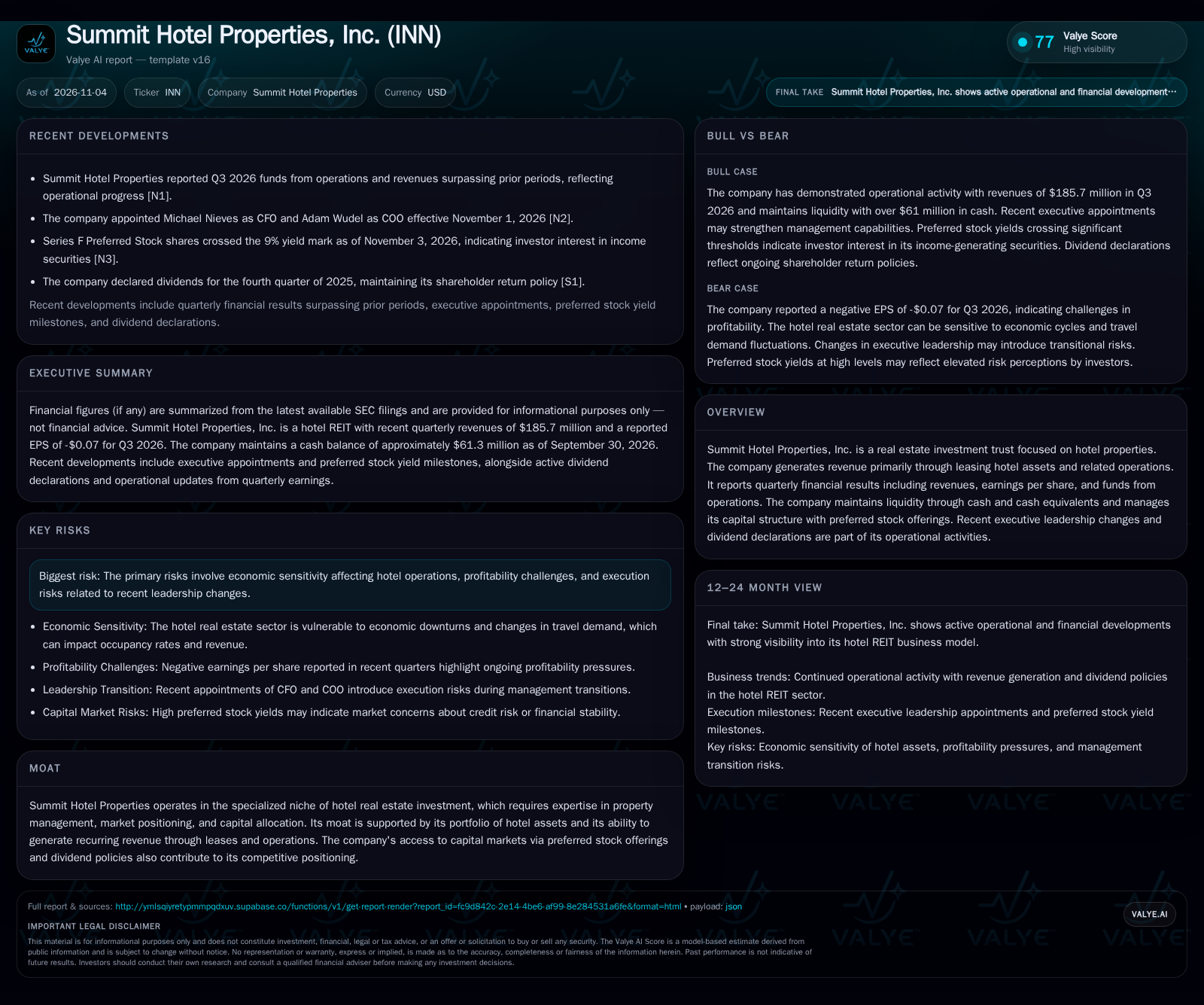
Summit Hotel Properties reported Q3 2026 revenues of $185.7 million and an EPS of -$0.07, reflecting ongoing profitability challenges despite top-line growth. Recent executive appointments and high preferred stock yields highlight both transition risks and investor caution. The company’s ability to maintain dividends and capitalize on operational momentum will be tested amid a sensitive hotel REIT landscape.[S2] [N1] [N2] [N3]
Summit Hotel Properties, a hotel-focused REIT, finds itself at a strategic crossroads as it juggles steady revenue growth, persistent profitability challenges, and a recent leadership transition. With quarterly revenues topping prior periods but earnings per share still negative, the company’s financial picture is mixed. Meanwhile, a spike in preferred stock yields and fresh CFO/COO appointments point to both market caution and the potential for operational reset. [S2] [N1] [N2] [N3] [S1]
Recent Financials and Leadership Changes Shape Strategic Outlook
Summit Hotel Properties reported Q3 2026 revenues of $185.7 million, outpacing prior periods and signaling ongoing operational activity in its hotel REIT portfolio.[S2] [N1] Despite this, the company posted a basic and diluted EPS of -$0.07, highlighting persistent profitability challenges. [S2] [N2] [N3]
How Revenue Streams and Capital Structure Define Value Creation
Summit Hotel Properties generates revenue primarily through leasing hotel assets and related operational activities. The core earnings engine is hotel occupancy and room revenue, which are inherently cyclical and sensitive to macroeconomic and travel trends. Lease agreements include both fixed and variable components, with some indexed to revenue or inflation, providing partial protection against cost increases but also exposing the company to demand shocks.[S2]
Operating leverage is a double-edged sword: fixed property costs mean incremental revenue can drive margin expansion in good times, but revenue declines can quickly erode profitability—as evidenced by the company’s negative EPS despite revenue growth.[S2]
Capital needs are ongoing, both for property maintenance and periodic upgrades to remain competitive. The REIT structure requires distribution of a significant portion of taxable income as dividends, constraining retained cash for reinvestment. Preferred stock, such as the Series F with a current yield above 9%, is a key funding lever, but high yields increase future capital costs and may signal market concerns about risk or dilution potential.[N3]
The interplay between fixed and variable lease components introduces nuanced risk management considerations for Summit. While fixed rents provide predictable baseline cash flows, variable or indexed rents align revenue with inflationary pressures, potentially preserving real income during cost escalations. However, in periods of demand contraction, reliance on variable rents can exacerbate revenue volatility. This duality necessitates sophisticated forecasting and scenario planning to balance cash flow stability against upside participation in favorable market conditions. Additionally, the capital structure's layering of common equity, preferred equity, and debt requires careful calibration to optimize the weighted average cost of capital while maintaining reported liquidity position buffers for cyclical downturns.
Navigating the Crowded Hotel REIT Arena
Summit operates within a highly competitive hotel real estate investment trust sector, vying with both specialized hotel REITs and diversified real estate investment vehicles. Competitors range from pure-play upscale and select-service hotel owners to larger diversified REITs with broader geographic and brand portfolios. Sector peers such as Ryman Hospitality Properties and VICI Properties have also reported recent financial results, reflecting industry-wide scrutiny on operational performance and capital discipline.[N4] [N6]
Competitive advantages for Summit may include geographic or brand concentration, operational expertise, and relationships with hotel operators, but these are offset by the sector’s low switching costs for asset buyers and the commoditized nature of hotel rooms for consumers. Real estate cycles, local market supply/demand imbalances, and sensitivity to travel trends all create headwinds. While recurring revenue from leases and third-party tenant income offers some stability, true pricing power is limited by competitive rate pressures and the need to maintain high occupancy.
Access to capital markets, as seen in the use of preferred stock and dividend policies, is vital for maintaining asset quality and funding growth. However, elevated preferred yields suggest that Summit is not enjoying a clear cost-of-capital advantage over peers, potentially constraining growth or asset repositioning options if market conditions worsen.[N3]
Summit's competitive positioning is further influenced by its portfolio composition and operator partnerships, which can affect both revenue resilience and cost efficiency. Concentration in markets with strong tourism fundamentals or limited new supply can insulate against oversaturation risks, whereas geographic or brand concentration may increase vulnerability to localized economic shocks or brand-specific demand shifts. Moreover, operational alignment with hotel operators, including incentive structures and service level agreements, can materially impact margin outcomes. The commoditization of hotel assets underscores the importance of differentiating through asset quality, customer experience, or ancillary revenue streams to sustain occupancy and pricing power amid intense competition.
Operational Turnaround and Capital Discipline Drive Value Realization
A favorable scenario for Summit would see new leadership successfully implementing operational improvements—such as cost controls, targeted renovations, or portfolio optimization—that translate revenue growth into sustained profitability. If travel demand remains robust and occupancy recovers to or exceeds pre-pandemic levels, operating leverage could magnify incremental gains, flipping EPS positive and supporting dividend growth.
Confirmation would come from sequential improvement in FFO (funds from operations), narrowing or reversing negative EPS, and management commentary on margin expansion or successful asset repositioning. A decline in preferred stock yields, reflecting reduced risk perception, would further validate the upside case, as would the ability to maintain or raise dividends without erosion of balance sheet strength.[N1] [N3] [S1]
Additional upside could materialize if Summit leverages its liquidity and capital markets access to acquire distressed or undervalued assets, provided integration is disciplined and does not dilute returns.
In addition to operational enhancements, strategic capital allocation decisions could amplify value creation. For instance, prioritizing investments in high-return renovations or technology upgrades that improve guest satisfaction and operational efficiency may yield compounding benefits. Furthermore, selective asset dispositions of underperforming or non-core properties could bolster balance sheet strength and redeploy capital into higher-growth opportunities. These moves, coupled with transparent communication of a coherent capital allocation framework, can enhance investor confidence and potentially narrow the yield premium on preferred stock. The new leadership’s ability to articulate and execute a clear strategic vision will be pivotal in unlocking this potential.
Incremental Improvement Amid Sector Headwinds
The most plausible trajectory is gradual operational progress: revenues remain stable or grow modestly on the back of steady travel demand, but profitability is slow to recover due to persistent cost pressures and competitive rate dynamics. New executive leadership may focus on incremental improvements—tightening cost controls, optimizing the portfolio, or modestly enhancing margins—yet sector volatility and macroeconomic headwinds limit the speed and scale of recovery.
In this scenario, Summit continues to declare regular dividends, supported by FFO, but payout growth is limited until EPS turns positive. Preferred stock yields remain elevated, reflecting lingering market caution, and the company’s access to lower-cost capital is constrained. Evidence supporting this scenario would include stable or slightly improving FFO, continued negative or marginally positive EPS, and management communications focused on cost discipline and risk management.[S2] [N1] [N3]
Profitability Pressures and Cost of Capital Risks Escalate
A negative scenario would unfold if travel demand softens—due to recession, geopolitical events, or sector oversupply—leading to declining occupancy and room rates. In this environment, Summit’s fixed costs would drive further EPS deterioration, potentially forcing dividend cuts or suspension to preserve cash. High preferred stock yields would signal rising risk aversion, increasing future capital costs or limiting access to additional funding.[S2] [N3]
Execution missteps during the CFO/COO transition—such as delayed cost actions, failed repositioning efforts, or asset impairments—could amplify downside risks. Confirmation of this scenario would come from sequential revenue declines, widening losses, dividend reductions, or adverse commentary on liquidity and capital allocation.
What Could Shift the Thesis for Summit Hotel Properties
Sequential FFO (funds from operations) trends—sustained improvement would signal operational momentum; deterioration would flag risk to dividends and balance sheet health. [N1]
EPS trajectory—movement from negative toward breakeven or positive EPS would indicate successful margin expansion or cost controls. [S2]
Preferred stock yield levels—declining yields would suggest reduced market risk perception; persistent elevation would indicate ongoing caution or capital cost headwinds. [N3]
Occupancy and average daily rate (ADR) metrics—if disclosed, these would provide granular insight into core portfolio health and pricing power.
Execution of leadership transition—management commentary and strategic actions by the new CFO/COO team will be critical in assessing execution risk. [N2]
Access to external capital—successful refinancing or new capital raises at reasonable terms would demonstrate market confidence and support for future asset investment or acquisition.
Disclaimer: This is research-only, informational analysis and not investment advice. It may include AI-generated interpretation and general industry context. Always verify important details using primary sources.

Comments