
Tenable’s AI-Driven Exposure Management: Can Recurring Revenue and Innovation Sustain Competitive Momentum?
Tenable Holdings’ recent financial results reflect both operational execution and the market’s appetite for advanced cybersecurity solutions. The company’s strategic pivot to AI-led exposure management platforms, strong Q3 profitability, and resilient cash position set the stage for a nuanced debate: can Tenable maintain its growth trajectory amid intensifying competition and evolving customer demands?
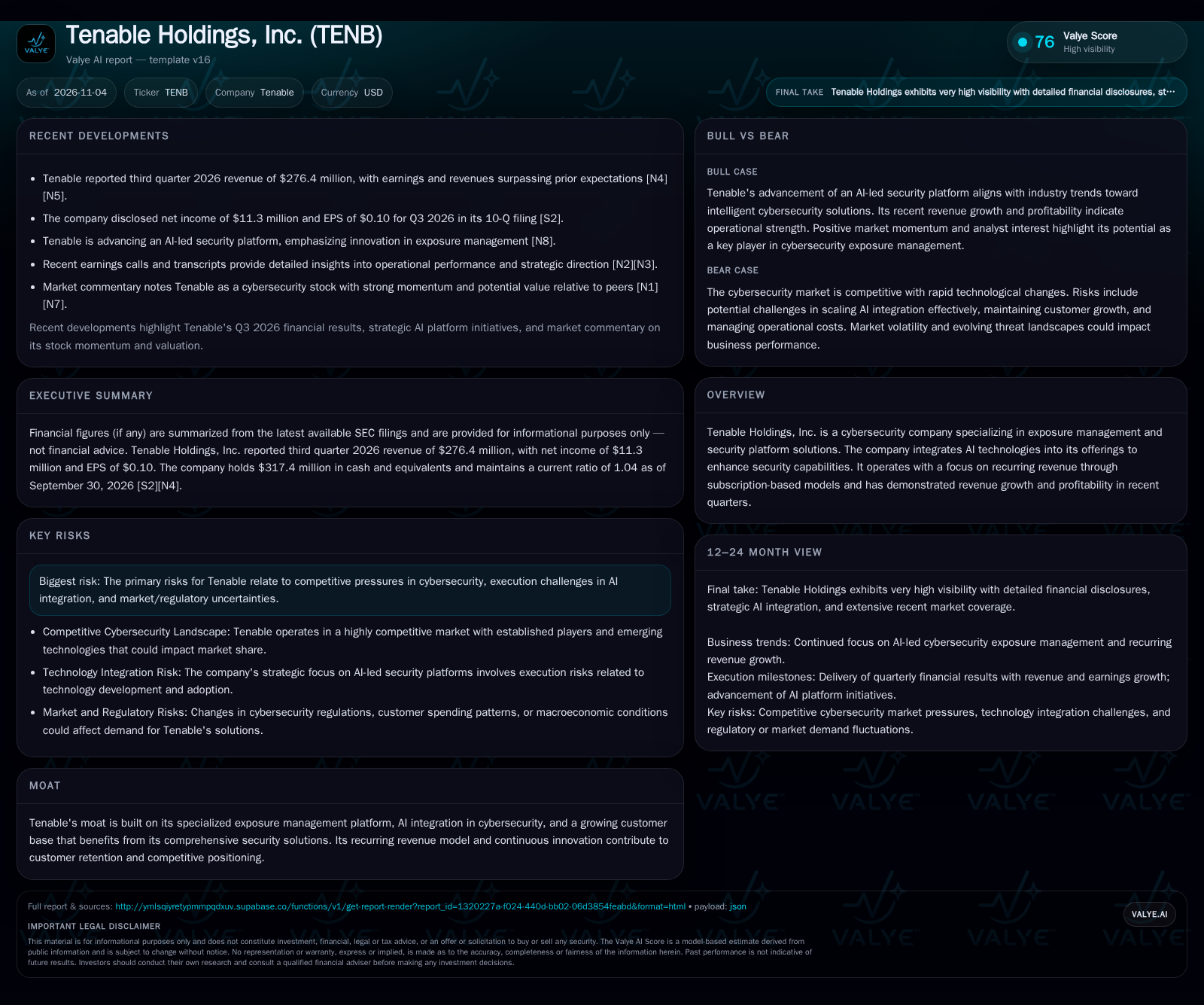
Tenable Holdings reported Q3 2026 revenue of $276.4 million and net income of $11.3 million, outperforming expectations and highlighting operational momentum [N4] [N5] [S2].
Tenable Holdings enters late 2026 with a blend of operational achievement and strategic ambition. The company’s robust third-quarter results—surpassing expectations both in revenue and net income—signal effective execution in a crowded cybersecurity market. Yet, Tenable’s true test lies ahead: as it doubles down on AI-driven exposure management and a subscription-centric business model, it must navigate intensified competition, technology integration challenges, and shifting customer priorities. The coming quarters will reveal whether its innovation engine can continue to translate into durable growth and margin expansion.
Recent Financials and Strategic Initiatives Redefine Tenable’s Position
Tenable Holdings reported third quarter 2026 revenue of $276.4 million, with net income of $11.3 million and EPS of $0.10, exceeding prior expectations and reinforcing the company’s operational momentum [N4] [N5] [S2]. The company’s cash and equivalents stood at $317.4 million, alongside $177.9 million in short-term investments, resulting in a current ratio of 1.04 as of September 30, 2026 [S2]. This provides a measure of near-term financial stability, although it does not by itself guarantee long-term flexibility. Tenable’s explicit push toward an AI-led security platform marks a strategic pivot aimed at strengthening its value proposition in exposure management and aligning with broader industry trends [N8]. Together, these developments indicate that Tenable is executing well in the present while positioning itself for the next phase of cybersecurity innovation.
Economic Drivers: Subscription Revenue, Platform Leverage, and Margin Potential
Tenable’s core business model relies on recurring revenue from subscription-based cybersecurity solutions, especially within its exposure management platform. Recurring revenue offers advantages in revenue visibility and customer retention, a critical differentiator in the cybersecurity sector where long-term relationships can mitigate customer acquisition costs and reduce churn risk. The integration of AI technologies could enhance both the value delivered per customer and operational efficiency, potentially driving higher average contract values and margin improvement if adopted at scale.
However, the economics of AI integration are nuanced. While automation and intelligent threat detection may allow for premium pricing or cross-sell opportunities, the upfront investment in R&D, cloud infrastructure, and talent can pressure margins in the near term. Operating leverage is plausible if growth in platform adoption outpaces incremental fixed costs, but this is contingent on successful customer uptake and the ability to maintain pricing discipline amid competitive pressure. Capital needs are moderate, given the company’s current cash and investment balances, but sustained investment in innovation and customer success will remain necessary to defend and expand its market position.
Defending Share in a Fragmented and Fast-Evolving Cybersecurity Market
Tenable operates in an intensely competitive environment, facing established enterprise security vendors, emerging cloud-native platforms, and niche specialists in vulnerability and exposure management. Its moat is predicated on a blend of proprietary exposure management technology, AI-led innovation, and a growing installed base. The company’s focus on integrating artificial intelligence into its platforms could create differentiation via superior detection, remediation, and analytics capabilities.
Counterforces are formidable. Large incumbents in cybersecurity have deep customer relationships, broad product portfolios, and the resources to emulate or outspend on AI initiatives. Meanwhile, new entrants and best-of-breed SaaS vendors can innovate rapidly or undercut pricing. Customer switching frictions in cybersecurity are real but not insurmountable—platform stickiness depends on proven efficacy, integration with existing IT stacks, and ongoing support. The question is whether Tenable’s current innovation cadence and customer experience will be enough to offset price and feature competition in a market where buyers are increasingly sophisticated.
AI Integration Drives Higher Retention and Expanding Wallet Share
A favorable trajectory for Tenable would see its AI-driven exposure management platform gaining traction across both existing and new enterprise clients. If the company can demonstrate tangible improvements in threat detection, risk prioritization, and remediation speed, customers may expand their platform usage, leading to higher net retention and upsell rates. Successful AI integration could also justify premium pricing or new tiered offerings, driving revenue growth above sector averages.
Evidence that would confirm this scenario includes sustained acceleration in subscription revenue growth, rising average contract values, and improvements in gross or operating margins owing to automation efficiencies. Additional proof points would be large enterprise customer wins, public reference accounts, and third-party validation of AI capabilities. Conversely, if customer growth slows or AI features fail to drive meaningful adoption or pricing power, the upside case would weaken.
Subscription Growth Continues, but Margin Expansion Remains Measured
The most plausible outcome is that Tenable continues to grow its recurring revenue base, leveraging its exposure management platform and gradual AI enhancements to retain and modestly expand its customer footprint. Revenue growth outpaces the market average, but margin expansion is incremental as the company balances continued investment in technology with competitive pricing pressures.
Confirmation of this scenario would come from steady increases in subscription and total revenue, stable or slightly improving operating margins, and consistent renewal rates. Falsification would involve meaningful deceleration in top-line growth, deteriorating margins due to cost pressures or discounting, or signs that AI-led initiatives are not resonating with core enterprise buyers.
Competitive Pressures and AI Execution Risks Erode Growth and Profitability
A less favorable scenario unfolds if Tenable’s AI-led strategy fails to differentiate its offerings, leading to stagnant or declining customer additions and heightened margin pressure. Established competitors may accelerate their own AI rollouts, narrowing the perceived technology gap, while price competition intensifies. If customers view Tenable’s innovation as incremental or hard to integrate, switching costs diminish and churn risk rises.
Downside confirmation would be signaled by slowing or negative revenue growth, shrinking gross or operating margins, or negative net retention trends. Additional warning signs would include elevated R&D or sales and marketing expenses without corresponding revenue leverage, or customer feedback citing insufficient differentiation. Execution missteps in AI productization or integration could further amplify these risks.
Testing Tenable’s Strategic Execution: Metrics and Developments That Matter Most
Subscription revenue growth rate: Sustained acceleration or deceleration in recurring revenue will be a direct indicator of platform adoption and customer retention, if disclosed.
Gross and operating margin trends: Improvements or declines in profitability will reflect the success of AI integration and operating leverage.
Net retention and upsell rates: A useful metric would be net retention, capturing the ability to expand wallet share within the existing customer base.
Enterprise customer additions: The pace and quality of new enterprise wins will test the company’s competitiveness and market relevance.
AI-driven product adoption: Evidence of customers migrating to or expanding usage of AI-enabled features would help confirm the thesis.
R&D and sales/marketing expense as a percent of revenue: Monitoring these ratios will provide insight into the efficiency and scalability of Tenable’s growth investments.
Customer feedback and third-party validation: Independent reviews, customer satisfaction surveys, or industry analyst reports would help assess whether Tenable’s AI-led platform is perceived as differentiated.
Competitive announcements or pricing moves: New product launches or aggressive pricing from rivals could signal intensifying market pressure and test Tenable’s moat.
Disclaimer: This is research-only, informational analysis and not investment advice. It may include AI-generated interpretation and general industry context. Always verify important details using primary sources.

Comments