
Sixth Street Specialty Lending: Navigating Regulatory Headwinds and Shareholder Value Tools in the BDC Arena
Sixth Street Specialty Lending, Inc. (TSLX) continues to generate positive net income, outperforming recent quarterly expectations, while managing the complexities of dilution risks, regulatory scrutiny, and operational dependency on external systems. Its strategic use of share repurchases and dividend reinvestment underscores a deliberate approach to shareholder value, but persistent external and structural risks could shape the durability of its competitive position.
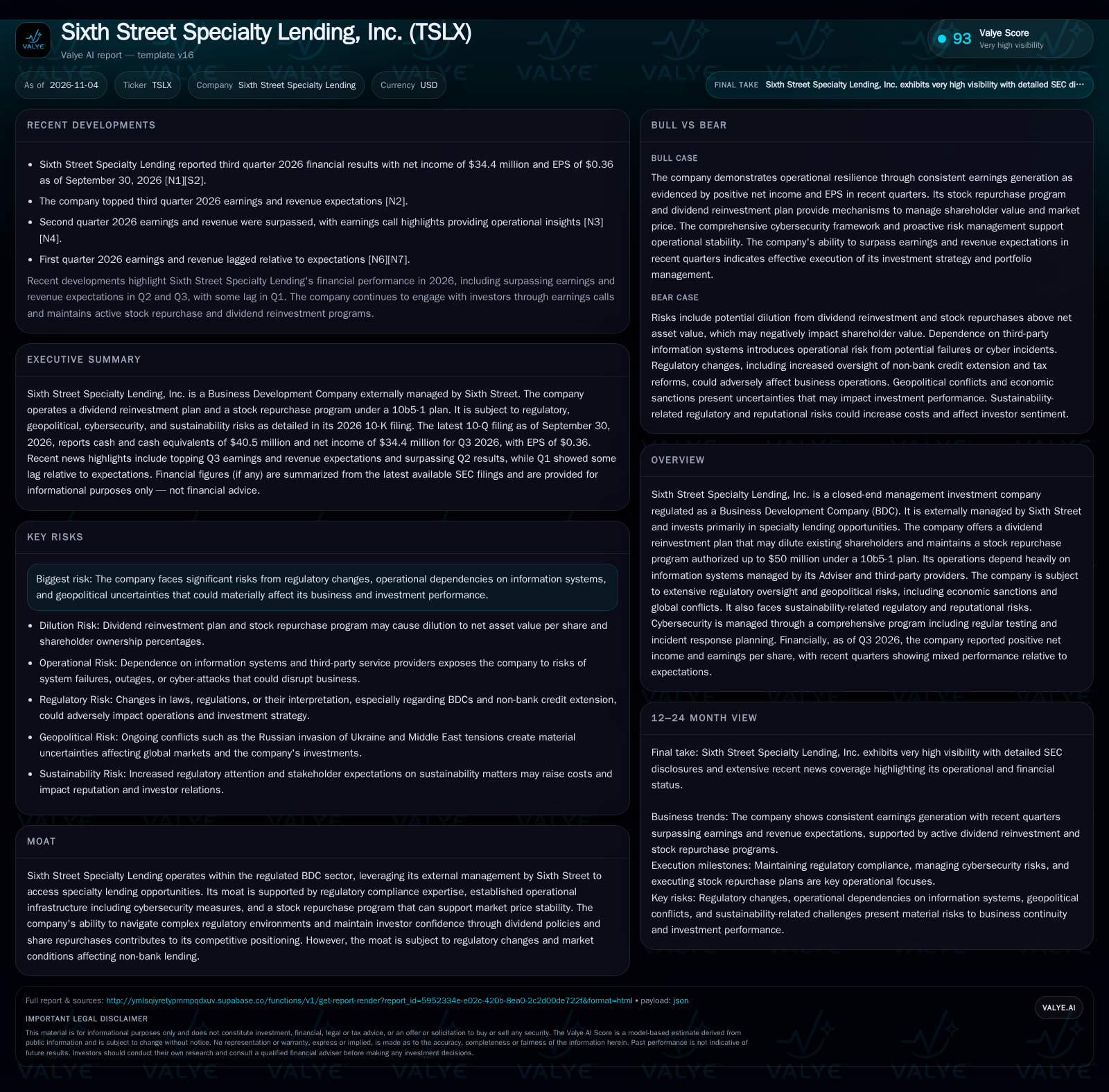
Sixth Street Specialty Lending posted positive net income and exceeded Q3 2026 expectations, leveraging stock repurchases and a dividend reinvestment plan to influence shareholder value. However, the company’s performance is intertwined with regulatory, operational, and geopolitical risks, with dilution and external system dependencies representing material uncertainties for investors. Its ability to sustain above-expectation earnings will depend on navigating these headwinds and maintaining disciplined portfolio and risk management practices. [S2] [N2]
Sixth Street Specialty Lending, Inc. (TSLX) stands out in the BDC sector for its recent streak of outperforming quarterly expectations, reporting $34.4 million in net income and $0.36 EPS for Q3 2026. Yet this operational momentum is set against a backdrop of complex risks: dilution from capital actions, reliance on third-party systems, and evolving regulatory and geopolitical headwinds. The company’s ability to sustain premium earnings and manage shareholder value will hinge on its navigation of these multifaceted pressures, as well as its ongoing execution of risk and portfolio management strategies. [S2] [N2]
Recent Results and Value Tools Set the Stage for Strategic Choices
Sixth Street Specialty Lending reported $34.4 million in net income and $0.36 earnings per share for Q3 2026, exceeding analyst expectations for both earnings and revenue. This marks a rebound from a weaker first quarter and sustains the company’s pattern of quarterly outperformance in 2026. The company holds $40.5 million in cash and cash equivalents as of September 30, 2026. Beyond headline earnings, TSLX is actively managing capital structure through a $50 million stock repurchase program under a 10b5-1 plan, and operates a dividend reinvestment plan—both mechanisms that can influence market price and shareholder value, but also introduce dilution risks if not carefully managed. [S2] [N2] [S1]
How TSLX’s Lending Model Converts Risk into Shareholder Returns
As a Business Development Company (BDC), Sixth Street Specialty Lending primarily generates revenue through interest income and fees from its portfolio of specialty loans to middle-market companies. The company’s externally managed structure means a portion of income is paid out in management and incentive fees, while regulatory requirements mandate that most taxable income be distributed as dividends. This creates a high payout, capital-light profile, but also limits internal reinvestment and can make the business more sensitive to credit cycles and portfolio performance.
TSLX’s stock repurchase program can help support the share price during periods of market stress, but if shares are repurchased above net asset value (NAV), this can dilute NAV per share for remaining holders. Similarly, the dividend reinvestment plan can be accretive if shares are issued above NAV, but dilutive if below. The company’s ability to generate operating leverage is contingent on portfolio growth outpacing both credit losses and rising operating costs, especially as regulatory and compliance expenditures rise. Fixed costs are relatively low due to the externally managed model, but variable costs can increase rapidly if credit stress emerges or if regulatory compliance requirements intensify. [S1]
Capital needs are framed by regulatory leverage limits and the necessity to fund new originations. The company reported cash and liquidity metrics for the period; these figures do not by themselves establish operating runway, investment capacity, financial flexibility, or financing capacity.
Regulation, Reputation, and Scale: What Sets TSLX Apart—And Where It’s Vulnerable
TSLX competes with other BDCs, private credit funds, and traditional banks for deal flow and yield. Its competitive edge is partly derived from Sixth Street’s platform—offering origination capabilities, underwriting expertise, and access to proprietary deal pipelines. Regulatory compliance and operational infrastructure, including a robust cybersecurity program, support its ability to operate in a heavily regulated sector.
However, BDCs are subject to strict leverage and investment rules, which can limit flexibility relative to private credit peers. Banks, while facing their own regulatory burdens, benefit from lower funding costs and often longer-standing client relationships. The BDC model’s reliance on external management can create conflicts of interest around fee structures and risk appetite, a potential disadvantage versus internally managed peers. Furthermore, TSLX’s operational dependency on third-party information systems introduces risks that could disrupt business continuity, especially if cyber or system failures occur. [S1]
Substitution risk is rising as private credit funds backed by institutional capital grow in scale and sophistication, sometimes outcompeting BDCs on pricing or deal terms. TSLX’s ability to maintain origination quality and risk-adjusted returns will be tested as competition intensifies and regulatory scrutiny increases.
Sustained Outperformance Through Credit Discipline and Smart Capital Actions
Sustained outperformance in quarterly earnings, as seen in Q2 and Q3 2026, would reinforce confidence in the company’s underwriting and portfolio management processes. [N2] [N3] [N4]
Confirmation would come from continued beats on earnings and revenue expectations, stable or improving NAV per share, and low non-accrual rates within the loan portfolio. Evidence of successful navigation of regulatory and compliance burdens—such as minimal regulatory findings or penalties—would support the thesis.
Falsification would be visible in a spike in credit losses, a decline in NAV per share, or share repurchases consistently conducted above NAV, eroding value for ongoing shareholders.
Navigating Mixed Quarters Amid Regulatory and Credit Complexity
The most plausible trajectory is a pattern of moderate earnings variability, with some quarters exceeding and others lagging expectations—mirroring the sequence observed in 2026. The company is likely to maintain positive net income and regular dividend distributions, but may face pressure on NAV per share if credit losses rise or market volatility increases.
Cyclical headwinds, such as a slowing economy or tighter credit conditions, could lead to higher non-accrual rates and modestly lower returns, but not a wholesale breakdown in the business model.
Falsification of this scenario would be a sharp and sustained deterioration in credit quality, major regulatory interventions, or operational disruptions stemming from system failures or cyber incidents.
Dilution, Credit Deterioration, and Regulatory Shocks Converge
A negative outcome could unfold if TSLX experiences a combination of rising credit losses, regulatory tightening, and mismanaged capital actions. Credit stress in the loan portfolio—driven by macroeconomic downturn or sector-specific shocks—could lead to spike in non-accruals, compressing earnings and eroding NAV per share.
Concurrently, if the company repurchases shares above NAV or issues new shares below NAV via the dividend reinvestment plan, dilution could compound the negative impact on existing shareholders. Regulatory changes, such as stricter leverage limits or new constraints on non-bank lending, could further restrict origination activity and increase compliance costs. [S1]
Downside confirmation would come from quarterly losses, declining NAV per share, increased non-accruals, regulatory findings or penalties, and negative surprises in reported earnings. Sustained operational disruptions or security breaches would amplify these risks, undermining confidence in management and the business model.
Testing the Durability of TSLX’s Model: Earnings, Dilution, and Regulatory Flux
Quarterly net income and earnings per share—especially whether the company continues to exceed or lag expectations.
Net asset value per share trends, particularly in relation to the timing and pricing of share repurchases and dividend reinvestment issuances.
Non-accrual rates and credit losses within the loan portfolio, as these directly affect earnings stability and dividend capacity.
Execution of the stock repurchase program—specifically whether shares are repurchased above or below NAV and the resulting impact on dilution or accretion.
Regulatory changes or enforcement actions affecting BDC leverage, investment rules, or non-bank lending, as these could alter business economics.
Operational incidents or cybersecurity breaches—frequency, severity, and impact on business continuity.
Sustainability-related regulatory developments or stakeholder actions, which may increase compliance costs or affect access to capital.
Disclaimer: This is research-only, informational analysis and not investment advice. It may include AI-generated interpretation and general industry context. Always verify important details using primary sources.

Comments