
Ceribell’s Rapid EEG Platform: Clinical Growth Advances While Profitability Remains Elusive
Ceribell’s recent regulatory wins and Medicare-backed delirium detection offer a broader clinical value proposition for its acute-care EEG platform. However, persistent losses, operational scaling risks, and entrenched competition raise questions about the path to sustainable economics.
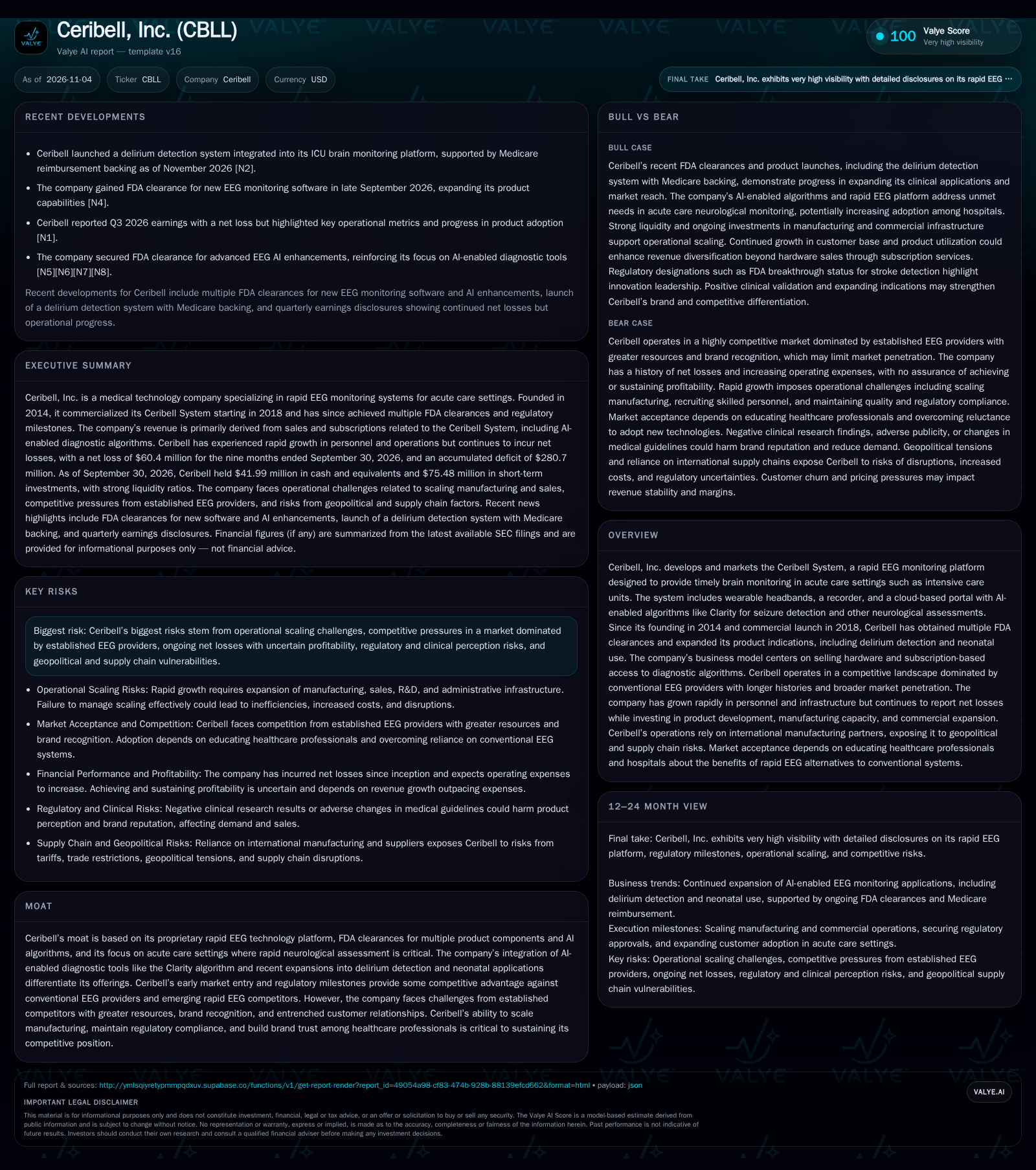
Ceribell’s rapid EEG platform is gaining traction with new FDA clearances and Medicare-supported indications in acute care neurology. The company is expanding its product suite and clinical reach, but has yet to prove a sustainable economic model, facing ongoing net losses, competition from established EEG vendors, and risks from operational scaling and international supply chains. The next phase hinges on broadening adoption, demonstrating recurring revenue growth from subscriptions, and managing the cost structure as scale increases. [N1] [N2] [N4] [S2]
Ceribell, Inc. is attempting to redefine acute neurological care with its rapid EEG platform, targeting faster and more actionable brain monitoring in ICU and emergency settings. The company’s recent launch of a Medicare-backed delirium detection system and multiple FDA clearances signal ambition to broaden its clinical and commercial reach. Yet, despite scaling up its workforce and product capabilities, Ceribell remains deeply unprofitable and faces the dual tests of market adoption and operational discipline. The coming quarters will reveal whether its blend of hardware and AI-driven subscriptions can carve out a durable position amid established EEG incumbents and mounting operational complexities.
Ceribell’s 2026 Progress: Clinical Expansions, Regulatory Milestones, and Continued Deficits
Ceribell’s most material recent developments include the November 2026 launch of its delirium detection system, now integrated into its ICU brain monitoring platform and supported by Medicare reimbursement. This marks a significant expansion of the Ceribell System’s clinical utility beyond seizure detection, potentially strengthening adoption in critical care settings where delirium is a pervasive and costly problem. The company also received FDA clearance for new EEG monitoring software in late September 2026, further validating its technology and expanding its regulatory moat. Financially, Ceribell reported a net loss of $60.4 million for the first nine months of 2026, with an accumulated deficit of $280.7 million, underscoring the company’s continued reliance on external capital while it scales operations and pursues broader market penetration. [N2] [N4] [S2] [N1]
Analyzing Revenue Streams: Hardware Margins, Subscription Trends, and Scaling Obstacles
Ceribell’s business model couples hardware sales (wearable EEG headbands and recorders) with subscription-based access to proprietary, AI-powered diagnostic algorithms such as Clarity. The addition of delirium detection and expanded FDA-cleared indications suggests a strategy to drive recurring revenue and deepen hospital integration. However, the company’s reported losses and expectation of rising operating expenses signal that the current revenue mix may be hardware-heavy or that recurring revenue from subscriptions is not yet at sufficient scale to offset investments in manufacturing, R&D, and commercial infrastructure. Fixed costs—such as R&D for regulatory submissions, salesforce expansion, and manufacturing overhead—are likely significant, suggesting Ceribell must achieve substantial installed base growth and high customer retention to realize operating leverage. The economics will be sensitive to hospital adoption rates, pricing power for algorithm subscriptions, and the ability to upsell new indications without significant additional customer acquisition cost.
Competitive Landscape: Navigating Differentiation and Entrenched Acute Neurology Players
Ceribell operates in a mature market dominated by conventional EEG providers such as Natus and Nihon Kohden, whose systems are deeply entrenched in hospital workflows and benefit from long-standing relationships, regulatory familiarity, and broad clinical validation. Ceribell’s competitive angle relies on speed, ease of use in acute settings, and the value of AI-driven interpretation—attributes that address well-documented pain points in emergent neurological assessment. However, the system is positioned as a supplement rather than a replacement for traditional EEG, potentially limiting wallet share and increasing the burden of physician education and workflow integration. Barriers to switching are high, as hospitals are slow to change neurological monitoring protocols and may face budget constraints or skepticism regarding new technology. The real competitive test will be whether Ceribell can move from adjunct status to core workflow for targeted use cases, and whether its expanding algorithm suite can generate network effects or stickiness that conventional EEG lacks.
Subscription Growth as a Lever: Unlocking Recurring Revenue and Enhanced Financial Profiles
The most favorable scenario for Ceribell is one where Medicare-backed delirium detection and new FDA-cleared indications drive rapid hospital adoption, leading to a growing installed base and increased utilization of subscription-based diagnostic algorithms. If Ceribell can demonstrate strong clinical outcomes and cost savings (such as reduced ICU length of stay or improved neurological outcomes), hospitals may be incentivized to standardize on its platform for acute brain monitoring. This would manifest in higher recurring revenue per account, improved gross margins as software scales, and operating leverage as sales and R&D costs are amortized over a larger revenue base. Evidence confirming this scenario would include disclosed metrics on customer retention, rising subscription revenue as a percentage of total sales, and published clinical data supporting utility in broader indications. Falsification would occur if hospitals remain reluctant to adopt beyond niche use, or if subscription uptake lags hardware placements.
Most Probable Outcome: Gradual Uptake Coupled with Ongoing Financial Challenges
The most plausible near-term trajectory is that Ceribell continues to expand its hospital footprint gradually, leveraging its regulatory milestones and Medicare support to win new accounts, but remains in a phase of heavy investment and operating losses. Adoption may be strongest in well-resourced academic and tertiary care centers, with more gradual penetration into community hospitals. The revenue mix could remain skewed toward hardware with incremental growth in subscriptions, but not yet at a scale to drive corporate profitability. Operating expenses are likely to rise in parallel as the company invests in sales, clinical education, and ongoing R&D for new indications. Confirmation would come from continued top-line growth, new account announcements, and additional FDA clearances, but with persistent net losses and limited public disclosure of recurring revenue depth. This scenario would be challenged if operating expenses flatten or if Ceribell reports a sudden inflection in subscription-driven gross margins.
Risks from Slowing Adoption and Rising Costs: Potential Impacts on Viability and Strategy
The adverse scenario is one where Ceribell fails to achieve meaningful adoption beyond early hospital innovators, either due to entrenched competitive workflows, negative or inconclusive clinical research, or hospital budget constraints. In this case, recurring revenue would stagnate, hardware placements would slow, and the company’s rising operating expenses could drive further dilution or force strategic retrenchment. External risks—such as supply chain disruptions in China or Vietnam, or adverse changes in Medicare reimbursement—could amplify cost pressures or disrupt product availability. Evidence for this scenario would include flat or declining hardware placements, lack of new clinical partnerships, rising customer churn (if disclosed), and cost-cutting signals such as layoffs or reduced R&D spend. It would be challenged if Ceribell reports resilience in hardware and subscription growth despite external shocks.
Ceribell’s Market Positioning and Operational Developments Shaping Future Prospects
The proportion of total revenue derived from recurring subscriptions versus hardware sales—if disclosed—would clarify the sustainability of Ceribell’s business model.
Disclosure of customer retention rates, average revenue per account, or upsell rates for new algorithmic indications would help gauge platform stickiness and expansion.
Updates on hospital account growth, particularly in community and non-academic settings, would test the breadth of market adoption.
Published clinical outcomes demonstrating utility and cost-effectiveness in delirium or other new indications would strengthen the adoption case.
Gross margin trends as software revenue scales, and whether operating leverage emerges as the installed base grows, are critical for the path to profitability.
Any supply chain disruptions, tariff impacts, or cost increases associated with international manufacturing partners should be monitored for operational risk.
Regulatory developments, including further FDA clearances or changes in Medicare reimbursement for new indications, could accelerate or constrain growth.
Disclaimer: This is research-only, informational analysis and not investment advice. It may include AI-generated interpretation and general industry context. Always verify important details using primary sources.

Comments