
Standard BioTools: Strategic Portfolio Shifts and the Search for Durable Profitability in Life Science Tools
Standard BioTools has executed major strategic maneuvers, including the $425 million SomaLogic divestiture and an all-stock merger with Treeline Biosciences. These moves, coupled with a reported liquidity position, are reshaping its business focus amid persistent revenue volatility and high exposure to international market dynamics.
Standard BioTools is redefining its life science tools portfolio through the divestiture of SomaLogic and a pending merger with Treeline Biosciences. Despite historical revenue variability, the company has reported improved profitability and maintains reported liquidity position. The real test is whether these strategic transactions can drive sustained margin expansion and operational resilience in a volatile, innovation-driven market.
Standard BioTools Inc. stands at an inflection point in the life sciences tools market, having executed two pivotal transactions: the $425 million divestiture of its SomaLogic business and an all-stock merger agreement with Treeline Biosciences. These moves, alongside a reported liquidity position and recent profitability, are meant to streamline the company’s portfolio and sharpen its operational focus. However, persistent revenue variability, complex sales cycles, and dependence on international markets and single-source suppliers raise questions about the company’s ability to achieve consistent, scalable growth and margin durability in a fiercely competitive and rapidly evolving sector.
Strategic Transactions Reshape the Business and Capital Structure
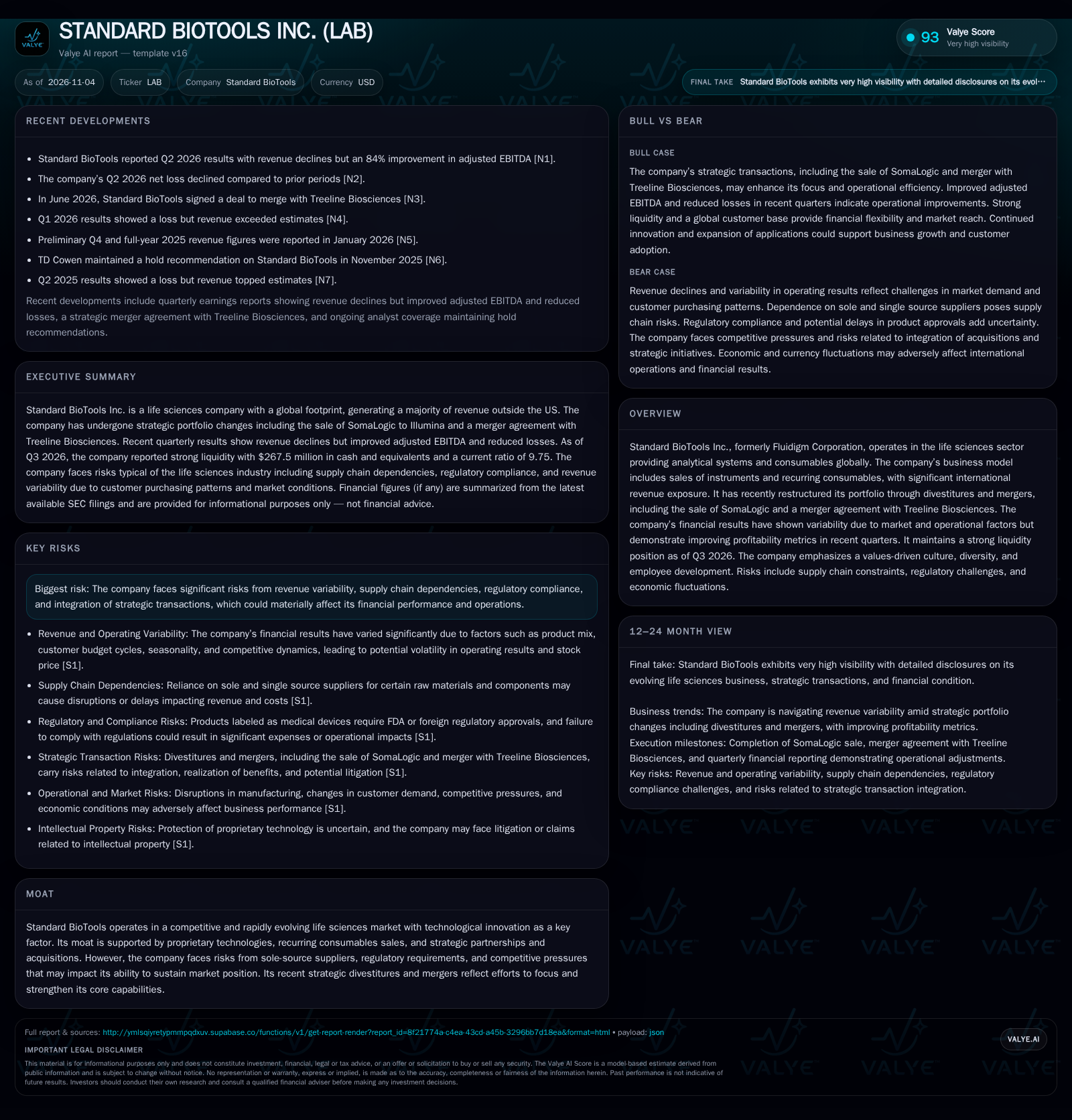
Standard BioTools’ recent execution of two major corporate actions—the divestiture of SomaLogic to Illumina for up to $425 million in January 2026 and the signing of a merger agreement with Treeline Biosciences in June 2026—marks a decisive portfolio transformation [N5] [N3] [S1]. The company reported cash and liquidity metrics for the period; these figures do not by themselves establish operating runway, investment capacity, financial flexibility, or financing capacity. [S2] These developments are material because they alter the company’s capital base, strategic direction, and risk profile, while the Treeline merger could bring new capabilities and scale but also integration and execution risks.
Instrument-Consumable Model: Recurring Revenue Potential vs. Volatility
Standard BioTools’ core business economics are built around a hybrid model: high-value analytical instrument sales (such as CyTOF, Hyperion, and Biomark platforms) paired with recurring revenue streams from consumables and reagents [S1]. This structure is common in life science tools, where instrument purchases tend to be lumpy and capital-budget dependent, while consumables generate steadier, higher-margin follow-on sales if device utilization is high. However, the company’s revenue has historically been highly variable due to uneven customer order timing, product mix changes, and the complexity of research funding cycles [S1]. Operating leverage exists if the installed base grows and consumables attach rates are high, but the model is sensitive to research budget cycles, competitive innovation, and customer retention. High fixed costs in R&D and SG&A, typical for the sector, mean that margin expansion is only sustainable if revenue stabilizes and grows. The recent portfolio moves may help focus resources on higher-margin or faster-growing segments, but integration and execution are key to realizing these benefits.
The instrument-consumable model’s success hinges critically on the company’s ability to deepen customer engagement beyond initial instrument sales. This requires not only technological leadership but also effective customer support, training, and service infrastructure to maximize instrument utilization. If Standard BioTools can enhance user experience and embed its platforms into customers’ workflows, it can increase the frequency and volume of consumable purchases, thus smoothing revenue streams. However, this dynamic is vulnerable to shifts in research funding priorities and the emergence of alternative technologies that could reduce consumable attachment rates. Moreover, the capital-intensive nature of instrument development means that timing new product introductions to align with market demand cycles is essential to avoid exacerbating revenue volatility.
Global Reach, Proprietary Tech, and the Battle for Share in a Crowded Market
Standard BioTools operates in a competitive, innovation-driven market dominated by large established players and specialized disruptors in proteomics, genomics, and multi-omics research. Its proprietary platforms and consumable ecosystem provide some differentiation, particularly in single-cell and spatial analysis. However, the company faces counterforces: many competitors also offer integrated instrument-consumable solutions, and switching costs for researchers—while present—may be offset by grant-driven purchases or technology upgrades. The company’s international footprint (with 67% of revenue outside the US) expands its addressable market but exposes it to currency volatility and diverse regulatory regimes [S1]. Dependence on sole and single-source suppliers for certain components introduces supply chain fragility that competitors with more diversified sourcing may exploit. The pending Treeline merger could either enhance Standard BioTools’ technology stack and market reach or, if poorly integrated, dilute focus and slow innovation.
Geopolitical and regulatory complexities in international markets add layers of uncertainty that can materially affect Standard BioTools’ competitive positioning. Variations in import-export regulations, data privacy laws, and clinical trial standards can delay product approvals or limit market access, impacting revenue predictability. Additionally, currency fluctuations can compress margins or create earnings volatility, especially if hedging strategies are limited. The company’s reliance on single-source suppliers amplifies supply chain risk, which can be compounded by geopolitical tensions or trade restrictions. Competitors with more geographically diversified supply chains and broader regulatory footprints may be better positioned to mitigate these risks, potentially capturing market share during periods of disruption.
Unlocking Margin Expansion Through Focused Portfolio and Consumable Growth
The most favorable scenario is that the SomaLogic divestiture and Treeline merger allow Standard BioTools to concentrate on core, higher-margin platforms and accelerate consumable attachment rates. If the merged entity streamlines R&D, leverages a broader sales footprint, and successfully integrates complementary technologies, the business could see steadier top-line growth and improved operating leverage. Confirmation would come from several quarters of rising gross margins, increased consumables as a percentage of revenue, and evidence that the installed base is expanding with high utilization. Additional signals would include successful cross-selling of new product lines post-merger, and disclosures of multi-year customer relationships or contracts that improve revenue visibility. This scenario would be falsified if integration costs spike, customer churn rises, or if consumable growth fails to offset instrument sales volatility.
Volatility Persists Amid Strategic Refocus and Integration Risks
The most plausible outcome is that Standard BioTools continues to experience revenue and margin volatility as it navigates the integration of Treeline Biosciences and adjusts to the loss of SomaLogic’s contributions. Confirmation of this path would be ongoing swings in quarterly revenues, gross margins fluctuating within a moderate range, and management guidance that continues to emphasize operational adjustments and strategic execution. Signs of integration friction, such as delayed product launches or elevated SG&A, would reinforce this scenario. A shift to greater recurring revenue from consumables or services, if disclosed, would be a positive step but not sufficient to eliminate volatility unless accompanied by evidence of customer retention and platform adoption.
Integration Stumbles, Supply Chain Shocks, and Renewed Revenue Pressure
A credible risk is that the Treeline merger fails to deliver synergies, leading to organizational distraction, culture clashes, or talent attrition. If integration proves more costly or complex than anticipated, operational disruptions could erode margins and delay new product development. Meanwhile, supply chain dependencies—especially on sole-source suppliers—could result in manufacturing delays or cost inflation, exacerbating revenue shortfalls. Confirmation would come from rising SG&A or COGS as a percentage of sales, missed product delivery timelines, or a spike in customer order deferrals or cancellations. Additional downside would be signaled by adverse regulatory events in major international markets, or by the loss of key customers due to perceived instability or competitive gains elsewhere.
Milestones and Metrics That Will Reveal If the Strategic Overhaul Delivers
Trends in consumables revenue as a percentage of total sales—if disclosed—would indicate whether the company is successfully building a more recurring, less volatile revenue base.
Quarterly gross margin progression, especially post-merger, will reveal the effectiveness of portfolio focus and operational integration.
Updates on the Treeline merger integration process, including timeline, cost, and realized synergies, will be crucial to judging execution risk.
Customer retention rates and installed base expansion—if disclosed—would confirm whether Standard BioTools is deepening relationships and driving usage of its platforms.
Supply chain resilience, measured by the impact of supplier disruptions or inventory write-offs, would highlight operational vulnerability.
International revenue growth and currency impact disclosures will help gauge the company’s ability to manage global complexity.
Any shift in R&D or SG&A as a percentage of sales post-transaction would indicate whether cost discipline is being maintained or eroded.
Disclosure of multi-year contracts, service agreements, or backlog—if provided—would improve visibility into future revenue stability.
Disclaimer: This is research-only, informational analysis and not investment advice. It may include AI-generated interpretation and general industry context. Always verify important details using primary sources.

Comments