
Booking Holdings: Navigating Profit Headwinds as Travel Demand Cools
Despite surpassing Q3 earnings expectations and maintaining substantial liquidity, Booking Holdings faces a pivotal period as global travel demand softens and profit growth stalls. The company’s business model, competitive moats, and risk management are being tested by shifting consumer patterns and intensifying industry competition.
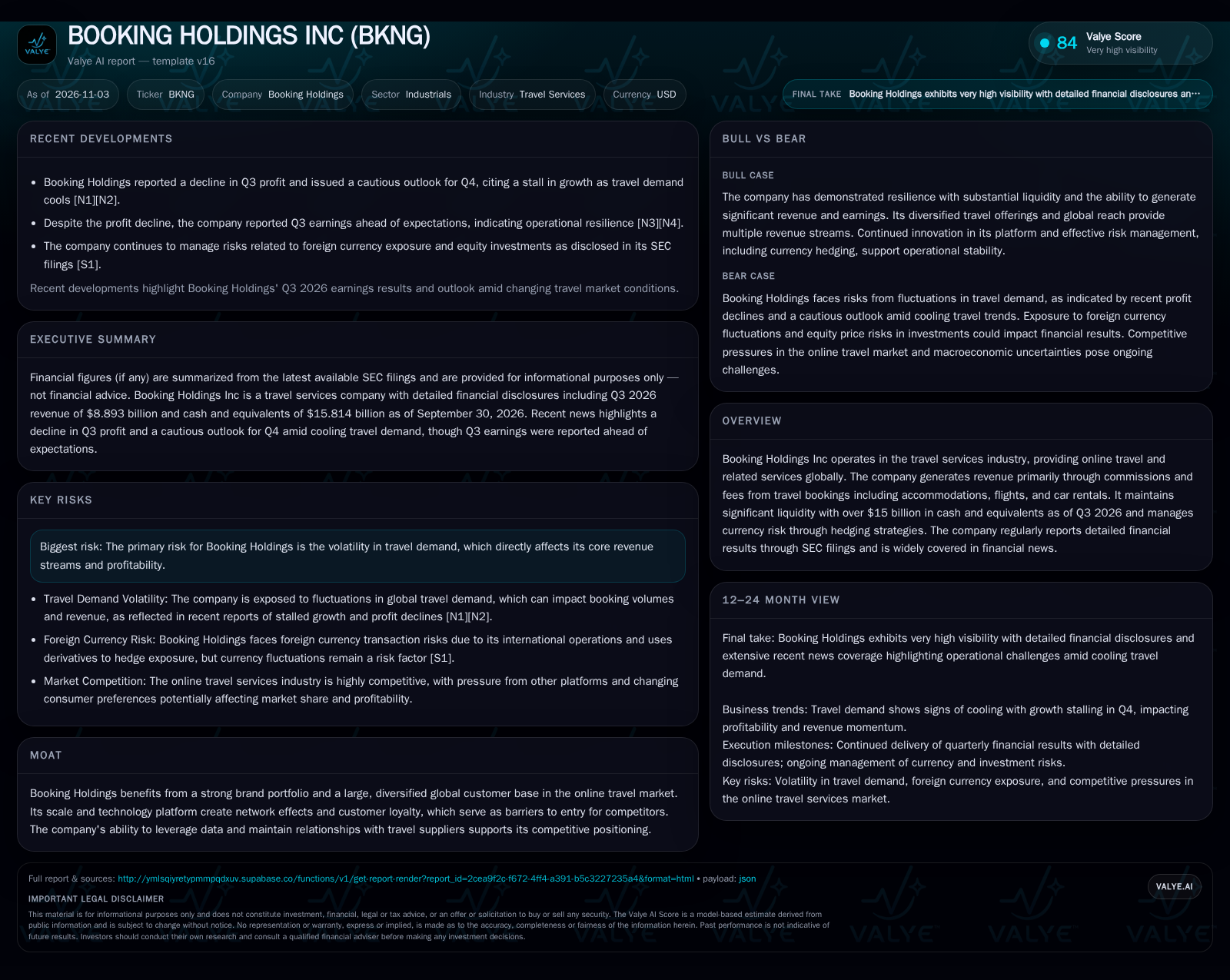
Booking Holdings reported Q3 2026 revenue of $8.893 billion and cash of $15.814 billion, but profit declined and guidance for Q4 is cautious as travel demand cools. While Q3 results beat expectations, the outlook highlights risks from volatile demand, currency exposure, and a competitive online travel market. Operational resilience, platform scale, and potential financial flexibility remain strengths, but the company’s next phase depends on rekindling growth and defending margins amid global headwinds. [S2] [N1] [N2] [N3] [N4]
Booking Holdings enters Q4 2026 at a crossroads: robust Q3 revenue and a large cash war chest underscore its operational scale and resilience, but recent profit declines and a cautious forward outlook reveal cracks in the travel demand recovery. The company’s ability to sustain growth, defend margins, and manage risk in a cooling macro environment now stands as the central question for investors and industry observers. As competitive dynamics sharpen and consumer trends evolve, Booking’s next moves will be critical in determining whether it can maintain leadership in the global online travel services market.
Profitability Slips as Travel Growth Stalls
Booking Holdings reported $8.893 billion in revenue for Q3 2026, but profit declined compared to prior periods and the company issued a cautious outlook for Q4, citing a stall in growth as global travel demand cools [S2] [N1] [N2]. Despite this, Q3 earnings exceeded analyst expectations, indicating some operational resilience even as the broader travel market shows signs of fatigue [N3] [N4]. The company’s liquidity position remains substantial, with $15.814 billion in cash and equivalents at quarter-end, and a current ratio of 1.11 [S2]. These developments signal a business at an inflection point: while operational scale and financial resources are intact, the fundamental challenge is rekindling demand and sustaining profitability as macro and industry headwinds intensify.
Commission-Driven Revenue Model and Margin Dynamics
Booking Holdings’ core business is built on earning commissions and fees from facilitating travel bookings—accommodations, flights, car rentals—across its global platform. This model is scaleable, with high fixed costs in technology, marketing, and customer service, but relatively low incremental costs per transaction. As a result, revenue growth historically drives operating leverage, expanding margins during periods of rising demand. However, in a cooling travel environment, the company’s fixed-cost base can compress margins if booking volumes stagnate or decline. Pricing power is typically limited, as online travel agencies (OTAs) compete fiercely on commissions and consumer-facing fees. Capital needs are moderate in absolute terms due to the asset-light nature of the platform, yet maintaining global reach requires ongoing investment in technology, marketing, and supplier relationships. The company’s liquidity, with over $15 billion in cash, affords flexibility for investment or shareholder returns, but the economic model’s sensitivity to volume swings remains a central risk.
Scale, Brand, and Data as Moats—But Competition Intensifies
Booking Holdings’ competitive advantages stem from its portfolio of well-known brands, extensive supplier relationships, and a global customer base. These factors could create network effects: more listings attract more travelers, which in turn attract more suppliers. The company leverages data analytics to optimize pricing, inventory, and customer engagement, reinforcing user loyalty and supplier dependence. However, the online travel market remains highly competitive, with rival OTAs, direct supplier channels, search engines, and emerging travel platforms all vying for share. Switching costs for consumers are low, and suppliers may increasingly seek to drive direct bookings or leverage alternative distribution channels. While Booking’s scale and technology platform present barriers to entry, the risk of commoditization and margin pressure is ever-present, especially if consumer price sensitivity increases or new entrants innovate in user experience or service offerings.
If Travel Demand Rebounds and Platform Innovation Delivers
A favorable scenario for Booking Holdings would see a rebound in global travel demand—driven by economic recovery, easing geopolitical tensions, or renewed consumer confidence—fueling higher booking volumes and revenue growth. If the company successfully innovates its platform, deepening integration with suppliers and enhancing user experience through AI, personalization, or new service verticals, it could capture greater wallet share and improve retention. Operational leverage would amplify earnings as fixed costs are spread over a larger transaction base. Evidence supporting this scenario would include a return to sequential booking growth, margin expansion, and positive revisions to forward guidance. Early indicators might be stronger-than-expected Q4 booking trends, increased direct traffic, or successful rollout of new platform features. Conversely, if travel demand remains tepid or competitive pricing erodes margins, this upside would be difficult to realize.
Stabilization Amid Slower Growth, Margin Pressure Persists
The most plausible near-term outcome is that Booking Holdings stabilizes at a lower growth rate as travel demand plateaus. Revenue may remain flat or grow modestly, with margin pressure from competitive dynamics and higher customer acquisition costs. Currency fluctuations and exposure to equity price risk in investments could introduce additional earnings volatility. Confirmation of this scenario would be quarterly results showing stable (but not accelerating) bookings, steady cost discipline, and ongoing—but not dramatic—margin compression. A shift in supplier behavior, such as increased direct booking initiatives, would further limit upside. The base case assumes resilience but not a return to high growth absent a macro or industry catalyst.
Prolonged Demand Weakness and Margin Erosion
A more adverse scenario would involve a sustained or deepening decline in global travel demand—potentially triggered by economic downturn, geopolitical shocks, or persistent inflation—leading to falling booking volumes and revenue contraction. In this environment, price competition among OTAs could intensify, forcing Booking Holdings to lower commissions or increase promotional spending to defend share, further squeezing margins. Fixed technology and personnel costs would limit the ability to flex down expenses, amplifying profit declines. Additional risks include unfavorable currency movements impacting international revenue and potential write-downs on equity investments. Evidence confirming this downside would be consecutive quarters of declining bookings, negative operating leverage, and downward revisions to earnings guidance.
Signals That Will Define Booking Holdings’ Next Phase
Quarterly booking growth or contraction, especially in Q4 and the first half of 2027, will provide early evidence of demand trajectory and revenue momentum.
Gross margin and operating margin trends—whether the company can defend profitability as competitive and macro pressures mount—will be critical to watch.
Customer acquisition cost (if disclosed) and marketing efficiency metrics would help gauge whether Booking can maintain share without overspending as growth slows.
Supplier retention and direct booking trends (if disclosed) would clarify whether suppliers are shifting away from OTAs or deepening their partnership with Booking.
Foreign currency impact on revenue and earnings, given the company’s international exposure and ongoing hedging activity.
Any strategic investments, platform innovations, or major supplier deals that could signal a new growth vector or reinforce competitive advantages.
Equity investment performance and related write-downs or gains, as these can introduce non-operating volatility to reported earnings.
Disclaimer: This is research-only, informational analysis and not investment advice. It may include AI-generated interpretation and general industry context. Always verify important details using primary sources.

Comments