
MSA Safety: Integrating Acquisitions and Managing Margin Pressures in a Changing Safety Landscape
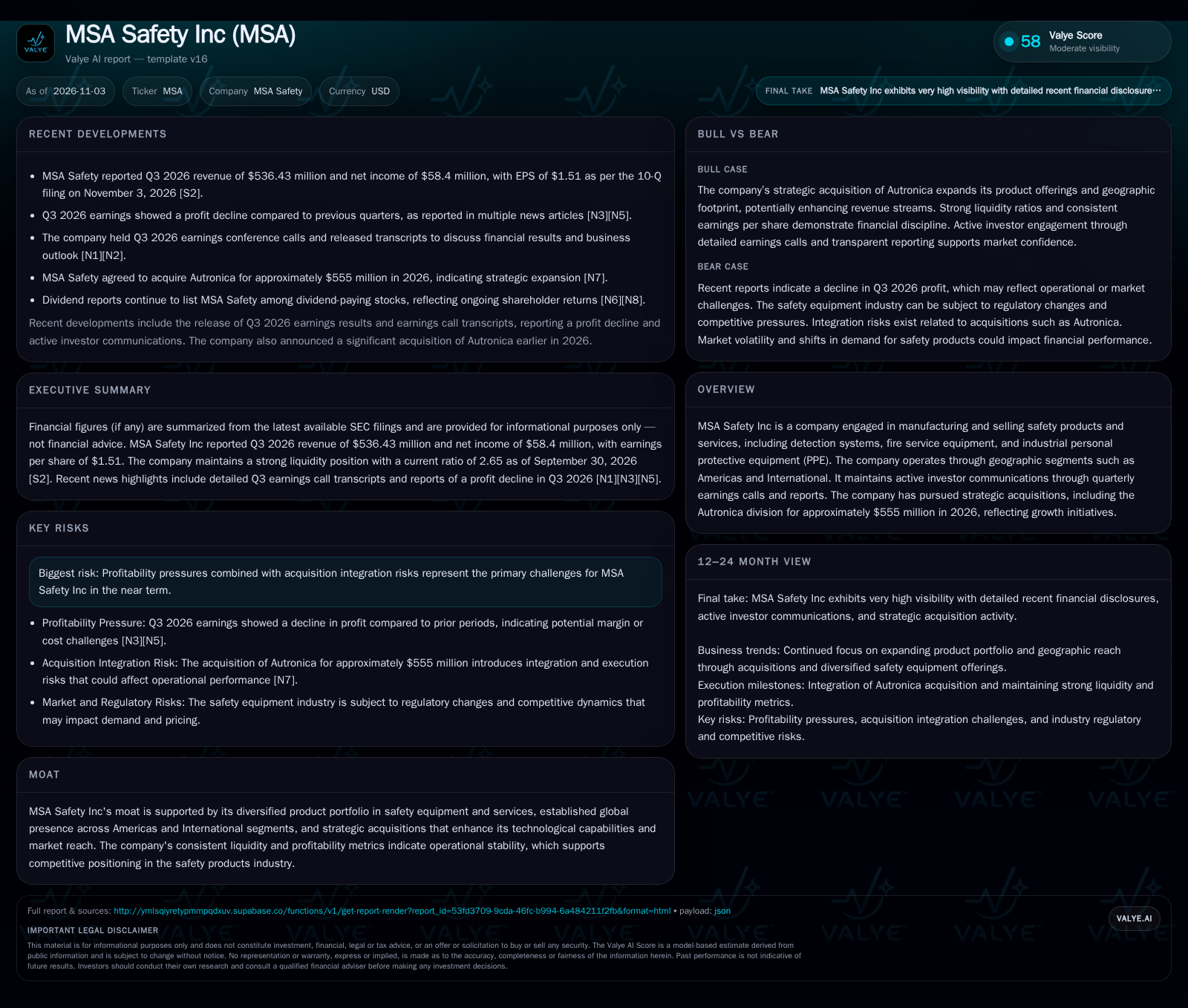
MSA Safety’s Q3 2026 profit decline and a major $555M acquisition highlight the company’s ongoing push for portfolio growth and geographic diversification, but also bring integration and margin challenges to the forefront.
MSA Safety’s Q3 2026 results show a notable profit decline alongside reported liquidity position and a transformative acquisition of Autronica. These developments sharpen the focus on integration execution, cost management, and the company’s ability to navigate competitive and regulatory shifts in the global safety equipment sector. Watch for margin trends, acquisition synergies, and any shifts in demand or pricing power as key determinants of the next phase.
MSA Safety Inc’s latest quarter encapsulates the strategic and operational crosscurrents shaping the safety products industry. The company reported a Q3 2026 profit decline despite solid revenue and a reported liquidity position, just as it closed a transformative $555 million acquisition of Autronica. These moves underscore MSA’s ambitions to expand its product suite and international footprint, but also sharpen the spotlight on whether integration and cost discipline can offset margin pressures and sector headwinds. The next several quarters will test MSA’s ability to translate scale and portfolio breadth into sustainable earnings growth.
Recent Profit Decline and a Major Acquisition Reshape the Outlook
MSA Safety reported Q3 2026 revenue of $536.43 million and net income of $58.4 million, resulting in earnings per share of $1.51 [S2]. However, the company experienced a decline in profit compared to previous quarters, a shift highlighted by both management filings and news coverage [N3] [N5]. The most material development is the completed acquisition of Autronica for approximately $555 million in 2026, a move aimed at strengthening MSA’s detection systems portfolio and expanding its international presence. The company reported cash and liquidity metrics for the period; these figures do not by themselves establish operating runway, investment capacity, financial flexibility, or financing capacity. [S2] These facts set the stage for a period of operational scrutiny: the company must integrate a major asset while navigating margin pressure and sector uncertainty.
Revenue Mix, Margin Dynamics, and the Cost of Growth
MSA Safety generates revenue primarily through the manufacture and sale of safety products and services, including detection systems, fire service equipment, and industrial PPE. The company’s business model is characterized by a mix of one-time equipment sales and, increasingly, recurring revenue from service contracts, maintenance, and monitoring—especially as detection systems and smart safety platforms gain traction in regulated industries. Pricing power in this sector is often a function of regulatory mandates, brand reputation, and the technical complexity of solutions, but is challenged by commoditization and aggressive competition from both global and regional players.
The Q3 2026 profit decline suggests that either gross margins are under pressure—possibly due to input cost inflation, competitive pricing, or integration expenses—or that operating costs have risen faster than top-line growth. Acquisitions like Autronica typically introduce near-term integration costs and may dilute margins before synergies are realized. Over time, successful integration could drive operating leverage if MSA can consolidate back-office functions, optimize procurement, and cross-sell higher-value solutions. Capital requirements remain significant in this industry, especially as companies invest in product innovation, regulatory compliance, and international expansion.
Defending Share in an Intensifying Global Safety Market
MSA Safety competes in a fragmented global market for industrial and public safety equipment, where barriers to entry are moderate but customer switching costs can be high for highly integrated detection and monitoring systems. Incumbent strengths typically include brand trust, regulatory certification, a broad product portfolio, and established distribution relationships. However, the sector is exposed to periodic regulatory changes (which can create both demand spikes and compliance cost burdens), as well as to price-based competition from lower-cost international and regional manufacturers.
The Autronica acquisition may enhance MSA’s position in fire and gas detection, especially in international markets, but also raises the bar for successful integration and customer retention. Technology substitution—such as IoT-enabled safety solutions and advanced analytics—could reshape the competitive landscape, favoring companies with the capital and expertise to develop or acquire next-generation platforms. MSA’s ability to defend share will depend on its speed in commercializing new products, leveraging cross-selling opportunities, and maintaining service quality in the face of cost pressures.
Synergy Realization and International Expansion Drive Reacceleration
If MSA Safety rapidly integrates Autronica and captures meaningful cost and revenue synergies, the company could see a reacceleration in earnings growth. Success would likely be confirmed by stabilization or improvement in operating margins, sequential profit gains, and evidence of new contract wins or expanded customer relationships in international markets. The combined portfolio could enhance pricing power, particularly if MSA leverages Autronica’s detection technologies across its existing customer base and opens cross-selling opportunities in regulated industries.
A favorable scenario would also require containment of integration costs and effective management of supply chain and input expenses. Early indicators might include an uptick in recurring service revenue, improved gross margins, and positive commentary from management regarding acquisition outcomes and pipeline strength. Evidence for this path would be rising EPS in subsequent quarters, steady or improving cash flows, and a robust backlog of contracted business—if disclosed.
Integration Progress Offsets Some Margin Headwinds but Growth Remains Mixed
The most plausible near-term outcome is a period of operational digestion: MSA Safety works through Autronica integration, realizing some but not all anticipated synergies, while managing ongoing margin pressure from competitive pricing and input costs. Revenue growth may remain solid due to portfolio breadth and regulatory-driven demand, but profit margins could stay constrained as integration expenses and cost inflation persist.
Confirmation of this scenario would include moderate sequential improvement in profit or EPS, reported liquidity position, and management signaling ‘on-track’ integration without major surprises. Falsifying evidence would be a sustained decline in margins, unexpected acquisition-related costs, or signs of customer attrition or pricing concessions. The middle path likely features incremental progress rather than dramatic inflection.
Integration Strains and Market Headwinds Compound Margin Erosion
In an adverse scenario, MSA Safety faces higher-than-expected integration costs, operational disruptions from the Autronica acquisition, and continued margin erosion from competitive and regulatory pressures. This could manifest as further declines in quarterly profit, negative operating leverage, and potential challenges in retaining key customers or contracts—especially if service levels or product delivery timelines are impacted by integration complexity.
Confirming evidence would include ongoing profit deterioration, negative cash flow trends, or management revising guidance downward due to integration setbacks or weaker-than-expected demand. Additional risks include regulatory changes that squeeze industry margins, or aggressive price competition from new entrants or international players. Falsification would require clear evidence that cost control, customer retention, and acquisition benefits are materializing more quickly than feared.
Factors That Will Determine MSA Safety’s Post-Acquisition Trajectory
Quarterly gross and operating margin trends, as these will reveal the extent of cost pressure and the pace of synergy capture.
Progress updates from management on Autronica integration milestones, including cost savings and revenue cross-sell results—if disclosed.
Sequential movement in EPS and net income, particularly any reversal of the Q3 2026 profit decline.
Recurring service revenue growth, which would indicate success in building higher-margin, stickier business lines.
Customer retention rates and contract renewal activity—data that would help assess switching frictions and post-acquisition stability, if disclosed.
Any changes in backlog or awarded contract volume, as a proxy for future revenue visibility—if reported.
Regulatory or competitive developments impacting pricing, product standards, or market access in core and new geographies.
Disclaimer: This is research-only, informational analysis and not investment advice. It may include AI-generated interpretation and general industry context. Always verify important details using primary sources.

Comments