
Profitability Reset and Capital Deployment: National Bank Holdings Corp at an Inflection Point
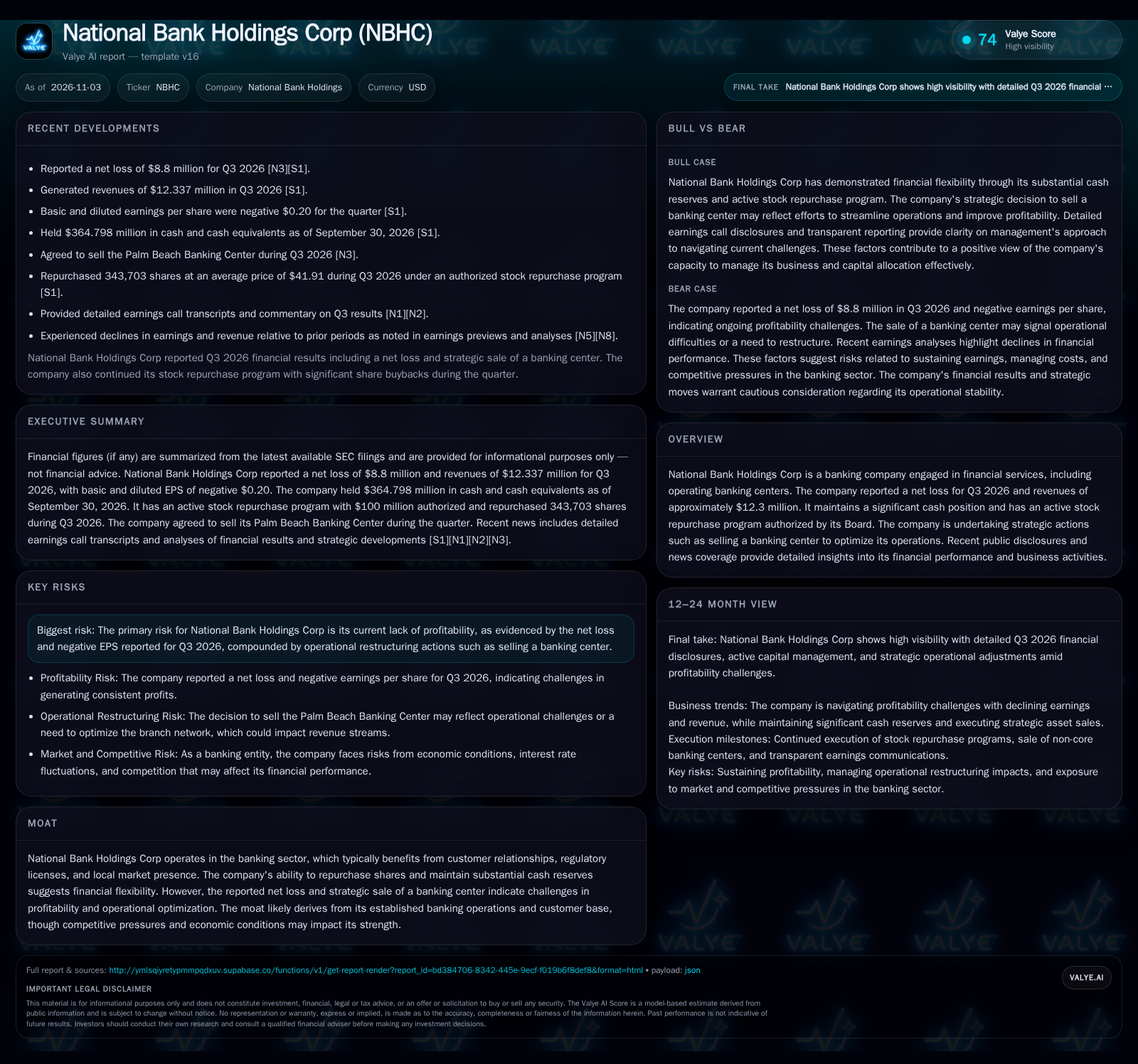
National Bank Holdings Corp (NBHC) reported a net loss in Q3 2026, reduced earnings, and executed the sale of a banking center, all while maintaining a large cash balance and actively repurchasing shares. These developments signal a transitional period where operational streamlining and capital allocation decisions may shape the company’s risk/reward profile over the next several quarters.
NBHC posted an $8.8 million net loss and declining Q3 2026 earnings, undertook a banking center sale, and repurchased substantial shares, all while holding over $360 million in cash. The core question is whether operational adjustments and capital return initiatives can restore profitability amid sector headwinds and competitive pressures. Watch for further asset sales, expense discipline, and evidence of revenue stabilization or recovery as leading indicators.
National Bank Holdings Corp’s third quarter 2026 results mark a decisive inflection point for the company. Facing a net loss and declining revenues, NBHC is simultaneously deploying capital through buybacks and executing operational changes such as the sale of a banking center. This mix of defensive moves and shareholder returns illustrates the tension between near-term earnings pressures and longer-term capital flexibility. The next phase for NBHC will likely hinge on its ability to stabilize the core franchise, manage costs, and redeploy capital in a way that restores profitability and competitive relevance.
Q3 2026: Net Loss, Revenue Decline, and Strategic Asset Sale Reshape the Narrative
National Bank Holdings Corp reported a net loss of $8.8 million for the third quarter of 2026, with negative earnings per share of $0.20, underscoring a reversal from prior profitability [S1] [N3]. Quarterly revenues were $12.337 million, reflecting a decline from earlier periods and a miss versus analyst expectations [S1] [N5]. The company’s decision to sell its Palm Beach Banking Center during the quarter signals a willingness to rationalize its branch footprint, potentially in response to underperformance or changing local economics [N3]. Despite these setbacks, NBHC maintained a substantial cash position of $364.798 million as of September 30, 2026, and continued to return capital through repurchasing 343,703 shares at an average price of $41.91, with $100 million still authorized under its buyback program [S1]. These facts collectively position NBHC at a crossroads between operational retrenchment and capital deployment.
The strategic decision to sell a banking center amid declining revenues also reflects a broader industry trend toward optimizing physical footprints in favor of digital channels. This shift necessitates careful consideration of the trade-offs involved: while reducing fixed costs associated with branch operations can improve profitability, it may simultaneously diminish customer touchpoints and weaken relationship-based revenue streams. The timing and selection of branches for divestiture must therefore align with a comprehensive assessment of local market dynamics, competitive intensity, and the bank's digital readiness to absorb displaced customer activity without eroding deposit and loan volumes.
How NBHC’s Revenue Mix and Cost Structure Shape Its Earnings Sensitivity
The core economics of regional banks like NBHC typically hinge on net interest income from lending activities, fee-based revenue from ancillary services, and disciplined expense management. The reported revenue decline and net loss suggest that NBHC’s interest margin or loan portfolio performance has come under pressure—potentially due to lower loan demand, higher deposit costs, or elevated credit provisioning. The sale of a banking center implies fixed-cost rationalization, but also risks reducing near-term revenue if customer relationships or deposit bases are disrupted.
The company reported cash and liquidity metrics for the period; these figures do not by themselves establish operating runway, investment capacity, financial flexibility, or financing capacity. The active share repurchase program may signal management’s confidence in intrinsic value or a lack of compelling organic growth opportunities. If cost cuts and asset sales are not matched by revenue stabilization or loan growth, operating leverage could work against NBHC, amplifying losses. Conversely, even modest improvements in net interest margin or expense discipline could quickly restore profitability given the sector’s typical fixed-cost base.
The sensitivity of NBHC’s earnings to interest rate fluctuations and credit cycle dynamics is a critical factor in evaluating its medium-term outlook. Should interest rates rise, the bank’s net interest margin could expand if asset repricing outpaces liabilities; however, this is contingent on the composition and duration of its loan and deposit portfolios. Conversely, an economic slowdown or credit deterioration would increase provisioning expenses, compressing earnings further. The interplay between revenue drivers and expense control measures thus creates a narrow margin for error, underscoring the importance of proactive risk management and dynamic capital allocation to navigate evolving macroeconomic conditions.
Branch Network Rationalization and the Local Banking Chessboard
NBHC’s competitive footing depends on its ability to balance local branch presence with cost efficiency and digital service delivery. The sale of the Palm Beach Banking Center suggests a focus on markets with greater profitability or strategic fit, but it also opens the door for local or regional competitors to absorb displaced customers. In the broader landscape, regional banks face mounting competition from larger national players with greater scale, fintechs offering digital-first banking, and community banks with hyper-local relationships.
Customer switching costs in banking are moderate; while direct deposit, lending relationships, and bundled accounts provide some stickiness, the risk of attrition rises when branches close or customer service is disrupted. The question is whether NBHC can leverage its remaining footprint and digital capabilities to defend or even grow its customer base, or whether it will continue to cede share to nimbler or more capitalized rivals.
NBHC’s ability to differentiate itself within a crowded regional banking landscape will likely depend on leveraging technology to enhance customer experience and operational efficiency. Investments in digital platforms can lower servicing costs and provide alternative channels to engage clients, partially offsetting the loss of physical branches. However, the effectiveness of digital transformation initiatives is conditional on user adoption rates and the bank’s capacity to integrate these platforms seamlessly with existing products. Additionally, partnerships or fintech collaborations could serve as accelerants for innovation, but they require careful alignment with NBHC’s strategic priorities and risk appetite to avoid diluting brand value or operational focus.
Operational Streamlining Catalyzes Margin Recovery and Capital Return
A bullish outcome for NBHC would see the current restructuring—asset sales, cost rationalization, and selective buybacks—drive a rapid rebound in core earnings power. If management can reallocate capital from underperforming branches to higher-yielding assets or more efficient operations, margin expansion could follow. Further, if the excess cash is deployed at attractive risk-adjusted returns (via lending, acquisitions, or continued buybacks), shareholder value could be enhanced.
Key evidence for this scenario would include stabilization or growth in net interest margin, a resumption of positive earnings per share, and retention of customer deposits after branch divestitures. Confirmation would also come from management commentary on successful expense control, new lending initiatives, or evidence that capital is being deployed at returns above the company’s cost of capital.
Earnings Volatility Persists as NBHC Adjusts to a More Competitive Landscape
The most plausible near-term outcome is that NBHC experiences continued earnings volatility as it navigates the aftermath of branch sales and adapts to sector headwinds. Revenue pressures may persist if loan growth remains muted and deposit costs stay elevated, even as expense reductions help cushion the bottom line.
This scenario would be corroborated by ongoing negative or low-single-digit EPS, further asset sales or operational adjustments, and management guidance that emphasizes restructuring rather than growth. Modest improvement in efficiency ratios and stable (but not growing) customer deposit levels would support the base case.
Protracted Profitability Struggles and Customer Attrition Threaten Franchise Value
NBHC’s downside risk centers on the possibility that operational restructuring fails to stem the tide of declining revenues and persistent losses. If branch closures trigger significant customer attrition, loan balances and fee income could erode further. Meanwhile, if the company is unable to redeploy capital into profitable lending or fee-generating activities, the reported cash balance could dwindle without generating incremental earnings.
Further evidence of this scenario would include continued net losses, shrinking deposit and loan balances, and additional asset sales driven by necessity rather than choice. Deterioration in credit quality or regulatory intervention would also be red flags. In this context, the buyback program could be curtailed to preserve capital, undermining shareholder returns and confidence.
Benchmarks for Testing NBHC’s Turnaround and Capital Allocation Thesis
Track quarterly net interest margin trends and lending volumes to assess whether core banking profitability is stabilizing or recovering.
Monitor customer deposit and account retention rates—especially in markets affected by branch sales—to gauge the impact of network rationalization.
Follow expense ratios and non-interest expense trends for evidence of effective cost management.
Watch for additional asset sales or branch divestitures, which could signal either proactive optimization or distress-driven restructuring.
Evaluate the pace and scale of share repurchases versus organic investment, to determine management’s capital allocation priorities.
If disclosed, scrutinize new loan origination quality and credit loss provisioning as leading indicators of future earnings volatility.
Assess management’s forward guidance and commentary for signs of improved operating visibility or persistent uncertainty.
A useful metric would be customer acquisition costs or digital engagement levels, to test whether NBHC is offsetting physical presence reductions with digital growth.
Disclaimer: This is research-only, informational analysis and not investment advice. It may include AI-generated interpretation and general industry context. Always verify important details using primary sources.

Comments