
Banner Corp: Dividend Strategy, Credit Dynamics, and Forces Influencing Regional Bank Valuation
The sustainability of Banner’s dividend and earnings profile hinges on its ability to manage credit risk and adapt to evolving regulatory and market conditions.
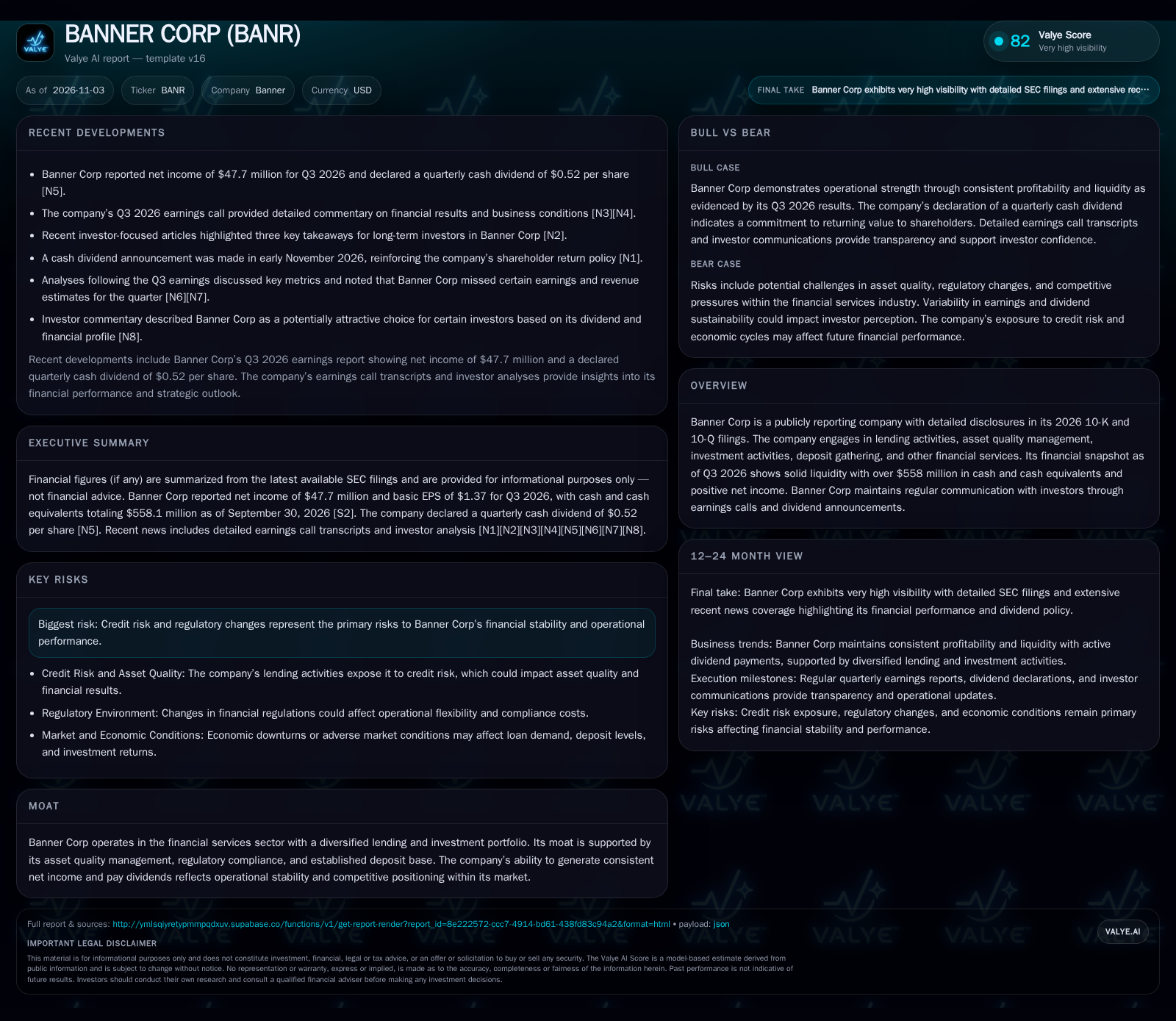
Banner Corp reported Q3 2026 net income of $47.7 million and maintained a quarterly dividend, underscoring operational stability. However, missed earnings and revenue estimates highlight margin pressure and the persistent challenge of credit risk and competition in the regional banking sector [S2] [N5] [N7].
Banner Corp enters the final quarter of 2026 with a financial profile that blends steady profitability and significant on-balance-sheet liquidity. As the regional banking landscape evolves amid changing regulations and economic conditions, Banner’s ability to preserve asset quality and grow its deposit and lending franchises will be decisive in shaping its long-term value proposition and investor appeal.
Q3 2026 Results: Profitability Sustains Despite Emerging Margin Challenges
Banner Corp reported net income of $47.7 million for the third quarter of 2026, translating to basic earnings per share of $1.37 and diluted EPS of $1.36 [S2] [N5]. This profitability metric, combined with a cash and cash equivalents balance of $558.1 million as of September 30, 2026, highlights the company’s ongoing ability to generate earnings and maintain liquidity. However, Banner missed consensus earnings and revenue estimates for the quarter, pointing to pressure on margins and/or topline growth [N7]. The cited source reports dividend-related activity; that disclosure alone does not establish dividend-policy continuity, management confidence, or a material constraint on capital flexibility. [N1] [N5]
Revenue Drivers at Banner: Lending, Spread Optimization, and Operational Efficiency
Banner’s core business model is anchored in traditional banking activities: gathering deposits and deploying them into loans and investment securities. Net interest income—the spread between interest earned on assets and interest paid on deposits and borrowings—remains the primary source of profitability. Loan growth and asset mix drive the volume component, while the net interest margin (NIM) reflects the pricing dynamic and competitive intensity. Non-interest income, such as fees from deposit services or investment activities, provides supplementary revenue streams but is typically less material for regional banks of Banner's profile.
Operating leverage is achieved by managing the cost base—primarily personnel and occupancy expenses—relative to revenue growth. As scale increases, fixed costs can be spread over a larger asset base, but this benefit may be offset by rising compliance, technology, and risk management costs, especially in a more stringent regulatory environment. Credit losses, if they rise, can quickly erode pre-provision earnings, making asset quality management a central economic lever.
The cited source reports dividend-related activity; that disclosure alone does not establish dividend-policy continuity, management confidence, or a material constraint on capital flexibility. Persistent profitability and retained earnings are key to self-funding growth and absorbing shocks, but adverse credit cycles or regulatory changes could necessitate capital raises or payout reductions if conditions deteriorate.
In addition to traditional net interest income drivers, Banner’s revenue stability also depends on its ability to manage interest rate risk effectively. Fluctuations in benchmark rates can compress net interest margins if asset repricing lags liability costs, especially in a rising rate environment. The duration gap between loans and deposits, as well as the use of hedging instruments, plays a critical role in mitigating this risk. Moreover, the composition of the loan portfolio—such as fixed-rate versus variable-rate loans—can influence sensitivity to rate changes, affecting both earnings volatility and capital planning.
Strategies for Winning Deposits and Loans in a Competitive Regional Banking Landscape
Banner operates in a highly competitive regional banking landscape, contending with other community and super-regional banks, as well as non-bank lenders and fintechs. Its primary advantages stem from established customer relationships, a diversified loan book, and ongoing investments in asset quality management and compliance. However, these strengths are not unique—most peers pursue similar strategies—which compresses pricing power and makes deposit and loan growth a function of service quality, local market share, and brand trust.
Competitive pressures are intensified by technology-driven entrants who can offer digital deposit products or lending at lower cost, and by larger banks with deeper resources for technology investment and regulatory compliance. Switching costs for retail and small business customers are modest, though Banner may benefit from local relationship banking and community presence. Threats from substitutes (e.g., money market funds, digital lenders) and regulatory changes can further erode margins or shift the competitive baseline.
Dividend and Earnings Growth Potential Linked to Credit Stability and Deposit Expansion
Evidence supporting this pathway would include improving or stable asset quality ratios (such as non-performing assets and net charge-offs, if disclosed), above-peer loan growth, and steady or rising net interest margin. Expansion into new markets or successful technology adoption that attracts new customers could further reinforce this dynamic.
Margin Pressure Balances Growth in a Stable Banking Environment
The most plausible outcome is that Banner continues to generate moderate profitability, with net income and dividends supported by prudent credit management and a stable deposit base. However, margin pressure—driven by competition, rising funding costs, or regulatory compliance expenses—limits upside on net interest income. Loan growth may track regional economic trends, but is unlikely to accelerate meaningfully without a clear differentiator.
If asset quality remains stable and capital ratios are preserved, Banner maintains its value proposition as a steady, income-oriented regional bank. Falsification would come from a sudden deterioration in asset quality, regulatory shocks, or a dividend cut.
Dividend Reductions and Earnings Decline Possible from Credit or Regulatory Setbacks
A negative turn in credit quality—such as rising delinquencies or loan losses—could quickly undermine Banner’s earnings base, given the operating leverage inherent in banking. Regulatory tightening or a sharp economic downturn could further pressure asset quality, increase compliance costs, and restrict lending activity. In this scenario, Banner may be forced to cut its dividend to preserve capital, and net income could fall materially below current levels.
Downside confirmation would come from rising non-performing assets, higher loan loss provisions, declining capital ratios, or a dividend reduction. External signals could include negative regional economic indicators or regulatory changes that increase capital or compliance requirements. Early warnings may also be visible in deteriorating net interest margin or customer attrition, especially if digital competitors gain share.
Evaluating Credit Trends, Margin Developments, and Dividend Sustainability
Changes in non-performing assets and net charge-offs (if disclosed) to detect early credit deterioration or improvement.
Quarterly net interest margin trends as a proxy for pricing power and funding cost management.
Loan and deposit growth rates relative to regional and peer benchmarks to gauge franchise health.
Dividend coverage ratio and payout sustainability, especially if profitability fluctuates.
Regulatory capital ratios to assess balance sheet resilience under stress.
Updates on technology adoption, digital banking initiatives, or customer acquisition/retention metrics—if disclosed.
Management commentary on competitive dynamics, asset quality outlook, and regulatory developments in earnings calls or filings.
Disclaimer: This is research-only, informational analysis and not investment advice. It may include AI-generated interpretation and general industry context. Always verify important details using primary sources.

Comments