
Syra Health: Government-Driven Population Health Expansion Meets Scale and Policy Uncertainties
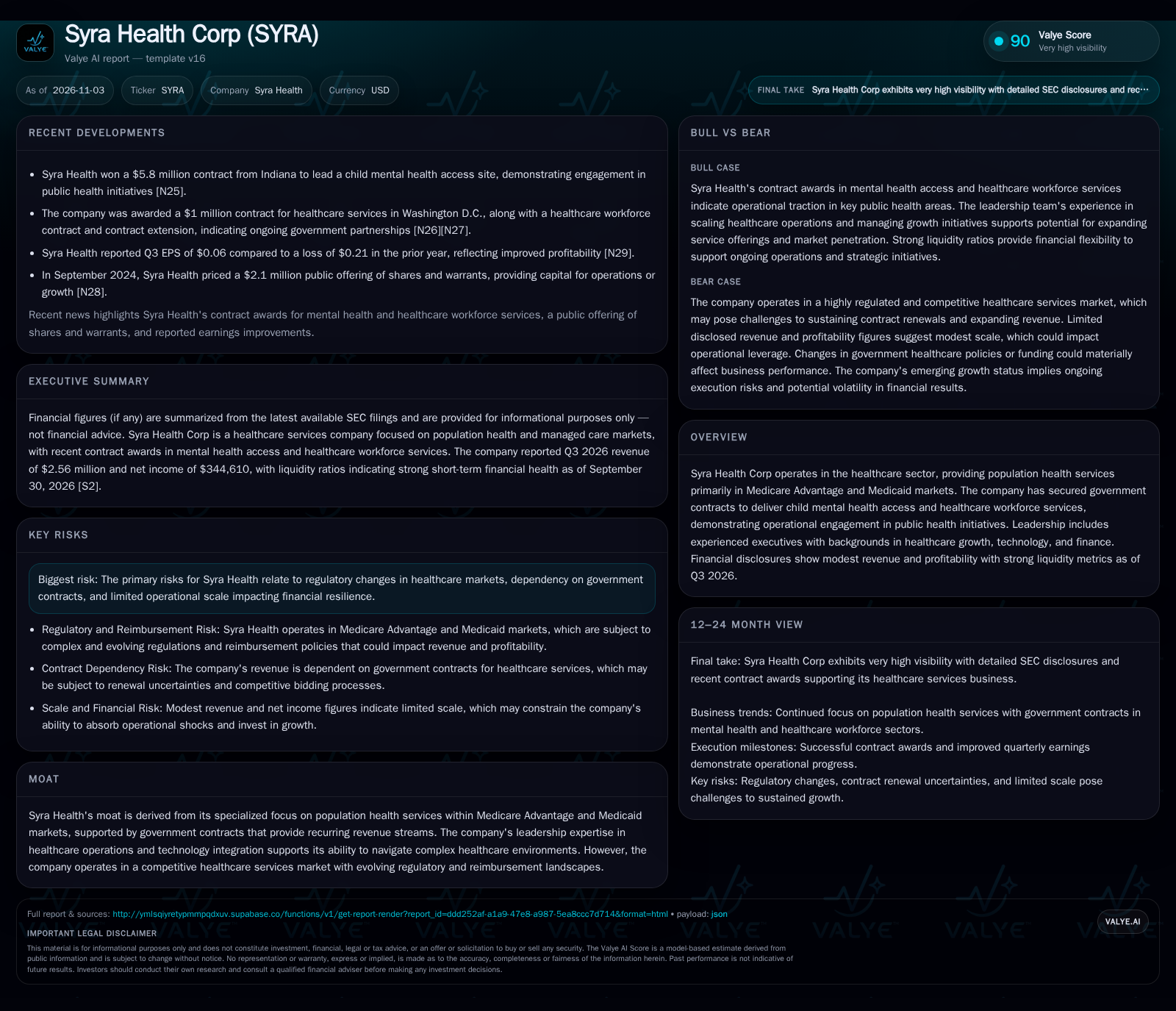
Syra Health’s niche in government-backed population health services has yielded early profitability and reported liquidity position, but its modest scale and contract dependency expose it to regulatory change and competitive bidding. The company’s future hinges on its ability to leverage leadership expertise, operationalize contract wins, and manage the inherent volatility of public-sector healthcare markets.
The company’s experienced leadership and government contract wins may enable growth, but regulatory shifts or contract losses could sharply impact performance [S1] [S2].
Syra Health Corp operates at the intersection of public health priorities and government-funded care, carving out a role in delivering population health and mental health services to Medicare Advantage and Medicaid markets. As regulatory and funding landscapes evolve, Syra Health’s ability to translate contract wins into durable, scalable growth will determine its long-term trajectory.
Recent Financial Performance Underscores Early Profitability—But Scale Remains Modest
Syra Health reported Q3 2026 revenue of approximately $2.56 million and net income of $344,610, with both basic and diluted EPS at $0.02 per share as of September 30, 2026 [S2]. [S2] Despite these positive financial indicators, the absolute revenue and income levels remain modest, reflecting the company’s limited scale and amplifying its vulnerability to operational disruptions or contract volatility. The company’s status as a smaller reporting company and emerging growth company further reinforces the early-stage nature of its business model [S1].
Beyond the headline profitability, a deeper examination of Syra Health’s revenue composition and cost structure would clarify the sustainability of its early financial results. For instance, understanding the proportion of revenue derived from newly awarded contracts versus renewals would illuminate growth momentum and client retention strength. Additionally, insight into the timing and variability of cash collections relative to reported revenue could reveal working capital dynamics that affect liquidity beyond static cash balances. Given the modest scale, even small shifts in contract terms or payment schedules could materially impact near-term cash flow and operational flexibility.
How Government Contracts Shape Revenue Streams and Margin Structure
Syra Health’s core economics are driven by service contracts with government agencies, primarily in population health management, child mental health, and healthcare workforce support. In these arrangements, revenue is typically structured around fixed-fee or per-member-per-month service contracts, with profitability dependent on efficient delivery and tight cost control. The company’s Q3 net income suggests that current contracts are being executed with positive unit economics, but the narrow margin for error is evident given the company’s modest size.
Fixed costs are likely dominated by personnel, compliance, and technology infrastructure, while variable costs scale with service delivery volume. Operating leverage may be achievable if Syra Health can grow contract volume without proportionally increasing overhead. However, the need to invest in compliance, technology integration, and workforce development could create lumpy capital requirements—especially if the company wins larger or multi-state contracts. Cash flow predictability is often higher in government-backed contracts, but renewal risk and payment timing can introduce volatility.
[S2] However, absent significant scale or recurring multi-year contracts, Syra Health’s ability to fund growth internally remains constrained, and external capital may be needed to pursue larger opportunities or weather adverse contract cycles.
The interplay between fixed and variable costs in Syra Health’s model suggests potential for operating leverage, but this depends critically on the company’s ability to efficiently scale service delivery without proportionally increasing overhead. Economies of scale could be realized through investments in technology platforms that automate care coordination or compliance monitoring, thereby reducing marginal service delivery costs. Conversely, if regulatory requirements intensify or if contract complexity increases, compliance costs could rise disproportionately, compressing margins despite revenue growth. Furthermore, the degree to which contract pricing includes inflation adjustments or performance incentives would influence revenue stability and margin predictability over contract durations.
Specialization in Population Health Offers Differentiation, but Barriers to Entry Are Not Insurmountable
Syra Health’s focus on population health services—particularly in managed care and public-sector markets—positions it within a specialized but crowded segment of the healthcare services industry. Its competitive edge is rooted in expertise with government contracting, regulatory compliance, and the operational demands of serving Medicaid and Medicare Advantage populations. Experienced leadership provides credibility in navigating these complex procurement processes [S1].
However, the company faces competition from both large diversified healthcare service providers and niche firms specializing in behavioral health, workforce augmentation, and care management. Barriers to entry are moderate: while regulatory and contracting expertise are required, larger incumbents can leverage scale, existing relationships, and broader service portfolios to compete for the same contracts. Technology-enabled care coordination and data analytics are increasingly important differentiators, but without proprietary platforms or clear network effects, Syra Health’s current moat may be limited to execution speed and relationship management.
Switching costs for public-sector clients are moderate; contract terms are often fixed-duration and subject to competitive rebidding, with performance and cost as key decision criteria. This dynamic can pressure margins and limit pricing power, making operational excellence and renewal rates critical to sustaining growth.
While Syra Health’s government contracting expertise is a competitive advantage, the moderate barriers to entry imply that maintaining differentiation requires continuous innovation in service delivery and client engagement. The growing importance of data analytics and outcome measurement in population health could favor providers that invest in proprietary technology or develop unique clinical insights. If Syra Health can integrate advanced analytics to demonstrate improved health outcomes or cost savings, it may strengthen its competitive positioning and justify premium pricing. However, failure to keep pace with technological advancements or to build scalable infrastructure could leave the company vulnerable to competitors with deeper resources and more comprehensive service offerings.
Operationalizing Contract Wins and Scaling Service Lines Could Unlock Step-Change Growth
If Syra Health successfully leverages its leadership’s experience and secures additional government contracts—especially multi-year or multi-state agreements—it could drive a significant increase in revenue and operating leverage. Expansion into adjacent service lines, such as behavioral health analytics or remote care management, could further diversify the revenue base and improve margins.
Confirmation for this scenario would include a sharp uptick in contract announcements, revenue acceleration that outpaces fixed cost growth, and evidence of multi-year contract awards or expansions. If disclosed, improved renewal rates and customer retention metrics would support the case for durable growth. Margin expansion would indicate effective scaling of operations and successful absorption of incremental volume.
Conversely, a lack of contract wins, sluggish top-line growth, or rising operating expenses without commensurate revenue would challenge this upside thesis.
Maintaining Niche Strength While Navigating Policy Shifts and Execution Risks
The most plausible near-term outlook is that Syra Health maintains a stable but modest growth trajectory, anchored by its existing government contracts in population health and workforce services. Revenue growth may be gradual, reflecting the pace of public-sector procurement and the company’s ability to renew existing agreements. Margins could remain positive but constrained by ongoing investments in compliance, workforce, and technology.
Regulatory changes—such as shifts in Medicaid or Medicare Advantage funding—could alter demand dynamics or require rapid adaptation.
This scenario would be confirmed by steady but incremental revenue increases, consistent contract renewal activity, and stable earnings. Deterioration in contract win rates, or evidence of greater-than-expected cost escalation, would signal a deviation from this base case.
Policy Disruption or Contract Losses Could Expose Fragility of Scale
In a downside scenario, Syra Health faces regulatory changes or funding cuts in its core markets, leading to reduced demand for its services or loss of key contracts. Increased competition or unfavorable rebid outcomes could further compress revenue, while fixed operating expenses limit the company’s ability to rapidly downsize. Delays in payment or contract renewals could strain liquidity despite strong current ratios, particularly if new business is not secured to backfill lost volume.
Evidence supporting this scenario would include sudden revenue declines, loss of significant contracts, rising operating losses, or the need to raise capital to maintain operations. Regulatory developments that curtail Medicaid or Medicare Advantage program funding could also trigger this adverse outcome.
Operational and Policy Milestones That Could Redefine Syra Health’s Trajectory
New government contract wins, especially multi-year or multi-state awards, would indicate the company’s ability to scale and diversify revenue sources.
Contract renewal rates and duration, if disclosed, would help assess the stickiness and visibility of Syra Health’s revenue base.
Gross margin and operating expense trends will reveal whether operational leverage is being achieved as revenue grows.
Changes in federal or state healthcare policy affecting Medicaid, Medicare Advantage, or population health funding could materially alter addressable market dynamics.
Evidence of successful expansion into new service lines—such as behavioral health analytics or telehealth—would test the company’s ability to diversify and grow.
Liquidity and working capital trends should be monitored for early signs of financial stress or the need for additional capital.
Management commentary or disclosures regarding competitive bidding outcomes and pipeline visibility would clarify the near-term growth outlook.
Disclaimer: This is research-only, informational analysis and not investment advice. It may include AI-generated interpretation and general industry context. Always verify important details using primary sources.

Comments