
LTC Properties: Profit Recovery, Demographic Tailwinds, and Healthcare Real Estate Yield Sustainability
The core question is whether LTC can sustain this momentum and mitigate sector headwinds including regulatory risk, operator health, and evolving real estate economics.
The REIT’s exposure to seniors housing and skilled nursing assets positions it to benefit from demographic trends, but sector risks—such as regulatory changes and tenant health—remain material. Sustaining profitability will depend on LTC’s ability to manage operator relationships, occupancy, and capital allocation in a shifting healthcare landscape. [S2] [N1] [N4] [N5] [N8]
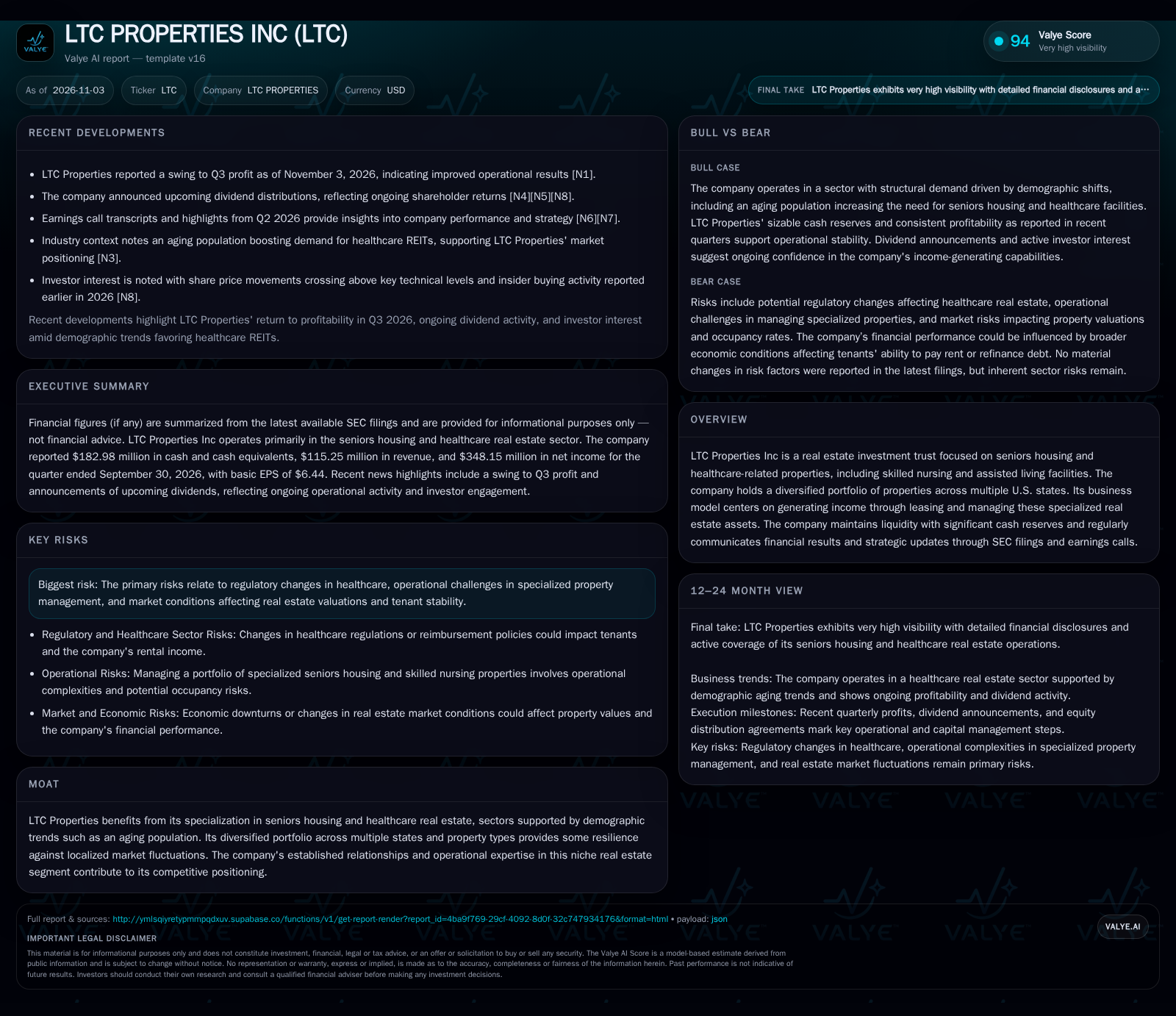
LTC Properties’ Q3 2026 results marked a notable turnaround, with the company returning to profitability and maintaining a reported cash position while continuing regular dividend payouts. As a healthcare REIT focused on seniors housing and skilled nursing facilities, LTC’s future will be shaped by its ability to harness demographic tailwinds, safeguard asset yields, and adapt to evolving regulatory and operating environments. The durability of recent gains will depend on execution across property management, tenant stability, and capital allocation as sector dynamics continue to shift.
Profitability Returns and Capital Strength Define the Current Landscape
LTC Properties swung to a Q3 2026 profit, reporting $115.25 million in revenue and $348.15 million in net income for the quarter ended September 30, 2026. This financial turnaround is particularly significant in a sector often pressured by tenant distress and regulatory flux. The company’s cash and cash equivalents stood at $182.98 million, providing notable liquidity as of the latest quarter. The cited source reports dividend-related activity; that disclosure alone does not establish dividend-policy continuity, management confidence, or a material constraint on capital flexibility. No material changes in risk factors were reported in the most recent 10-Q, suggesting operational stability but not eliminating sectoral uncertainty. [S2] [N1] [N4] [N5] [N8]
The company reported cash and liquidity metrics for the period; these figures do not by themselves establish operating runway, investment capacity, financial flexibility, or financing capacity. The cited source reports dividend-related activity; that disclosure alone does not establish dividend-policy continuity, management confidence, or a material constraint on capital flexibility. Continuous monitoring of cash flow adequacy relative to dividend commitments and capital expenditure plans is therefore critical to assess potential financial flexibility.
How LTC’s Revenue Model and Capital Allocation Shape Outcomes
LTC Properties generates income primarily through rent from triple-net leases and, to a lesser extent, direct operating participation in seniors housing and skilled nursing facilities. This model leverages the stability of long-term leases but exposes the company to tenant credit risk and sector-specific volatility—particularly in skilled nursing, where reimbursement rates and operator solvency can shift rapidly.
The REIT structure channels most taxable income to shareholders via dividends, constraining retained earnings but supporting yield-driven investor appeal. Capital expenditures are typically moderate, with significant outlays only for property acquisitions, repositioning, or redevelopment.
The interplay between fixed lease income and variable property-level performance is central: when tenants are healthy, LTC enjoys predictable cash flows; when operators struggle, rent collections and asset values may come under pressure. The company’s ability to manage this balance—through underwriting, portfolio diversification, and selective operator support—will determine the sustainability of its distribution model and potential for NAV growth.
The reliance on triple-net leases in LTC’s portfolio introduces a nuanced risk-return tradeoff. While these leases transfer many operating expenses to tenants, reducing landlord exposure to variable costs, they also concentrate credit risk on tenant solvency. In healthcare real estate, tenant financial health is closely linked to external factors such as regulatory reimbursement rates and demographic demand, which can fluctuate independently of broader economic cycles. Consequently, LTC’s underwriting discipline and portfolio diversification strategies are pivotal in mitigating concentrated credit risk and preserving stable income streams. Capital allocation decisions must balance the pursuit of accretive acquisitions against the risk of overexposure to operators facing sector-specific headwinds.
Specialization in Seniors Housing and Skilled Nursing: Advantage or Exposure?
LTC’s focus on seniors housing and skilled nursing assets positions it within a niche of the healthcare REIT sector that is structurally supported by demographic aging. This specialization offers potential advantages in underwriting, operator relationships, and property management expertise compared to diversified or generalist REIT peers.
However, these same assets are exposed to unique risks: skilled nursing operators are highly sensitive to Medicare/Medicaid reimbursement changes, wage/labor pressures, and evolving care models. Seniors housing faces occupancy risk tied to local market supply, shifting consumer preferences, and the pace of post-pandemic recovery. Larger healthcare REITs with broader portfolios may enjoy greater geographic and asset-type diversification, potentially smoothing returns during sector-specific shocks.
LTC’s competitive resilience will depend on its ability to maintain tenant quality, negotiate favorable lease structures, and identify growth opportunities that do not unduly raise risk. If operator distress remains contained and demographic-driven demand persists, LTC’s specialized focus could enhance returns; if sector headwinds intensify, this concentration could amplify downside volatility.
Geographic concentration within LTC’s portfolio can amplify exposure to localized regulatory changes or market dynamics, such as state-level Medicaid policy adjustments or regional labor market constraints. While specialization in seniors housing and skilled nursing enhances operational expertise and tenant relationship management, it may limit the REIT’s ability to offset localized downturns through geographic diversification. The interplay between demographic tailwinds and competitive supply growth in specific markets further complicates occupancy and rent growth prospects. Therefore, LTC’s strategic focus on markets with favorable demographic and regulatory profiles, combined with active asset management, is essential to sustaining competitive advantage and mitigating downside risks inherent in a specialized portfolio.
Demographic Demand and Operator Recovery Drive Sustained Yield Expansion
A favorable scenario for LTC Properties involves the convergence of robust demographic demand—driven by the aging U.S. population—and stabilization or improvement among its major operators. As occupancy rates in seniors housing and skilled nursing facilities rise, rent coverage improves, reducing the risk of tenant defaults and enabling LTC to collect full contractual rent.
Moderate Growth Anchored by Stable Occupancy and Prudent Capital Management
The most plausible trajectory for LTC over the next 12-24 months is one of moderate growth, underpinned by stable occupancy and cautious capital deployment. The company maintains its current portfolio, collects the majority of contractual rents, and continues to pay regular dividends, leveraging demographic tailwinds to offset sector volatility.
Incremental growth may come from selective acquisitions or redevelopment projects funded by existing cash or periodic equity raises, but large-scale expansion is likely tempered by competitive asset pricing and ongoing tenant/operator risks. Operating leverage remains contained, with rent escalators and modest occupancy gains balancing inflationary pressures and potential regulatory changes.
Operator Distress, Regulatory Shocks, and Occupancy Decline Erode Asset Yield
A negative outcome for LTC would be triggered by a combination of operator distress—driven by reimbursement cuts, labor cost spikes, or localized oversupply—and adverse regulatory changes impacting rent collections or asset values. If key tenants default or seek rent concessions, LTC could face reduced cash flows, impairments, or the need to assume property operations directly, straining management resources and margins.
A sustained drop in occupancy rates, particularly in seniors housing, would further pressure rental income and potentially lead to asset write-downs.
Evidence for this scenario would include rising rent collection issues, increased tenant bankruptcies or restructurings, negative property revaluations, and any suspension or reduction of the dividend.
Testing the LTC Thesis: Performance, Operator Health, and Sector Signals to Track
Quarterly rent collection rates and the proportion of rent paid versus contractual amounts (if disclosed) would help gauge tenant health and operational risk.
Occupancy rates across the seniors housing and skilled nursing portfolio—rising, stable, or declining—would signal real-time demand and revenue sustainability.
Any reported rent deferrals, abatements, or operator restructurings would indicate emerging stress or the need for proactive asset management.
Property revaluations, impairments, or asset sales—particularly at prices above or below book value—would impact NAV and investor sentiment.
Regulatory or reimbursement policy updates affecting skilled nursing or seniors housing economics would reshape risk and return assumptions.
A useful metric would be the weighted average lease term remaining and rent coverage ratios by top tenants, which would clarify risk concentration and earnings visibility.
Disclaimer: This is research-only, informational analysis and not investment advice. It may include AI-generated interpretation and general industry context. Always verify important details using primary sources.

Comments