
Aldel Financial II: SPAC Structure, Trust Asset Leverage, and the Clock on Financial Services Deal Flow
Aldel Financial II Inc. sits at the pre-merger crossroads typical for SPACs—armed with nearly $250 million in trust assets, reported liquidity position, and a tight focus on the financial services sector. With no operations or revenue beyond investment income, its future pivots entirely on executing a transformative business combination before the SPAC window closes.
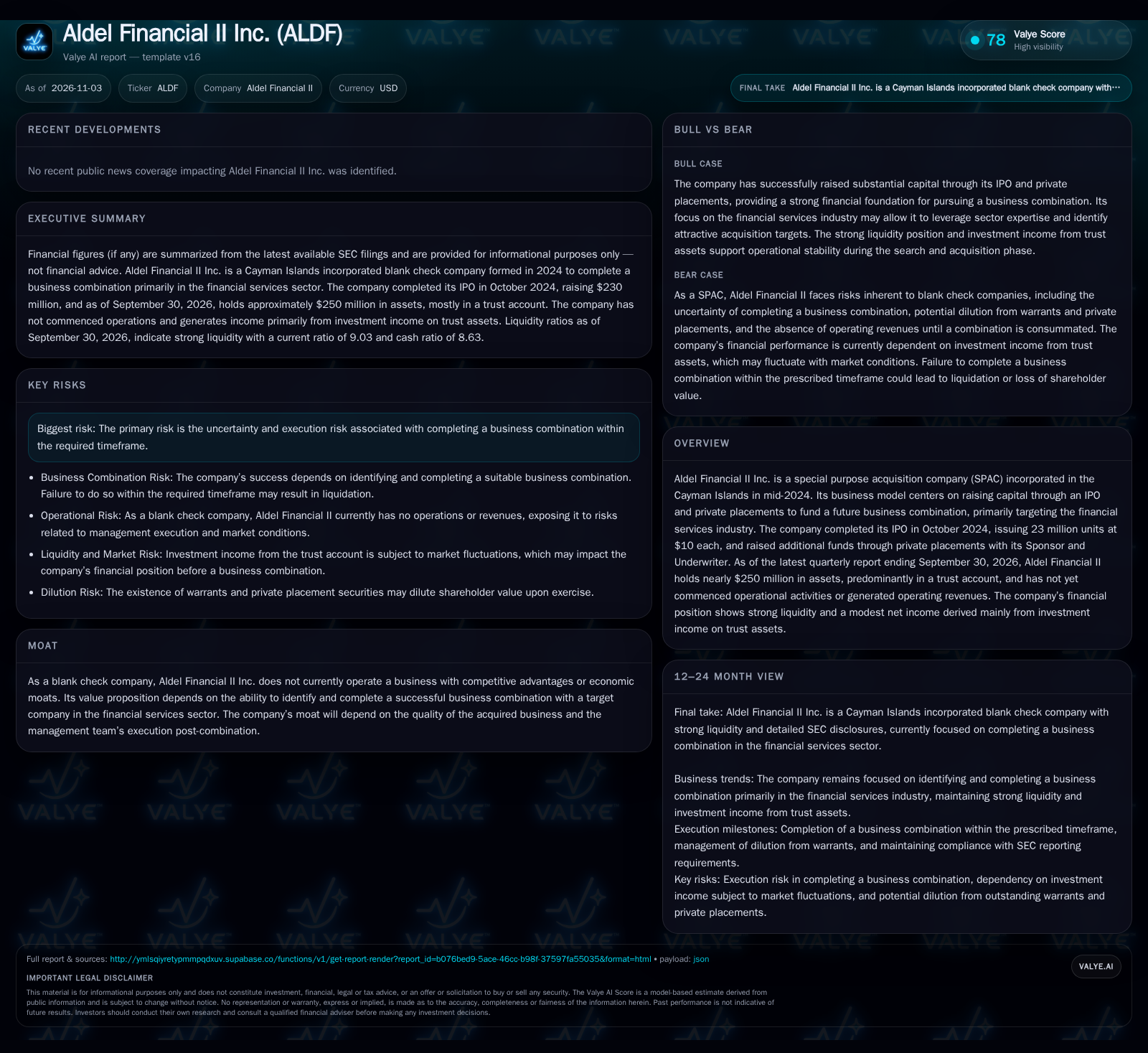
Aldel Financial II Inc., a Cayman Islands-incorporated SPAC, has raised $230 million via IPO and private placements, and holds nearly $250 million in trust assets as of September 30, 2026. [S2]
Aldel Financial II Inc. exemplifies the modern SPAC: flush with IPO-raised capital and trust assets, yet wholly dependent on finding and closing an acquisition to create real enterprise value. As of September 30, 2026, the company’s nearly $250 million in trust, paired with high liquidity ratios and zero operating revenue, underscores both its readiness to transact and its existential vulnerability. The next phase will be defined by the search for a suitable financial services target, the negotiation of deal terms, and the challenge of turning a shell into a sustainable business—all against the ticking clock of SPAC regulations and investor patience. [S2]
Trust Assets, Liquidity, and the Absence of Operations: Where Aldel Financial II Stands
Aldel Financial II Inc. is a Cayman Islands-based blank check company, or SPAC, formed in mid-2024 with the express purpose of effecting a business combination, particularly in the financial services sector. As of September 30, 2026, Aldel had not commenced operations or generated operating revenue; its net income of $2.16 million for the recent quarter was derived almost entirely from investment income on nearly $250 million held in trust. The company’s current assets of $219,852 and current liabilities of $24,340 yield a current ratio of 9.03 and a cash ratio of 8.63, indicating reported liquidity position for its limited ongoing expenses. The IPO in October 2024 raised $230 million through 23 million units at $10 each, combining Class A shares with half-warrants, and private placements with the sponsor and underwriter added further capital. With 10,178,194 Class A shares and 1 Class B share outstanding as of November 3, 2026, Aldel’s entire economic story remains predicated on executing a qualifying acquisition before its regulatory clock runs out. [S2]
How Value Could Be Created: SPAC Economics, Dilution, and the Deal Imperative
Aldel Financial II’s economics are currently those of a financial holding shell: the trust account generates investment income, but no operating revenues exist until an acquisition closes. The IPO structure—units with shares and half-warrants—means that future business value must eventually be shared with warrant holders, introducing dilution risk upon a successful deal. The trust assets are generally restricted and cannot be used for general operations or acquisition targets until a deal is approved by shareholders. Upon a successful merger, the economics shift dramatically: Aldel would inherit the revenue, cost structure, and capital needs of the acquired entity, while facing redemption risk (as some shareholders may opt for cash rather than participate in the new venture) and the impact of warrant exercises. The economics of the eventual combined entity will depend on the profitability, growth prospects, and capital intensity of the chosen target—factors currently unknowable but critical to the ultimate outcome.
SPACs, Sponsor Reputation, and the Race for Attractive Financial Services Targets
Aldel Financial II’s competitive position is defined by its access to capital, sector focus, and sponsor network. In the crowded SPAC landscape, differentiation often hinges on the sponsor’s deal-sourcing capability, sector expertise, and credibility with both targets and investors. The company’s focus on financial services could be advantageous if it brings specialized evaluation skills or relationships that unlock proprietary deal flow. However, Aldel competes with a large cohort of other SPACs, private equity funds, and strategic acquirers, all hunting for accretive targets in a sector known for regulatory complexity and valuation challenges. The SPAC structure itself can be both a draw and a deterrent for targets: it offers rapid public listing and cash, but often at the price of heavy scrutiny and potential post-merger volatility. The terms of Aldel’s warrants and sponsor economics could also shape its appeal to targets and investors, as excessive dilution or misaligned incentives can undermine post-deal value creation.
Catalyst Chain: Successful Acquisition Unlocks Value and Market Re-Rating
The bull case for Aldel Financial II rests on its ability to identify, negotiate, and close a business combination with a high-quality financial services target. If the sponsor leverages its network to secure a proprietary deal—one that is accretive, growth-oriented, and operationally robust—Aldel could deliver value to shareholders via both the initial merger and the post-combination business performance. Confirmation of this scenario would include a definitive merger announcement with a credible, growing target; a favorable investor reception (measured by low redemption rates and positive trading action); and clear post-deal guidance on strategy, synergies, and growth potential. Further validation would be evident if the combined company attracts long-term investors, secures analyst coverage, and demonstrates early operational execution. Falsification would occur if the announced deal is met with high redemptions, skepticism about target quality, or failure to close.
SPAC Clock Ticks: Most Likely, Protracted Search and Standard Redemption Dynamics
The most plausible scenario is that Aldel continues its search for a suitable financial services target, facing the typical challenges of SPACs in a competitive and sometimes overheated market. The search could stretch closer to the regulatory deadline, with investor sentiment fluctuating as the clock ticks. If a deal is announced, it may be with a mid-tier or less differentiated company, leading to a mix of redemptions and continued shareholder participation. The post-merger entity could face integration hurdles, warrant dilution, and the need to quickly establish credibility as an operating company. Evidence supporting this scenario would be incremental SEC filings about target evaluation, engagement of advisors, and eventual deal announcement with moderate redemption rates. Falsification would involve either a failure to announce a deal by the SPAC’s deadline or, conversely, a high-quality target that drives unusually low redemptions and strong aftermarket performance.
Deal Failure, Liquidation, and Shareholder Value Erosion
The primary risk is that Aldel Financial II fails to identify or close a business combination within the prescribed timeframe, triggering SPAC liquidation. In this event, shareholders would receive their pro rata share of the trust account, but warrants would expire worthless, and sponsor economics would be wiped out. Even if a deal is announced, it could be poorly received—due to target quality, valuation, or adverse market conditions—leading to high redemptions and limited capital for the combined company. Downside confirmation would include repeated extensions, lack of credible target announcements, or a failed shareholder vote. Further evidence would be a regulatory or market shift that makes SPAC deals less attractive to targets, or a sharp decline in trust asset value due to market turmoil. The downside could also be exacerbated by dilution from warrants and private placements if the deal is marginal.
Milestones and Data Points That Will Define Aldel Financial II’s Outcome
Announcement of a definitive merger agreement, including target identity, sector fit, and transaction structure.
Shareholder redemption rates upon deal announcement and at the merger vote—if disclosed, these will reveal investor confidence and capital retention.
Post-announcement trading activity and aftermarket performance of the combined entity, if and when a deal closes.
SEC filings detailing extensions, updated deadlines, or modifications to the SPAC structure.
Changes in trust asset value or investment income, especially if market conditions shift and impact the trust portfolio.
Any indication of regulatory or legislative changes affecting SPAC transactions or the financial services sector.
Sponsor or board member purchases or sales of founder shares or private placement securities, if disclosed, as a signal of perceived deal quality or timing.
Level of warrant exercises post-combination, as this will impact dilution and final capital structure.
Disclaimer: This is research-only, informational analysis and not investment advice. It may include AI-generated interpretation and general industry context. Always verify important details using primary sources.

Comments