
Lake Superior Acquisition Corp: SPAC Structure Pressures and the Race for a Viable Business Combination
As a blank-check company with no operating revenue, its value and risks hinge on its ability to execute a value-creating business combination before deadlines or adverse market/regulatory shifts intervene.
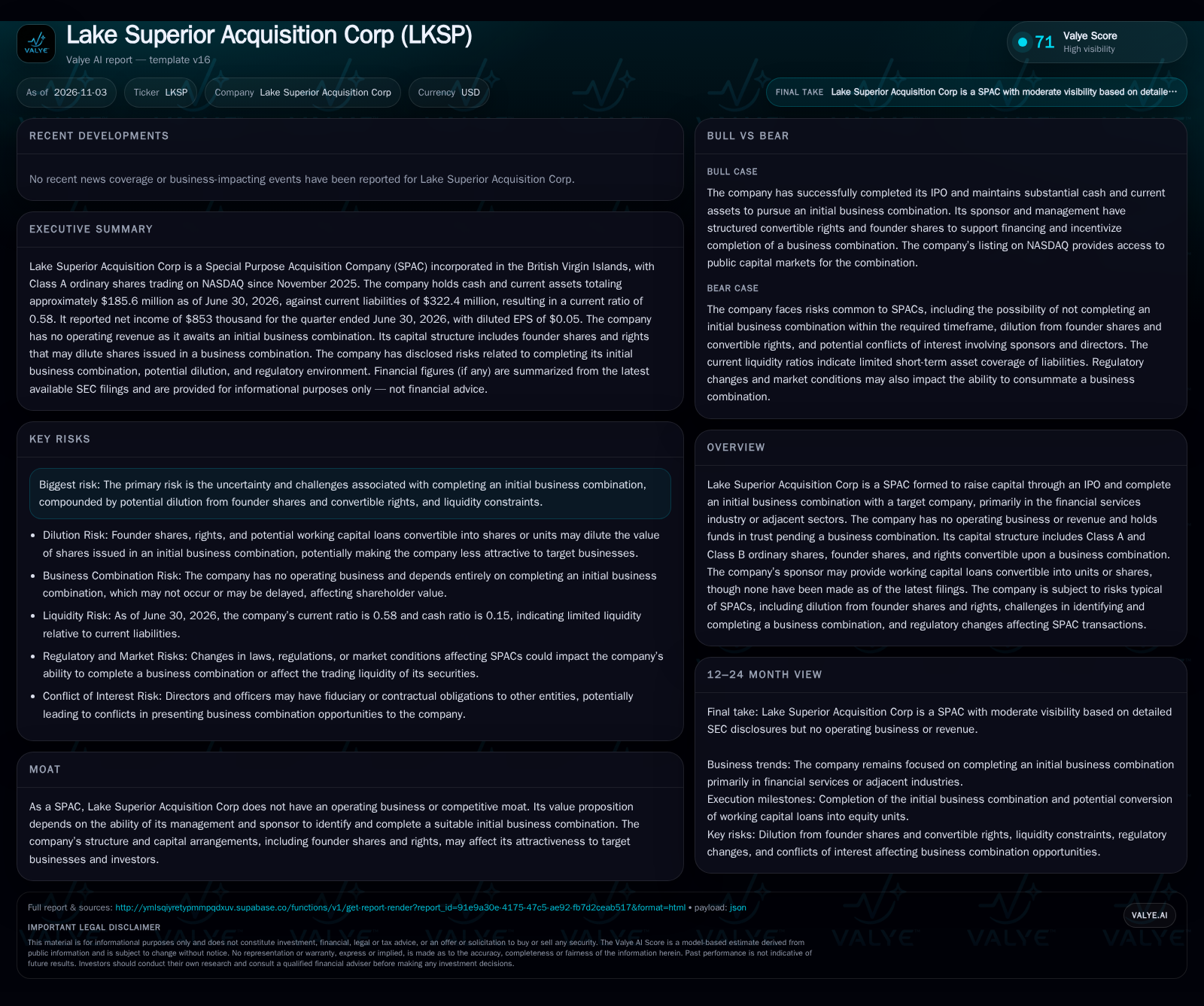
Lake Superior Acquisition Corp is a SPAC with $185.6 million in current assets and $322.4 million in current liabilities as of June 30, 2026, resulting in a reported current ratio of 0.58. The company has not commenced operations or generated revenue, with net income reflecting non-operating items. Its capital structure includes founder shares and rights that may dilute public shareholders upon a business combination. [S2]
Lake Superior Acquisition Corp stands at a crossroads typical of late-stage SPACs: flush with trust capital but facing a shrinking window to complete a business combination. With no operating business or revenue, its reported net income is a function of non-operating items rather than commercial success. The company’s low liquidity ratios and looming dilution from founder shares and rights create a complex calculus for both shareholders and prospective targets. The essential question is whether management can secure a value-accretive deal before regulatory, market, or structural headwinds erode the SPAC’s appeal and flexibility. [S2]
Liquidity, Dilution, and the Absence of a Business Combination: Where Lake Superior Stands
Lake Superior Acquisition Corp has not commenced operations or generated operating revenue as of November 2026, remaining in the pre-merger phase typical of SPACs. Its balance sheet as of June 30, 2026, shows $185.6 million in current assets against $322.4 million in current liabilities, resulting in a current ratio of 0.58 and a cash ratio of 0.15. These ratios reflect the structural mechanics of SPACs, where trust capital is largely restricted until a business combination is consummated. The company also reported net income of $853 thousand for the quarter ended June 30, 2026, but this figure is not indicative of operating profitability, as the company has yet to execute a business combination. Critically, the capital structure includes founder shares and rights that will dilute public shareholders upon the closing of a deal, a dynamic that may influence negotiation leverage and the economics of any future transaction. [S2]
SPAC Value Creation: How Lake Superior Could Monetize Its Platform
Lake Superior’s economic model is entirely contingent on executing a successful business combination. Until then, the company earns only minimal interest income on trust assets. Upon a merger, the SPAC’s value proposition depends on acquiring a target at a price that creates upside for public holders even after accounting for dilution from founder shares, rights, and potential sponsor loans converted to equity. This structure is inherently dilutive: founder shares (Class B) and rights convert into additional Class A shares, lowering the ownership percentage of public shareholders post-merger.
SPACs typically face significant transaction costs, including deferred underwriting fees and legal expenses, which further erode available capital for the target. The low current and cash ratios reflect that much of the trust capital is not accessible for general corporate purposes pre-merger, making the company reliant on sponsor loans or additional fundraising if unexpected costs arise. The economics for public investors thus hinge on the SPAC’s ability to source a target that can absorb the dilution and still deliver attractive post-merger value. If the eventual merger is perceived as low-quality, redemptions may spike, further reducing available capital and increasing the risk of deal failure or post-merger underperformance.
SPAC Marketplace Dynamics: Competing for Scarce, High-Quality Targets
Lake Superior operates in a crowded SPAC landscape, competing with numerous other blank-check companies for a shrinking pool of high-quality private targets. As the SPAC cycle matures, many attractive targets have already merged or opted for traditional IPOs, raising the bar for what constitutes a compelling deal. Regulatory scrutiny has also increased, with evolving SEC rules aiming to improve disclosure and investor protection, which can slow deal timelines and increase compliance costs.
Unlike operating companies, Lake Superior has no commercial moat or differentiated offering. Its attractiveness to targets rests on the sponsor’s reputation, the amount of cash held in trust, and the terms of the proposed deal—including how much dilution the target's owners and public shareholders must absorb. The presence of founder shares and rights can make Lake Superior less appealing to sophisticated targets, who may prefer to negotiate with SPACs that offer cleaner capital structures or more flexible transaction terms. In this environment, speed, sponsor networks, and the ability to structure creative, minimally dilutive deals become critical competitive levers.
Unlocking Value: A High-Quality Target and Muted Redemptions Drive Success
The best-case scenario for Lake Superior is the identification and successful merger with a private company that possesses strong growth prospects, credible management, and a compelling post-merger equity story. If the deal is announced with favorable terms—limited dilution, strong strategic logic, and target financials that excite public investors—redemptions may remain low, preserving the cash in trust and maximizing the capital available to the new entity.
Signs that would confirm this scenario include: a robust merger announcement with a recognized, high-quality target; minimal public shareholder redemptions during the vote; and favorable analyst or market reaction to the deal structure and target fundamentals. Post-merger, sustained trading above the $10/unit SPAC trust value would indicate market confidence. This outcome would validate the sponsor’s deal-sourcing ability and could create meaningful upside for both public and founder shareholders.
Business Combination Under Pressure: A Typical SPAC Outcome with Moderate Dilution
The most plausible scenario is that Lake Superior identifies a viable but not marquee target—likely a mid-sized private company looking for public-market access without the rigors of a traditional IPO. The deal terms may involve moderate dilution from founder shares and rights, and redemptions could be significant but not overwhelming, reducing the cash delivered to the target but allowing the transaction to close.
Confirmation would come from a deal announcement with a credible, if not headline-grabbing, target, and successful completion of the shareholder vote with redemptions within industry norms. The post-merger entity may trade near or slightly below trust value, reflecting market uncertainty about the target’s prospects and the impact of dilution. If the company manages to close a deal before regulatory or market windows close, this outcome would represent a typical, if unremarkable, SPAC lifecycle. Falsification would occur if the company fails to announce a deal, faces overwhelming redemptions, or is forced to liquidate.
Deal Failure, Heavy Redemptions, or Regulatory Shifts Erode Shareholder Value
The adverse scenario centers on Lake Superior’s inability to secure an acceptable target within the required timeframe or under evolving regulatory scrutiny. As deadlines approach, the risk of a rushed or low-quality merger increases. If a proposed deal is perceived as unattractive—either due to excessive dilution, weak target fundamentals, or unfavorable market conditions—public shareholders may redeem en masse, depleting trust capital and potentially causing the deal to collapse.
Evidence for this path would include repeated extensions of the business combination deadline, lack of credible merger announcements, or a deal that triggers high redemptions and negative market reaction. Regulatory changes could further complicate or delay the process, while continued absence of sponsor loans or additional funding would limit flexibility. In the worst case, failure to complete a business combination would force Lake Superior to liquidate, returning remaining trust funds to shareholders (less expenses), and resulting in the loss of sponsor capital and opportunity cost for public holders.
Milestones That Will Define Lake Superior’s SPAC Outcome
Announcement of a definitive business combination agreement with a credible, high-quality target—deal size, industry, and financial profile would help test the thesis.
Level of public shareholder redemptions at the time of the business combination vote—if disclosed, a high redemption rate would pressure deal economics and post-merger cash.
Conversion or initiation of sponsor working capital loans, which, if utilized, could signal cash needs but also increase dilution risk.
Changes in SPAC regulatory environment, including SEC rule updates or new market practices that affect deal timelines or structure.
Disclosure of additional transaction costs, including fees or expenses beyond those already reported—would affect net trust proceeds.
Any amendments to the terms of founder shares, rights, or sponsor agreements that could impact dilution or transaction attractiveness.
Evidence of target company quality, including financial statements, management background, and industry positioning, if and when a merger is announced.
Shareholder vote timing and results—delays, extensions, or failed votes would materially affect the outlook.
Disclaimer: This is research-only, informational analysis and not investment advice. It may include AI-generated interpretation and general industry context. Always verify important details using primary sources.

Comments