
Univest Financial Corp: Profitability, Disclosure Gaps, and the Limits of Visibility in Regional Banking
The company’s ability to navigate margin pressures and deliver on expectations may determine its future trajectory.
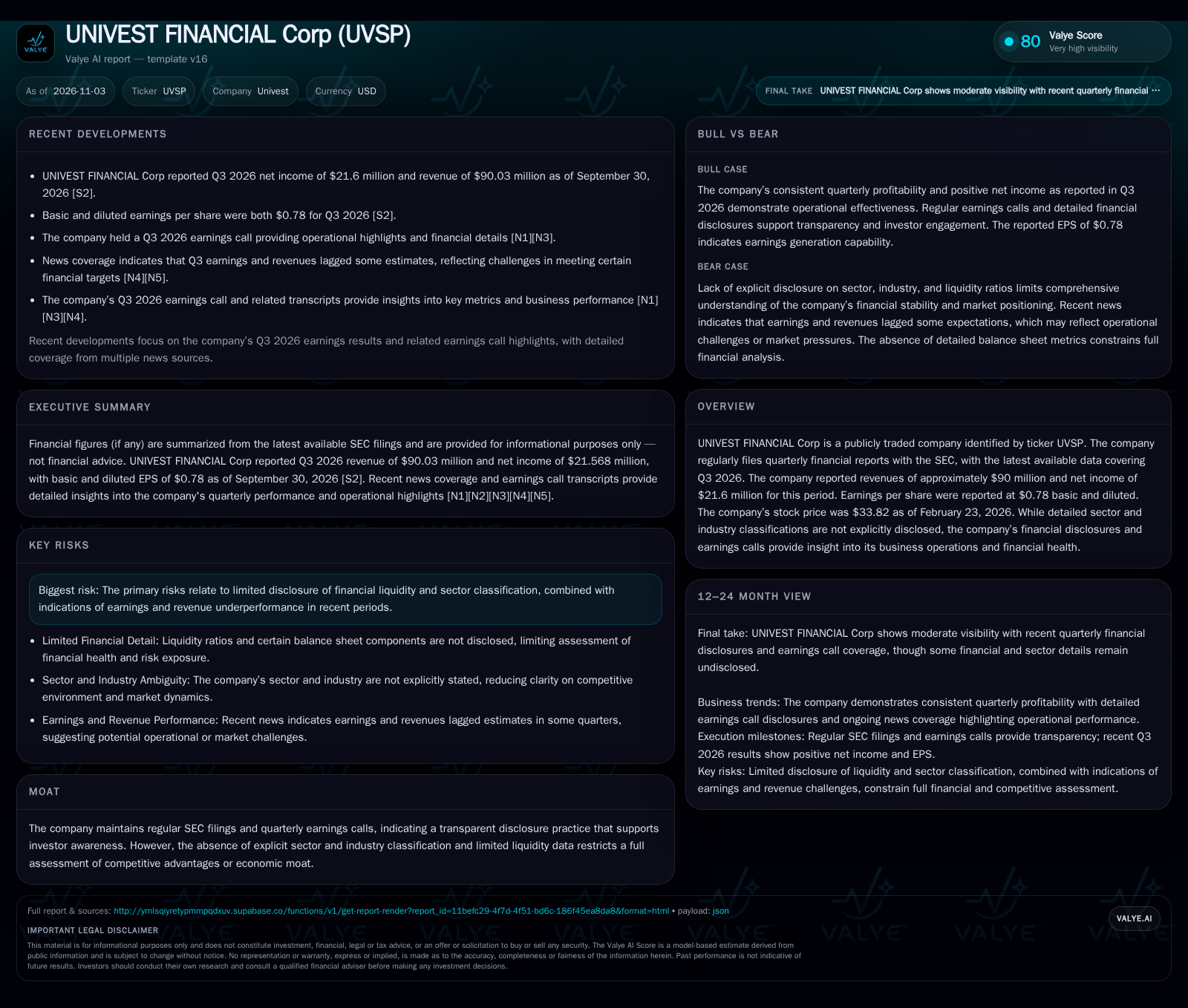
Univest Financial Corp reported Q3 2026 revenue of $90.03 million and net income of $21.57 million, with EPS at $0.78. News coverage indicates Q3 results lagged some expectations, raising questions about operational momentum and risk management going forward. [S2] [N2] [N4] [N5]
Univest Financial Corp’s third-quarter 2026 results confirm a pattern of sustained profitability, with $90 million in revenue and over $21 million in net income. While regular earnings calls and transparent reporting practices bolster investor confidence, Q3’s revenue and net income lagged some analyst expectations, highlighting the importance of operational execution and risk management in the periods ahead.
Recent Results Highlight Profitability and Disclosure Limits
Univest Financial Corp reported Q3 2026 revenue of $90.03 million and net income of $21.57 million, translating to basic and diluted EPS of $0.78. These results reflect ongoing profitability and suggest a stable earnings engine over recent quarters. However, news coverage notes that both earnings and revenues lagged some estimates, flagging possible operational or market challenges during the period [S2] [N4] [N5]. Notably, the company’s latest filings do not disclose liquidity ratios such as current or cash ratio, leaving a gap in balance-sheet transparency [S2]. The absence of explicit sector and industry classification further limits direct peer comparisons and competitive mapping.
Revenue Streams, Cost Structure, and the Role of Operating Leverage
While the company’s precise business model is not detailed, its regular financial disclosures and public trading status suggest a traditional operating structure—likely as a regional bank or diversified financial services provider—focused on interest income, lending, and fee-based services. In such models, revenue is typically driven by net interest margin (NIM), loan growth, and non-interest income streams such as service fees and wealth management. The reported net income margin of roughly 24% in Q3 2026 indicates a potentially efficient cost structure, but the absence of segment breakdowns or non-interest expense data precludes a deeper analysis of fixed versus variable cost leverage.
Operating leverage in regional financials often comes from the ability to scale non-interest income and manage credit costs as the loan book expands. However, without disclosure of loan loss provisions, deposit mix, or asset composition, it is not possible to assess the sustainability of margins or vulnerability to credit shocks. Capital requirements are another critical factor in banking economics; the lack of disclosed liquidity or capital ratios means investors cannot gauge the company’s flexibility to absorb losses, pursue growth, or respond to regulatory changes.
In addition to the fundamental drivers of revenue and cost, the interplay between interest rate cycles and asset-liability management critically shapes profitability in regional banking models. If Univest’s loan portfolio is heavily weighted toward fixed-rate assets, rising interest rates could compress net interest margins unless funding costs are similarly constrained. Conversely, a predominantly variable-rate loan book could enable quicker repricing benefits but may introduce volatility in interest income. The absence of detailed asset composition data limits the ability to assess interest rate sensitivity, which is pivotal in forecasting earnings stability amid macroeconomic shifts. Furthermore, the balance between retail and commercial lending segments, each with distinct risk and return profiles, would influence capital allocation and risk management strategies.
Cost structure dynamics also warrant a nuanced view beyond headline margins. Fixed costs such as branch network maintenance and compliance expenses may limit scalability, especially if digital transformation investments are required to remain competitive. Variable costs linked to loan origination and servicing can fluctuate with volume and credit quality, affecting operating leverage. Without granular expense disclosures, it remains unclear whether Univest’s profitability gains stem from genuine efficiency improvements or temporary cost deferrals. Additionally, the potential impact of regulatory capital requirements and stress testing on capital allocation decisions could constrain growth or prompt strategic shifts toward lower-risk, lower-return assets, thereby influencing future revenue and margin trajectories.
Transparency Versus Market Ambiguity: Benchmarking Without a Sector Lens
Univest’s regular SEC filings and earnings calls support a culture of transparency, but the lack of sector and industry classification complicates competitive benchmarking. If Univest operates as a regional bank, its primary competitors would be other community and regional banks, credit unions, and potentially fintech platforms targeting similar customer bases. In this context, competitive advantages often stem from local relationship banking, cost efficiency, and differentiated service offerings.
However, the absence of explicit product, geographic, or customer segmentation data limits the ability to identify unique selling propositions or switching frictions. If the company relies heavily on traditional lending, it may face substitution risk from digital-first lenders or larger institutions with scale-driven cost advantages. Conversely, a strong local franchise or niche specialization could provide some insulation from commoditization and pricing pressure—but this cannot be confirmed from the current disclosures.
Margin Expansion and Franchise Strength Drive Outperformance—If Confirmed by Mix and Credit Metrics
A favorable scenario for Univest would see the company leverage its core franchise to grow loans and deposits, expand fee income, and maintain strong asset quality. If operating leverage is achieved through expense control and digital channel adoption, margins could widen even in a competitive rate environment. Outperformance relative to peers may be possible if the company demonstrates above-average credit discipline and capital flexibility, allowing it to weather macro shocks and invest in growth initiatives.
Confirmation of this scenario would require disclosure of loan growth rates, non-interest income expansion, credit loss metrics, and capital ratios. Evidence of diversified revenue streams, stable or improving net interest margin, and low non-performing asset levels would further support the case. Conversely, a lack of such detail or signs of rising credit costs would undermine the upside thesis.
Sustained Profitability Amidst Modest Growth and Ongoing Disclosure Gaps
The most plausible trajectory is that Univest continues to deliver steady, if unspectacular, earnings and revenue growth, supported by prudent balance-sheet management and a focus on core banking operations. Regular earnings calls and filings suggest management is committed to transparency, even if key financial ratios remain undisclosed. In this scenario, the company maintains profitability but may struggle to command a valuation premium without clearer evidence of sector leadership, margin resilience, or differentiated growth levers.
Confirmation would come from continued delivery of positive net income and stable EPS, regular disclosure practices, and absence of major credit or operational shocks. Lack of improvement in disclosure depth, persistent lag versus analyst expectations, or evidence of margin compression would signal the persistence of current constraints.
Earnings Misses Compound With Balance-Sheet Ambiguity to Erode Confidence
The risk scenario for Univest features ongoing or worsening underperformance relative to expectations, with earnings and revenue misses persisting over successive quarters. If these are accompanied by deteriorating credit quality, rising expenses, or margin compression—none of which can currently be tracked due to disclosure gaps—investor confidence could erode quickly.
Confirmation of this scenario would come from further misses versus consensus, negative news flow regarding asset quality, or any regulatory scrutiny related to capital or liquidity. Improved transparency or a reversal in operating performance would be required to arrest this negative spiral.
What Would Actually Validate or Challenge the Univest Thesis?
Disclosure of liquidity and capital ratios—if provided—would clarify financial resilience and risk-bearing capacity.
Quarterly loan growth and deposit inflow metrics, if disclosed, would indicate underlying demand and competitive positioning.
Trends in net interest margin and non-interest income mix would help reveal the sustainability of current profitability.
Credit quality indicators such as non-performing assets or loan loss provisions—if reported—would test the robustness of the earnings base.
Expense control and efficiency ratio trends, if made available, would indicate operating leverage and management discipline.
Comparative analysis versus peer group performance, should sector and industry details emerge, would sharpen the competitive lens.
Quarterly management commentary on macro conditions and strategic priorities would help anticipate shifts in risk or opportunity.
Disclaimer: This is research-only, informational analysis and not investment advice. It may include AI-generated interpretation and general industry context. Always verify important details using primary sources.

Comments