
GPODS, INC.: Development-Stage Ambition Meets Urban Agriculture’s Resource Demands
GPODS, INC. is attempting to carve out a niche in urban micro-farming with modular, technology-enabled indoor growing systems—but faces immediate existential pressure from its limited resources, pre-revenue status, and the challenge of breaking into a highly competitive, capital-intensive market.
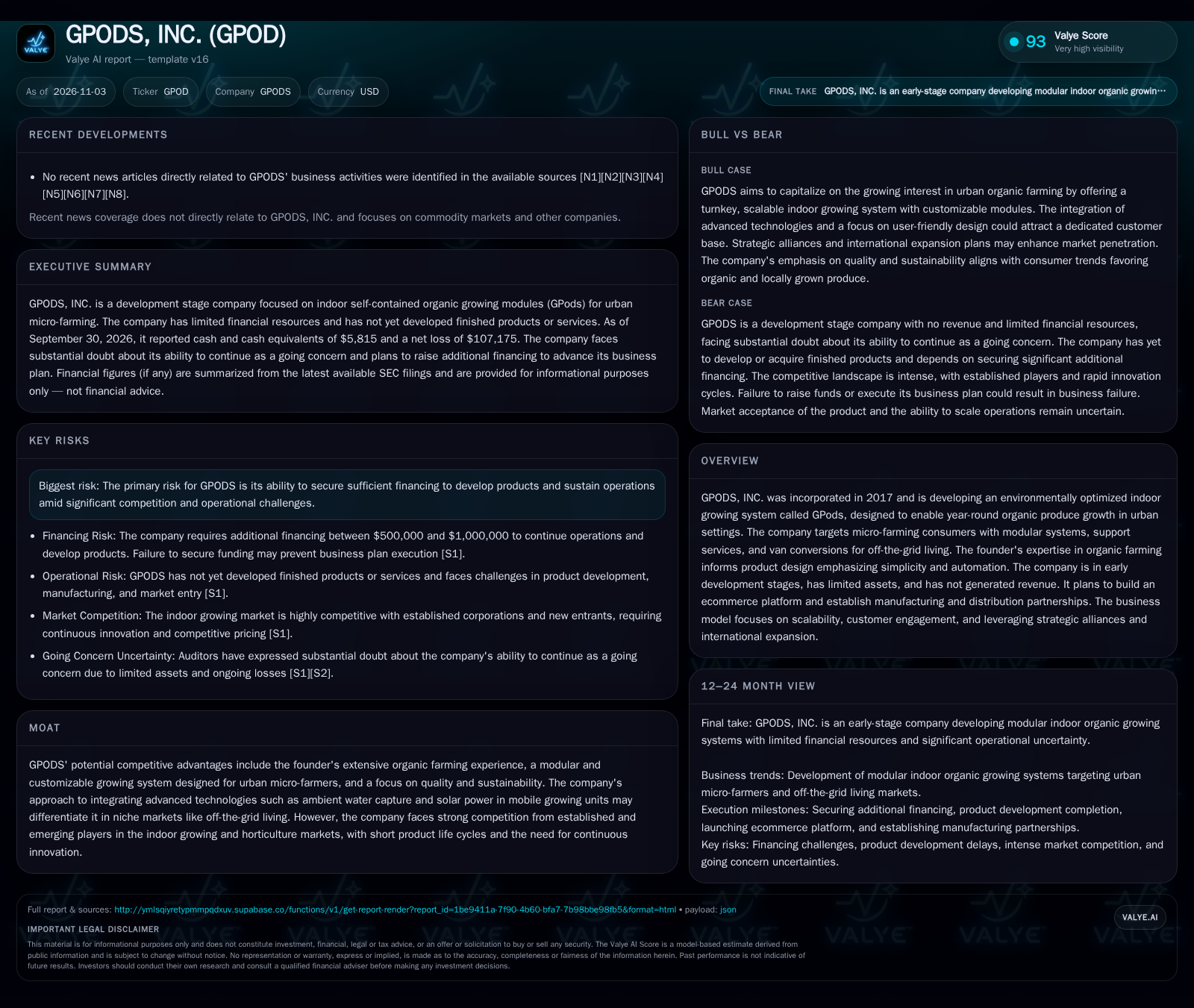
GPODS, INC. is a pre-revenue business developing modular indoor organic growing systems aimed at urban and off-grid consumers. With only $5,815 in cash as of September 2026, significant net losses, and no finished products or services, the company’s future depends on raising $500,000–$1,000,000 in new funding. The real test will be converting its founder’s expertise and technological vision into a scalable, differentiated product in a crowded and rapidly evolving market [S1] [S2].
GPODS, INC. is betting on the convergence of urbanization, sustainability, and consumer demand for fresh, organic produce by developing modular indoor growing systems for micro-farming enthusiasts. The core challenge is not just product development, but also proving that GPODS can achieve differentiation and scale in a market dominated by well-funded competitors and fast-moving innovation cycles [S1] [S2].
GPODS’ Early-Stage Status and Funding Gap Define Its Immediate Outlook
As of September 30, 2026, GPODS, INC. remained a pre-revenue entity with only $5,815 in cash and current assets totaling $7,247, posting a net loss of $107,175 for the period [S2]. The company has not yet developed any finished products or services and faces substantial doubt about its ability to continue as a going concern [S1] [S2]. Management has disclosed plans to raise between $500,000 and $1,000,000 in additional financing to fund product development and working capital [S1]. These facts frame a business with significant operational and existential risk: the absence of commercialized products, acute funding needs, and the need to quickly convert vision into a viable offering in order to survive.
Economic Model: Modular Systems, Service Potential, and Capital Constraints
GPODS’ proposed economic engine centers on selling GPod modular systems for indoor organic growing, with ancillary revenue from support services and van conversions for off-grid living [S1]. If executed, such a model could feature a mix of upfront hardware sales (growing modules and van systems) and recurring or service-based revenue (customer support, consumables, or digital services). The target market—urban micro-farming consumers—may be willing to pay a premium for turnkey, automated, and sustainable solutions, but price sensitivity and capital outlays could limit initial adoption.
Fixed costs are likely to be significant in the near term, including R&D, prototyping, regulatory compliance (for food-grade or electrical systems), and ecommerce platform development. Variable costs will depend on materials, supply chain efficiency, and service delivery. Operating leverage could be attractive if the company scales, as core R&D and digital infrastructure costs could be spread over growing unit volumes. However, high upfront capital needs and the lack of current revenue mean cash burn and funding requirements will remain acute until commercial traction is established.
The plan to source raw materials from multiple suppliers with no geographic limitations could help avoid single-source bottlenecks but may also present logistical complexity and working capital strain in the absence of scale [S1]. The company’s ability to manage these economics will be tested by its initial funding round and early market response.
Competing in a Crowded Indoor Agriculture Arena
GPODS enters a market characterized by established horticultural equipment manufacturers, high-tech vertical farming startups, and consumer-focused indoor gardening brands. Many incumbents offer hydroponic or aeroponic systems, smart garden appliances, and integrated ecosystem platforms, often with significant R&D and marketing budgets. The company’s stated differentiators—simplicity, automation, sustainability, modularity, and potential for off-grid deployment—may appeal to niche segments, particularly urban dwellers and vanlife enthusiasts seeking self-sufficiency [S1].
However, barriers to entry are high: customer acquisition costs, brand trust, and technical reliability are critical in a market where consumers expect robust, low-maintenance solutions. Without demonstrable product advantages or a strong go-to-market strategy, GPODS risks being outpaced by both large corporations and agile startups. The company’s lack of finished products and limited resources amplify these competitive challenges, making rapid innovation and clear differentiation essential for survival.
If GPODS Delivers a Scalable, Differentiated Product, Early Adopter Momentum Could Follow
A favorable scenario unfolds if GPODS successfully develops and launches its modular indoor growing systems, leveraging its founder’s organic farming expertise and integrating advanced features such as automation, ambient water capture, and energy efficiency. Early adoption among urban micro-farmers and off-grid consumers could drive initial sales, while the ecommerce platform expands reach and enables customization. If the company is able to secure the targeted $500,000–$1,000,000 in funding, it could invest in manufacturing partnerships and customer support infrastructure, building credibility and brand equity [S1].
Confirmation of this scenario would come from product launch announcements, robust pre-orders or initial sales figures, successful completion of a funding round, and evidence of positive customer engagement or media coverage. Signs of strategic partnerships or early adopter advocacy would further validate commercial potential. Falsification would be evident if product development stalls, funding is not secured, or customer response is tepid despite a market launch.
Most Likely: Slow Progress and Ongoing Cash Flow Strain as GPODS Seeks Traction
The most plausible path is one of incremental progress punctuated by ongoing operational and financial strain. GPODS may secure a modest amount of funding, enabling limited product development and early market testing. However, delays in finalizing the product, securing manufacturing, or achieving meaningful sales could extend the pre-revenue phase and increase the risk of additional dilution or down-round financing. The company might struggle to differentiate itself in a crowded field, facing slow customer adoption and persistent cash burn until a clear product-market fit is demonstrated.
Evidence confirming this middle ground would include partial funding rounds, beta product launches, continued net losses, and limited but growing customer interest. The scenario could be falsified if either a significant funding event or a commercial breakthrough (large order, strategic partnership) accelerates the company’s trajectory—or if operational setbacks force a retrenchment or pivot.
Failure to Secure Funding or Launch Products Could Lead to Business Cessation
The primary risk for GPODS is existential: failure to raise the necessary $500,000–$1,000,000 in new financing would likely halt product development and could force the company to wind down operations [S1]. Even if some funding is secured, unresolved product development challenges or inability to compete effectively could prevent revenue generation and erode any remaining cash. Intense competition, supply chain complexity, or regulatory hurdles could further derail progress.
Evidence of this adverse scenario would be unsuccessful capital raises, continued going concern warnings, executive departures, or the public acknowledgment of strategic alternatives such as asset sales or liquidation. A lack of product development milestones or extended silence regarding commercialization plans would reinforce the risk of failure.
Milestones That Will Determine Whether GPODS Can Transition from Vision to Viability
Completion and public demonstration of a working GPod prototype, with clear articulation of its differentiating features and technical reliability.
Announcement and closing of a financing round in the $500,000–$1,000,000 range, with terms and investor composition that support ongoing product development [S1].
Launch of the ecommerce platform with initial product availability, and disclosure of any pre-order or early sales data (if disclosed).
Evidence of manufacturing or distribution partnerships that enable scalable production and delivery to customers.
Customer feedback, reviews, or case studies from early adopters, indicating real-world performance and satisfaction.
Updates on regulatory compliance or certifications relevant to indoor food production systems, where applicable (if disclosed).
Disclosures regarding cash burn rate, runway, and any further funding needs beyond the initial target (if disclosed).
Disclaimer: This is research-only, informational analysis and not investment advice. It may include AI-generated interpretation and general industry context. Always verify important details using primary sources.

Comments