
MPLX LP: Contractual Visibility, Margin Uncertainty, and the Implications of Asset Repositioning
A 12.5% distribution hike and a $4.2 billion asset sale underscore MPLX’s evolving capital strategy, but declining attributable earnings despite rising revenues highlight margin and cost pressures. The company’s dependence on long-term contracts with Marathon Petroleum provides revenue stability, yet the mix of asset divestitures and board expansion signals both strategic flexibility and exposure to shifting industry and partner dynamics.
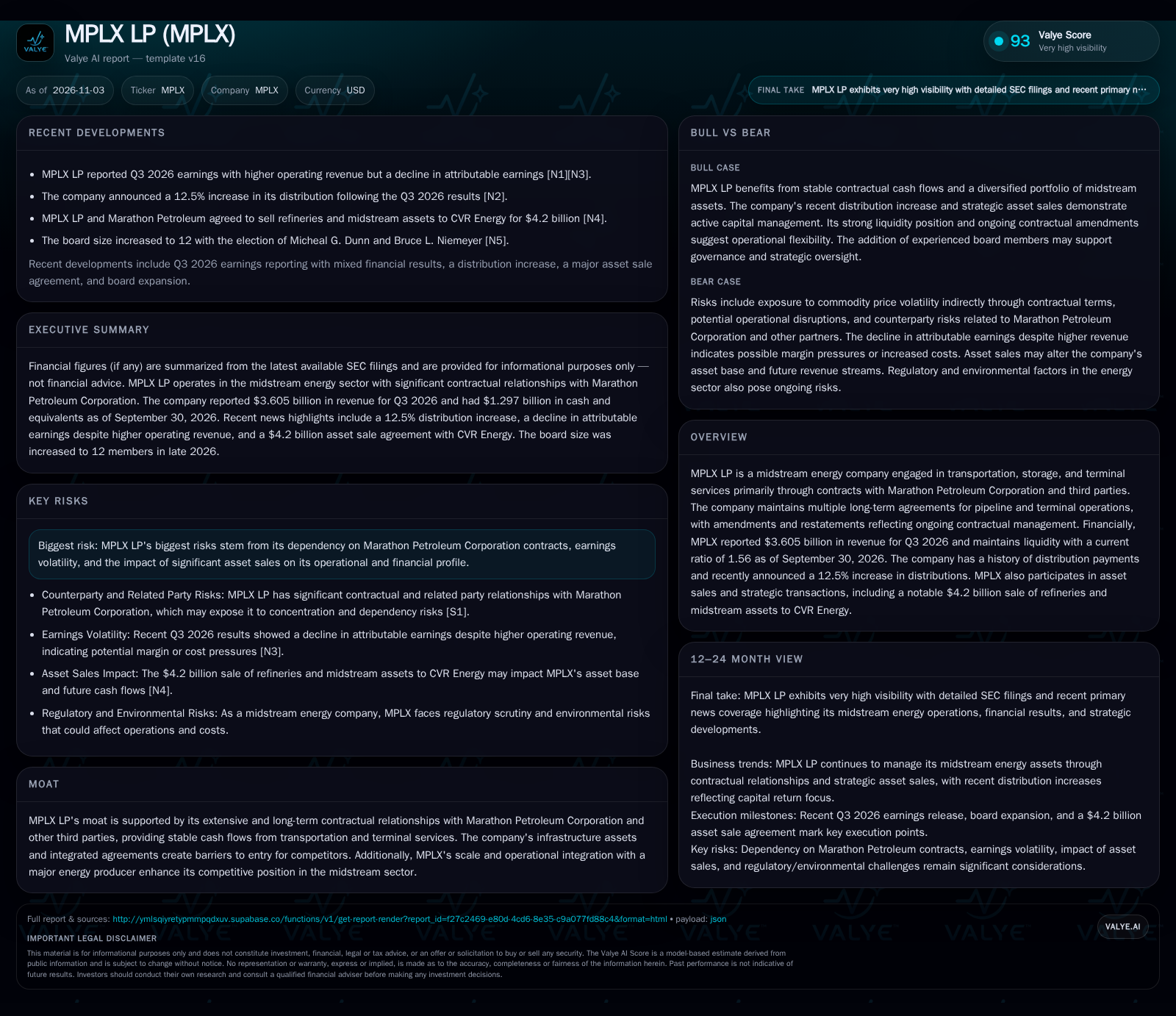
MPLX LP reported $3.605 billion in Q3 2026 revenue and raised its distribution by 12.5% after closing a $4.2 billion asset sale with Marathon Petroleum to CVR Energy. Despite higher operating revenue, attributable earnings declined, pointing to potential margin pressures. The company’s business remains anchored by long-term contracts with Marathon Petroleum, but the asset base and cash flow profile are shifting amid sector and partner evolution. [S1] [S2] [N1] [N2] [N3] [N4]
MPLX LP’s latest developments paint a picture of a midstream operator in transition: while Q3 2026 saw a 12.5% distribution increase and a major $4.2 billion asset sale, the company also reported a decline in attributable earnings despite higher revenue. This tension between headline growth and underlying profitability surfaces key questions about cost structures, margin resilience, and the durability of MPLX’s capital return strategy. With long-term contracts—especially with Marathon Petroleum—continuing to anchor the business, MPLX finds itself balancing contractual stability with the risks and opportunities of asset portfolio shifts and industry change. [S2] [N1] [N2] [N3] [N4]
Recent Distribution Hike, Asset Sale, and Margin Compression: What’s Changed for MPLX?
MPLX LP reported $3.605 billion in revenue for Q3 2026, but attributable earnings declined even as top-line growth persisted—a sign that cost pressures or margin erosion are impacting results. [S2] [N1] [N3] The company announced a 12.5% increase in its distribution following these results, signaling a commitment to capital returns. [N2] In parallel, MPLX and Marathon Petroleum agreed to sell refineries and midstream assets to CVR Energy for $4.2 billion, a transaction that will alter the company’s asset base and could reshape future cash flows. [N4] The expansion of the board to 12 members with two new directors may reflect governance responses to increased operational complexity. [N5] Together, these moves suggest a company actively managing both its capital structure and its strategic risk profile amid evolving sector dynamics.
Revenue Anchors and the Economics of Contract-Driven Midstream Operations
MPLX’s business model is structurally tied to long-term transportation and terminal service agreements, predominantly with Marathon Petroleum and its subsidiaries. These contracts, typically featuring fixed or volume-based fees, offer a degree of revenue predictability that is atypical in other parts of the energy value chain. As a result, MPLX’s top-line is less sensitive to spot commodity prices and more reliant on throughput volumes and contract renewal terms. The company’s Q3 2026 revenue of $3.605 billion reflects this contractual stability, but the simultaneous decline in attributable earnings suggests that rising operating costs, inflation-linked expense escalators, or lower-margin asset mix may be eroding profitability. [S2] [N1] [N3]
Operating leverage is a key feature of midstream economics: high fixed costs mean incremental throughput can significantly boost margins, but the reverse is also true if volumes or contract rates soften. The recent asset sale to CVR Energy for $4.2 billion could reduce MPLX’s fixed cost base and free up capital, but may also lower future revenue streams unless proceeds are redeployed into higher-return assets or used to reduce debt and interest expense. The 12.5% distribution increase suggests management’s confidence in future cash flows, but its sustainability depends on the underlying economics post-divestiture. [N2] [N4]
Capital needs in the midstream sector are substantial, particularly for maintenance and regulatory compliance. The company reported cash and liquidity metrics for the period; these figures do not by themselves establish operating runway, investment capacity, financial flexibility, or financing capacity. [S2]
Contractual Moats, Concentration Risks, and Peer Pressures in Midstream Energy
MPLX’s competitive position is built on its integrated asset footprint and long-term contractual relationships, especially with Marathon Petroleum. This alignment provides a moat against new entrants, as replicating such infrastructure and securing similar contract volumes requires substantial capital and longstanding customer trust. The company benefits from high barriers to entry—both regulatory and capital-intensive—and a network effect from its interconnected pipeline and storage assets.
However, this same contractual model creates counterparty concentration risk. Marathon Petroleum is not only a major customer but also a related party, meaning MPLX’s fortunes are partially tied to the operational and financial health of its parent. Any shift in Marathon’s throughput needs, contract renegotiations, or strategic direction could materially impact MPLX’s revenue base.
Competition in the midstream sector comes from other large pipeline operators, diversified energy logistics platforms, and, to a lesser extent, emerging alternatives such as rail or shipping for bulk transport. Additionally, sector-wide pressure from regulatory scrutiny, energy transition trends, and evolving customer requirements could gradually erode the pricing power or relevance of legacy assets. Asset sales, like the recent $4.2 billion transaction, may be a response to such pressures, but they also risk ceding scale advantages if not offset by reinvestment or operational gains. [N4]
If Asset Recycling and Capital Return Strategies Unlock New Value
In a favorable scenario, MPLX’s asset sale proceeds are redeployed into higher-return, lower-risk projects—such as expanding fee-based pipeline segments or investing in infrastructure tied to emerging fuels—while the company maintains or grows its distribution. The company’s reported liquidity position could enable opportunistic acquisitions or debt reduction, enhancing per-unit distributable cash flow and improving its cost of capital. If cost discipline is restored and margin pressures abate, attributable earnings could rebound, validating the recent distribution hike and supporting further increases.
Confirmation of this scenario would require evidence of successful post-sale capital deployment, improved operating margins, stable or rising distributable cash flow, and continued contract renewals or expansions with major customers. A track record of integrating new assets or optimizing the portfolio for energy transition trends would further bolster the upside case.
Contract Stability Offsets Margin Pressures, but Distribution Growth Moderates
The most plausible near-term trajectory is that MPLX continues to generate stable revenue from its core contractual base, but faces ongoing margin pressure due to higher operating costs, inflation, or less favorable asset mix after divestitures. Distributions remain elevated following the recent 12.5% increase, but further growth is constrained by the need to balance capital returns with reinvestment and debt management.
This scenario would be supported by evidence of steady contract renewals with Marathon Petroleum and third parties, a stable (but not expanding) earnings base, and prudent capital allocation that prioritizes maintenance and selective growth over aggressive expansion. Margin stabilization—even if at a lower level—would indicate that cost and operational headwinds are being managed. Conversely, signs of rising leverage, further earnings declines, or contract renegotiations at lower rates would challenge this base case.
Margin Erosion and Asset Base Shrinkage Undermine Cash Flow Durability
A negative scenario emerges if the decline in attributable earnings accelerates—driven by persistent cost inflation, unfavorable contract renewals, or loss of scale following major asset sales. If proceeds from the CVR Energy transaction are not effectively redeployed, MPLX could face a shrinking asset base and reduced revenue visibility, while still being obligated to maintain or grow distributions to meet investor expectations.
This scenario would be confirmed by further declines in net income, deteriorating coverage ratios for distributions, increased reliance on debt, or material contract losses with Marathon Petroleum or other large customers. Regulatory or environmental incidents could also exacerbate cost pressures or force additional asset sales at unattractive valuations.
Signals That Will Shape MPLX’s Cash Flow Visibility and Strategic Viability
The evolution of operating margins and attributable earnings in upcoming quarters—especially relative to revenue trends—will clarify whether recent cost pressures are transitory or structural.
Updates on the redeployment of $4.2 billion in asset sale proceeds, including whether funds are allocated to debt reduction, acquisitions, or shareholder returns, will indicate future earnings power. [N4]
Renewal terms, duration, and volume commitments in major contracts with Marathon Petroleum and third parties—particularly any changes in pricing or take-or-pay structures—would help test the degree of revenue stability. [S1]
Any further changes in board composition, management turnover, or governance policies may signal shifting strategic priorities or responses to operational complexity. [N5]
Distribution coverage ratio trends—whether cash flow from operations continues to comfortably cover payouts—will be crucial for assessing the sustainability of the new distribution policy.
Level and trend of maintenance and growth capital expenditures, especially post-asset sale, will reveal whether MPLX is investing for future competitiveness or prioritizing near-term returns.
External developments: regulatory changes, environmental compliance costs, or macro shifts in North American energy demand could rapidly alter the economics of MPLX’s core assets.
Disclaimer: This is research-only, informational analysis and not investment advice. It may include AI-generated interpretation and general industry context. Always verify important details using primary sources.

Comments