
Broadridge’s Regulatory Anchor Meets Technological Crosscurrents: Can Stability Outpace Disruption?
Broadridge Financial Solutions continues to deliver revenue growth from its entrenched position in regulated investor communications and securities processing, but faces rising margin pressure and existential threats from technology shifts, client consolidation, and evolving delivery models. The company’s ability to adapt its business model and maintain its moat will determine whether its high visibility translates into durable value.
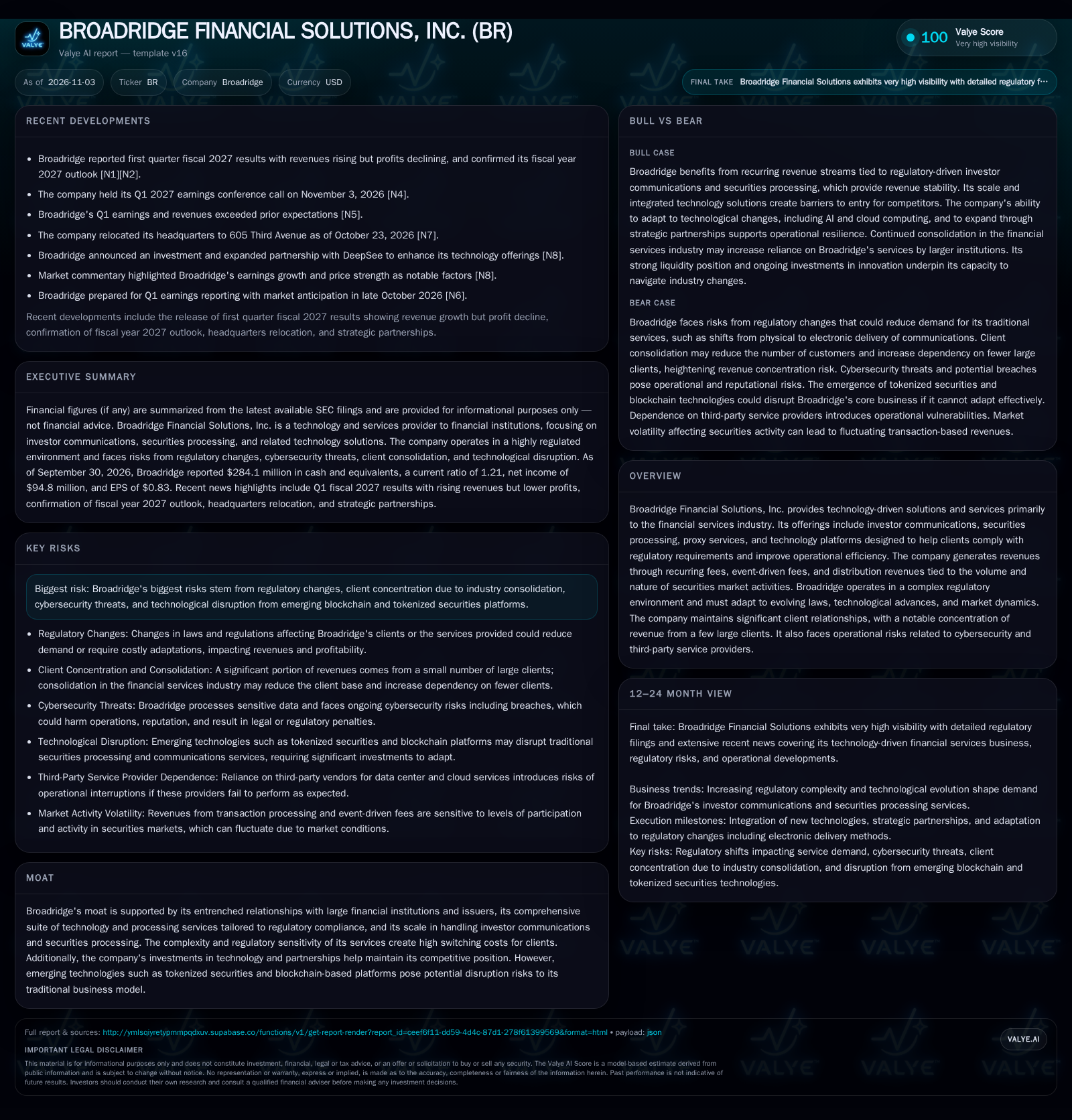
Broadridge’s Q1 FY27 revenues rose while profits declined, highlighting both its resilience and exposure to margin pressure. Its business rests on regulatory-driven recurring revenues, but faces structural challenges from industry consolidation, technological disruption (notably tokenization and blockchain), and regulatory shifts toward electronic communications. The concentration of revenue among a few large clients and dependence on third-party providers add to operational risks. The core question: Can Broadridge leverage its scale and relationships to adapt faster than the market changes beneath it? [N1] [N2] [S2]
Broadridge Financial Solutions sits at the intersection of regulation, technology, and market structure. Its long-standing role as an indispensable intermediary for investor communications and securities processing provides stability through recurring revenues and entrenched client relationships. Yet the company is now navigating a landscape defined by margin pressures, accelerating digital transformation, and the risk of disintermediation from new technologies like blockchain. As profits dip and industry consolidation intensifies, Broadridge’s future will hinge on its ability to evolve its business model, deepen partnerships, and defend its moat against both regulatory and technological headwinds. [N1] [N2] [S2]
Recent Results Reveal Growth-Resilience but Margin Strain
Broadridge reported rising revenues but declining profits in its first quarter of fiscal 2027, with both metrics exceeding prior expectations. This dynamic—top-line expansion coupled with profitability pressure—highlights the company’s ability to maintain momentum even as it absorbs higher costs or faces pricing pressure. The company confirmed its fiscal year 2027 outlook, suggesting confidence in its core business lines despite these headwinds. Notably, Broadridge’s largest client represented about 7% of consolidated revenues in fiscal 2026, underscoring significant client concentration risk. The company reported cash and liquidity metrics for the period; these figures do not by themselves establish operating runway, investment capacity, financial flexibility, or financing capacity. The company also recently relocated its headquarters, a logistical move that signals investment in its operational footprint. [N1] [N2] [N5] [N7] [S2]
Recurring Revenues Anchor Stability, but Fee Structures Face Erosion Risks
Broadridge’s financial model is built on recurring fees tied to regulatory-mandated investor communications (such as proxy mailings and annual statements) and securities processing. These predictable, contract-based revenues provide unusually high visibility and buffer the business against short-term market swings. Event-driven and distribution revenues—dependent on transaction volume and market activity—introduce some top-line variability, especially in volatile or declining markets.
The economic engine relies on scale: Broadridge processes enormous volumes of communications and trades, leveraging fixed-cost technology platforms to drive operating leverage as volumes rise. However, this leverage can work in reverse if regulatory reforms (for example, mandatory electronic delivery) shrink physical mailings, compressing high-margin distribution revenues. The shift toward digital communication and straight-through processing could also reduce fee pools or require costly platform upgrades, pressuring margins.
Capital needs are moderate for a technology and services company, with ongoing investments in cybersecurity, compliance, and platform modernization. The balance between fixed platform costs and variable event-driven volumes is delicate—if digitalization accelerates or market activity slumps, Broadridge may see negative operating leverage. The company’s dependency on third-party data centers and cloud services may also introduce less control over infrastructure costs and risk exposure, particularly in the event of outages or escalating vendor fees. [S2]
Entrenched Relationships and Regulatory Complexity Provide Moat—For Now
Broadridge’s competitive position is grounded in its deep integration with large financial institutions and issuers, its ability to navigate complex regulatory requirements, and its scale in handling high-volume, high-stakes transactions. The company’s suite of services is woven into the compliance and operations fabric of its clients, creating real switching frictions: regulatory risk, operational disruption, and integration cost all deter clients from changing providers.
However, the moat is not unassailable. The rise of blockchain-based securities platforms and tokenized assets presents a credible threat of disintermediation, potentially enabling issuers and investors to bypass traditional intermediaries for both processing and communications. Furthermore, as digital delivery becomes the norm, the rationale for complex, outsourced communication logistics may weaken. Competitors range from established financial technology vendors to nimble startups leveraging distributed ledger technology, as well as in-house solutions developed by the largest global custodians and brokerages.
Broadridge’s scale, regulatory expertise, and long-term contracts give it an edge, but the durability of these advantages depends on its ability to integrate next-generation technologies and maintain relevance as market structure evolves. Ongoing investments in AI, cloud, and blockchain integration will be critical to defending its position. [S2]
If Regulatory Complexity and Industry Consolidation Deepen, Broadridge’s Platform Could Become Even Stickier
In the most favorable scenario, regulatory requirements become more complex and demanding, reinforcing the need for robust, outsourced solutions. Simultaneously, further consolidation among financial institutions leads to larger, more entrenched clients that are even less likely to switch providers due to the rising cost and risk of migration. Broadridge successfully adapts by integrating advanced digital delivery and AI-driven automation, offsetting any loss in physical distribution revenues with new digital workflow and compliance products.
The company’s investments in emerging technologies—such as blockchain for proxy voting or tokenized asset processing—pay off, allowing Broadridge to participate in, rather than be displaced by, the next wave of market infrastructure evolution. Event-driven revenues from increased capital markets activity or new regulatory mandates could further boost results.
Evidence supporting this scenario would include expanded multi-year contracts with top-tier clients, new product launches leveraging AI/blockchain, stable or rising margins despite digital migration, and regulatory proposals that increase compliance complexity rather than reduce it. Confirmation would come from robust digital revenue growth outpacing declines in legacy distribution fees, and from Broadridge being selected as a technology partner for next-generation financial market infrastructure initiatives.
Digital Shift and Margin Pressure Offset by Incremental Platform Upgrades and Retained Client Base
The most plausible outcome is a gradual transition: Broadridge maintains the bulk of its recurring revenues as regulatory requirements and client inertia continue to support its core services, but faces ongoing margin pressure as physical communications decline and digital delivery grows. The company adapts incrementally, introducing new digital products and automations that partially replace lost distribution revenues, but must continually invest to keep pace with evolving client and regulatory expectations.
Client consolidation continues, increasing revenue concentration risk, but the operational complexity of switching providers keeps most large clients in place. Occasional losses to in-house or startup competitors are offset by new mandates (such as ESG reporting or digital asset compliance) that reinforce the value of Broadridge’s integrated platform.
This scenario would be confirmed by steady top-line growth in the low- to mid-single digits, stable but pressured operating margins, and continued high renewal rates among major clients. Evidence of ongoing investment in technology upgrades and incremental product launches—rather than transformative reinvention—would support this path. Falsification would come from sharp drops in legacy revenue lines not offset by digital gains, or from major client departures.
Accelerated Disintermediation and Regulatory Simplification Threaten Core Revenue Streams
The bear case centers on rapid adoption of blockchain-based securities infrastructure and tokenized assets, which enable issuers and investors to communicate and settle directly, bypassing traditional intermediaries like Broadridge. Simultaneously, regulatory reforms mandate universal electronic delivery and streamline compliance, sharply reducing the complexity and volume of services required.
In this environment, Broadridge’s legacy distribution and event-driven revenues erode faster than it can replace them with new digital offerings. Margin compression accelerates as fixed platform costs are spread over a shrinking revenue base, and high-profile client losses to new solutions or in-house initiatives amplify the impact. Regulatory authorities may also standardize open protocols for investor communications, further commoditizing the service.
Indicators of this scenario would include a steep decline in physical distribution and event-driven fees, margin contraction outpacing cost cuts, management guidance downgrades, and announcements of major clients moving to blockchain-native or internal platforms. Falsification would require evidence that Broadridge is winning mandates to operate or integrate with the new infrastructure, or that regulatory complexity is increasing rather than retreating.
What Will Determine Broadridge’s Resilience as Market Structure Evolves?
Net changes in recurring revenue versus event-driven and distribution revenues—especially the pace at which digital delivery replaces physical communications—would help test the resilience of the core business if disclosed.
Margin trends (gross and operating) in the context of rising technology and compliance costs: persistent compression would suggest negative operating leverage.
Major client renewal, expansion, or loss announcements, especially among the largest 5-10 clients, would reveal the true stickiness of Broadridge’s relationships.
Product launch cadence and adoption rates for AI, blockchain, or digital workflow solutions—especially if these offset declines in legacy services.
Evidence of Broadridge being selected as a technology partner or infrastructure provider for next-generation securities or digital asset platforms.
Regulatory developments—such as new electronic delivery mandates or simplification of investor communication requirements—that could compress or expand the company’s addressable fee pool.
Material cybersecurity incidents, outages, or operational disruptions tied to third-party service provider failures, given the company’s dependence on external data center and cloud vendors.
Disclaimer: This is research-only, informational analysis and not investment advice. It may include AI-generated interpretation and general industry context. Always verify important details using primary sources.

Comments