
BALL Corp: Navigating Aluminum Packaging Growth with Margin Pressures and Debt Constraints
BALL Corp’s latest results highlight volume growth and price/mix tailwinds in global aluminum beverage cans, but a net loss and significant debt underscore the company’s sensitivity to input costs, competition, and operational discipline. The next phase turns on margin capture, capital allocation, and the company’s ability to offset raw material and competitive headwinds.
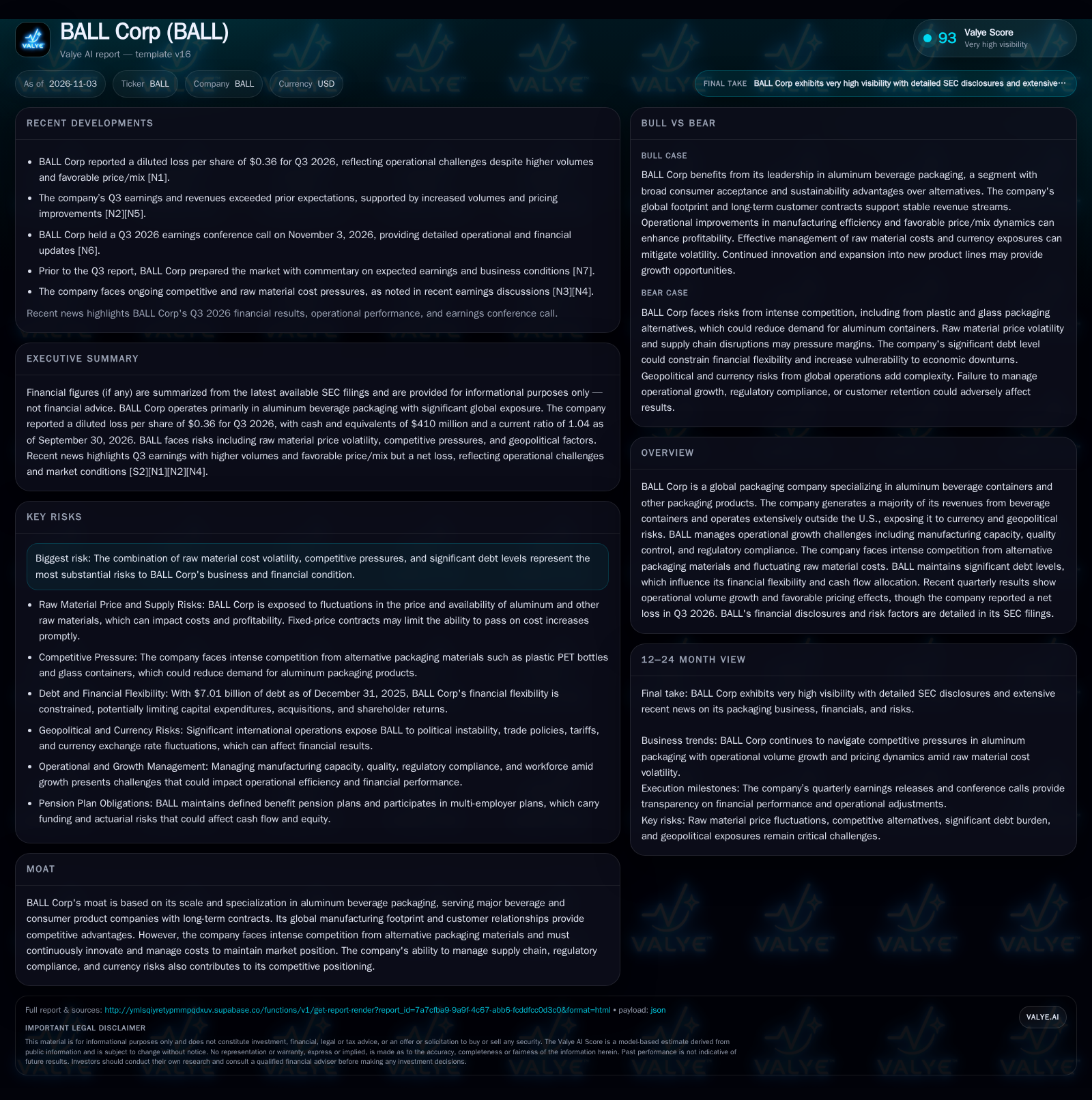
BALL Corp reported a Q3 2026 net loss despite higher volumes and favorable pricing, reflecting the challenge of converting operational momentum into sustained profitability amid high debt and raw material volatility. Its global reach and scale provide leverage, but execution on cost management and capacity optimization will likely determine future upside or downside.
BALL Corp stands at a pivotal juncture in the global packaging industry, showing operational momentum but facing acute margin and capital allocation pressures. The company’s Q3 2026 results—higher volumes and improved price/mix, yet a net loss—underscore both the resilience and fragility of its business model. With over half its revenues from non-U.S. markets, BALL must navigate not only raw material and competitive pressures but also the complications of global currency and regulatory risks. Its elevated debt load amplifies the consequences of any misstep, putting a premium on execution in cost control, capacity utilization, and strategic innovation.
Q3 2026 Results Reveal Growth Versus Profitability Dilemma
BALL Corp’s third-quarter 2026 results captured a paradox: operational momentum met with bottom-line strain. The company reported a diluted loss per share of $0.36, even as volumes rose and price/mix effects exceeded expectations [N1] [N2]. This suggests that while demand for aluminum beverage cans persists, BALL’s margin capture remains pressured by input cost volatility and competitive pricing. The company reported cash and liquidity metrics for the period; these figures do not by themselves establish operating runway, investment capacity, financial flexibility, or financing capacity. [S2] Debt remains high at $7.01 billion as of December 31, 2025, limiting financial maneuverability and magnifying the impact of any downturn or cost shock [S2]. Over 53% of revenue comes from outside the United States, further exposing results to currency swings and geopolitical risks [S2].
Volume, Price/Mix, and Cost Structure: What Drives BALL Corp’s Earnings Power?
BALL Corp’s core economics hinge on high-volume production of aluminum beverage containers, where scale can drive operating leverage but margin outcomes are highly sensitive to raw material prices (notably aluminum), energy costs, and labor. Pricing is typically negotiated with large beverage customers, often under multi-year contracts, but the ability to pass through cost increases may lag input price spikes, especially if fixed-price terms are in place. Volume growth can expand gross profit if capacity is well utilized, but overcapacity or demand fluctuations can lead to under-absorption of fixed costs.
The company’s current results indicate that while price/mix improved and volumes grew, these gains were not enough to offset cost pressures in Q3 2026 [N2] [N4]. Significant debt service requirements absorb cash flow, restricting capital available for investment or shareholder returns. As a capital-intensive manufacturer, BALL must continually invest in plant optimization, new product lines, and compliance, all while managing working capital tightly. Pension obligations and participation in multi-employer plans add to fixed outflows, making free cash flow generation more challenging during margin squeezes.
Scale, Substitution Threats, and the Limits of Moat in Packaging
BALL Corp’s competitive position is rooted in its global manufacturing footprint, scale economies, and long-term relationships with major beverage brands. These advantages confer some negotiating power and make it costly for customers to switch suppliers at scale, especially for standardized beverage cans. However, the packaging industry remains intensely competitive, with rival aluminum can producers, as well as plastic PET, glass, and carton alternatives vying for share. Substitution dynamics are influenced by cost, sustainability perceptions, and regulatory trends (such as bans on single-use plastics or recycled content requirements).
While aluminum is often seen as more recyclable and environmentally preferable to plastic, it is also more exposed to commodity price swings. BALL’s global reach exposes it to local overcapacity, price wars, and the risk that beverage customers shift packaging mix in response to cost or consumer trends. The company’s moat is thus real but limited: it must innovate in product design, manufacturing efficiency, and sustainability to defend share, while continuously managing cost and execution risk.
Margin Recapture and Strategic Innovation Could Drive Re-Rating
A plausible upside scenario sees BALL Corp successfully leveraging its operational scale to improve margin capture as input costs stabilize or decline. If the company can extract greater value from price/mix—perhaps through premium product offerings, lightweighting cans, or sustainability-driven innovations—while optimizing capacity and driving down unit costs, earnings could rebound sharply. Improved free cash flow would enable balance sheet repair, potentially lowering debt and freeing capital for growth initiatives or dividends.
Confirmation of this scenario would come from sequential margin expansion, a return to positive net income, and evidence of sustained volume growth outpacing industry averages. Additional positive signs would include successful new product launches, contract wins with major beverage customers, or disclosures of improved pricing terms. A reduction in net leverage, increased free cash flow, or guidance upgrades would further support the case.
Operational Volatility and Debt Service Dominate the Near-Term Outlook
The most probable near-term trajectory for BALL Corp is one of modest operational progress offset by persistent margin and capital allocation constraints. The company will likely continue to grow volumes in core aluminum packaging, supported by global beverage demand and some ability to pass through price/mix improvements. However, ongoing exposure to raw material price swings, competitive pricing, and the fixed burden of debt service will keep net profitability volatile.
In this scenario, BALL manages to maintain liquidity and avoid major operational missteps, but margin expansion is incremental and subject to periodic setbacks. This view would be confirmed by stable or slightly improving margins, steady (if unspectacular) revenue growth, and continued but cautious commentary from management on cost and capacity initiatives.
Raw Material Shocks or Market Share Loss Could Trigger Further Losses
The principal downside risk is that BALL faces another spike in aluminum or energy costs, or loses share to alternative packaging formats, eroding margins further and threatening covenant compliance or liquidity. If beverage customers aggressively shift to cheaper or more flexible packaging (such as PET or cartons), or if overcapacity in key regions leads to price wars, BALL’s fixed cost base could become a liability rather than an asset.
A downside scenario would be evidenced by a further decline in gross and operating margins, negative free cash flow, or an increase in net loss quarter-over-quarter. Early warning signs might include plant closures, restructuring charges, or negative revisions to earnings and cash flow guidance.
Company-Specific Milestones That Could Shift the BALL Corp Thesis
Quarterly gross and operating margin trends, especially the trajectory of margin recovery or further compression.
Volume growth rates in core aluminum beverage cans versus industry benchmarks and alternative packaging materials.
Net debt and leverage ratio progress; a reduction would suggest improved potential financial flexibility.
Free cash flow generation after debt service and pension contributions, if disclosed.
Capacity utilization rates and plant optimization updates, particularly in regions with prior overcapacity.
Material changes in raw material (aluminum) procurement costs and the effectiveness of hedging strategies.
Major new contracts, renewals, or customer losses that could alter revenue visibility.
Management commentary or disclosures regarding innovation in sustainable packaging and product diversification.
Disclaimer: This is research-only, informational analysis and not investment advice. It may include AI-generated interpretation and general industry context. Always verify important details using primary sources.

Comments