
Magellan Copper & Gold: Exploration Ambitions Collide with Financial and Operational Realities
Magellan Copper & Gold Corp remains firmly in the exploration stage, facing a daunting combination of unproven reserves, ongoing losses, acute liquidity pressure, and a lack of operational track record. The company’s near-term future depends on its ability to secure financing, advance exploration to establish reserves, and navigate complex regulatory demands—a high-risk formula in a competitive mining sector.
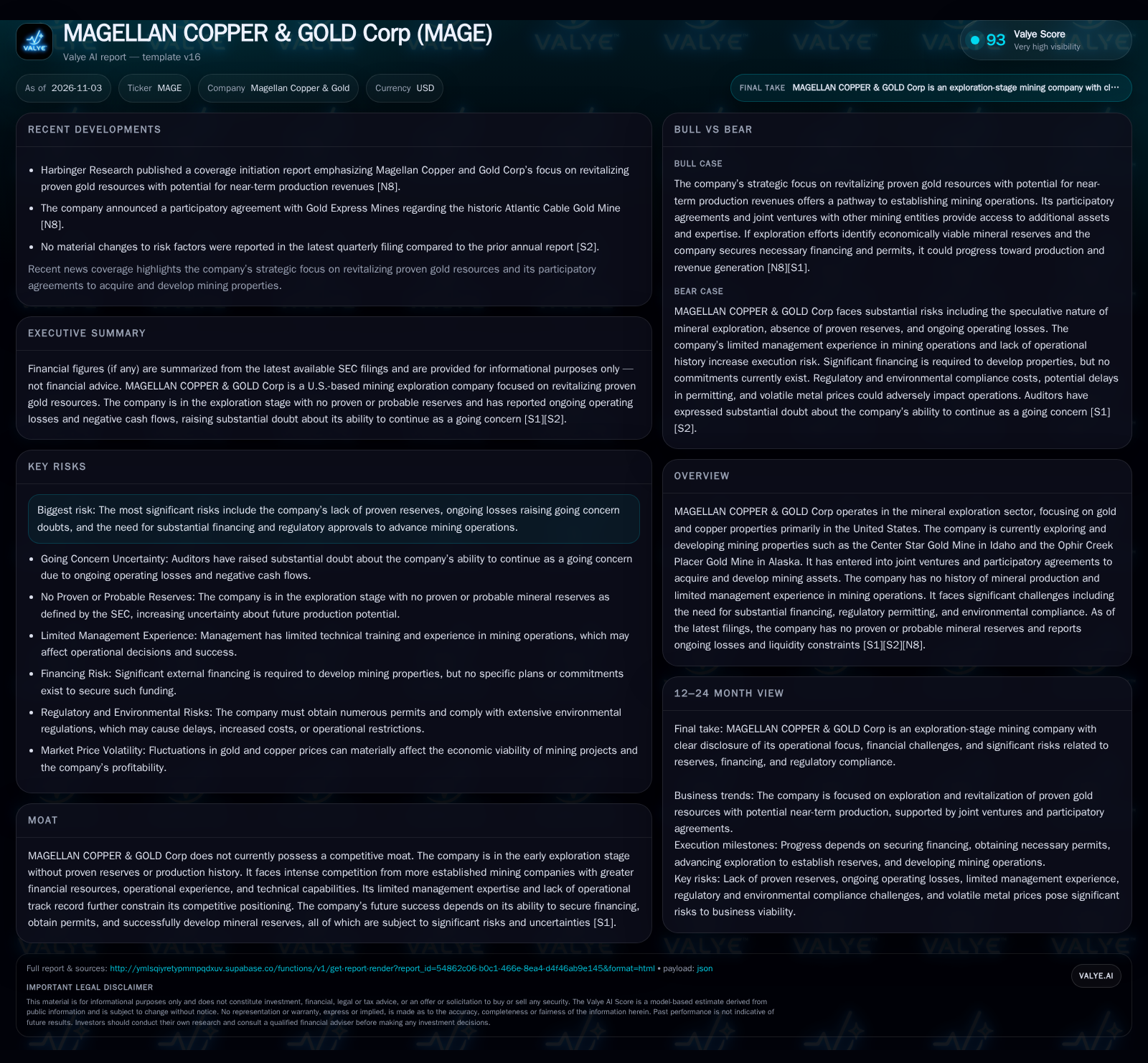
Magellan Copper & Gold is an early-stage U.S. mining explorer with no proven reserves, zero revenue, and a substantial net loss as of Q3 2026. The company’s extremely reported liquidity position, lack of committed financing, and auditors’ going concern warning underscore the urgent need for capital and operational breakthroughs. Success hinges on securing funding, progressing exploration, and overcoming regulatory and execution risks in a fiercely competitive industry. [S1] [S2] [N8]
Magellan Copper & Gold Corp sits at a precarious crossroads: it is a U.S.-based mining exploration company with ambitions to revitalize gold and copper resources, but faces a stark lack of proven reserves, acute liquidity pressures, and no history of production. The company’s future hinges on its ability to secure external funding, make exploration breakthroughs, and clear significant regulatory and operational hurdles. With auditor warnings about its ability to continue as a going concern and no committed capital for mine development, Magellan’s story is emblematic of the risks and uncertainties inherent in early-stage mineral exploration. [S1] [S2] [N8]
A Snapshot of Financial Strain and Exploratory Uncertainty
Magellan Copper & Gold Corp reported a net loss of $23,414 for the period ending September 30, 2026, with zero revenue generated and basic and diluted EPS at zero. The company’s liquidity is extremely limited: cash and equivalents stand at $98,654, current assets at $7,222, and current liabilities at $2,522,141—resulting in a cash ratio of 0.04 and a current ratio of 0. Auditors have explicitly raised substantial doubt about the company’s ability to continue as a going concern, citing ongoing losses and negative cash flows. No proven or probable mineral reserves have been established to date, despite exploration efforts at properties such as the Center Star Gold Mine in Idaho and the Ophir Creek Placer Gold Mine in Alaska. There are no specific plans or commitments for the significant financing needed to advance these properties toward production. [S1] [S2] [N8]
How Value Could Be Created: The Economics and Constraints of Early-Stage Mining
In the mineral exploration business model, value creation fundamentally depends on progressing from exploration to the establishment of economically viable reserves, securing the necessary permits, and eventually commencing profitable production. Until proven reserves are defined, Magellan’s properties are speculative assets with no basis for revenue generation. The transition from exploration to development is capital intensive, typically requiring multi-million dollar investments for drilling, feasibility studies, environmental assessments, and infrastructure. At present, Magellan has neither the reserves nor the access to capital required for this transition. Fixed costs (such as permitting, regulatory compliance, and overhead) dominate at this stage, with minimal variable costs until actual mining commences. This creates high operating leverage, but only if the company can successfully cross the chasm to production. The lack of committed financing or off-take agreements means Magellan is entirely dependent on external fundraising—likely through dilutive equity or expensive joint venture terms—just to maintain operations, let alone build a mine. The economics will only become attractive if exploration uncovers substantial, high-grade resources and if metal prices remain favorable by the time production can be commenced.
Navigating a Crowded Field: Why Scale and Experience Matter
Magellan’s competitive position is weak by industry standards. The company is competing in a sector dominated by incumbents with proven reserves, production track records, and access to capital markets. Large mining companies can outbid smaller explorers for attractive properties, absorb regulatory and environmental costs more easily, and deploy technical teams with deep operational experience. Magellan’s reliance on joint ventures and participatory agreements is a common strategy for explorers to access both assets and expertise, but it also means sharing upside and potentially ceding control. The company’s management explicitly lacks extensive technical mining experience, which can impair operational decision-making and credibility with investors or partners. Moreover, Magellan faces substitution risk from other junior explorers who might be first to delineate viable reserves or secure funding, as well as from established miners expanding their holdings. The absence of a production history or proven reserves further undermines Magellan’s ability to negotiate favorable terms or attract non-dilutive capital.
What Would a Breakthrough Look Like? Pathways to Viable Production
The most favorable scenario for Magellan involves a successful exploration program at one of its key properties (such as Center Star or Ophir Creek) that results in the delineation of a significant, economically viable gold or copper deposit. This breakthrough would enable the company to publish a resource estimate, catalyzing interest from institutional investors or strategic partners. With credible reserves in hand, Magellan could attract the substantial financing needed—either through joint ventures, project finance, or a public equity raise—enabling it to move into development and, eventually, production. Metal prices remaining robust would further underpin the project’s economics. Confirmation of this scenario would require the disclosure of positive drilling results, a formal resource estimate compliant with SEC or NI 43-101 standards, and a material financing agreement or partnership with an established mining company. Falsification would occur if exploration results are poor, permitting is delayed, or financing remains elusive.
Incremental Progress Amid Funding and Regulatory Headwinds
The most plausible near-term scenario is that Magellan continues its exploration activities at a slow pace, constrained by limited cash and lack of committed funding. The company may attempt to raise capital opportunistically—likely at unfavorable terms due to its weak balance sheet and lack of reserves—which could result in significant dilution or the need to surrender project interests to partners. Progress on drilling or permitting may be incremental, as regulatory and environmental hurdles are time-consuming and costly to navigate, especially for under-capitalized teams. No material revenue is likely in the next twelve months, and ongoing operating losses will persist. Evidence supporting this scenario includes continued small-scale exploration updates, further auditor going concern warnings, and the absence of resource estimates or significant financing announcements. Any material project advancement or financing breakthrough would challenge this baseline.
Failure to Secure Funding or Reserves: The Path to Asset Liquidation
In the adverse scenario, Magellan’s inability to secure external funding, coupled with lackluster drilling results or regulatory setbacks, would exhaust its limited cash resources. Without a financing lifeline, Magellan would be forced to curtail operations, relinquish project interests, or liquidate assets to satisfy creditors. The absence of proven reserves or tangible progress would make the company an unattractive acquisition target, and its shares could lose substantially all value. Confirming signals would include failed or distressed capital raises, asset sales, or insolvency filings. A reversal of this scenario would require an unexpected breakthrough in exploration or a last-minute capital infusion.
Milestones That Will Determine Magellan’s Future Trajectory
Announcement of a compliant mineral resource estimate (NI 43-101 or SEC S-K 1300) at any property, which would materially change the company’s risk/reward profile.
Disclosure of a substantial financing commitment—whether via equity, debt, or joint venture—that covers at least the next phase of exploration or moves a project toward development.
Updates on drilling results or technical studies that indicate the presence (or absence) of economically viable gold or copper mineralization.
Material changes in environmental permitting status or the receipt of key regulatory approvals for exploration or development activities.
Changes in management team composition, particularly the addition of executives with deep mining operations experience.
Trends in gold and copper prices, as significant downward moves could further impair project economics and investor appetite.
If disclosed, working capital trends and burn rate projections to assess the timing and urgency of future financing needs.
Any auditor commentary in future filings regarding going concern status or material weaknesses in internal controls.
Disclaimer: This is research-only, informational analysis and not investment advice. It may include AI-generated interpretation and general industry context. Always verify important details using primary sources.

Comments