
First Watch Restaurant Group: Daytime Dining Scale, Growth Levers, and the Realities of Capital Tension
First Watch’s differentiated breakfast-lunch model, operational focus, and culture-driven retention have powered expansion to over 630 locations and double-digit revenue growth.
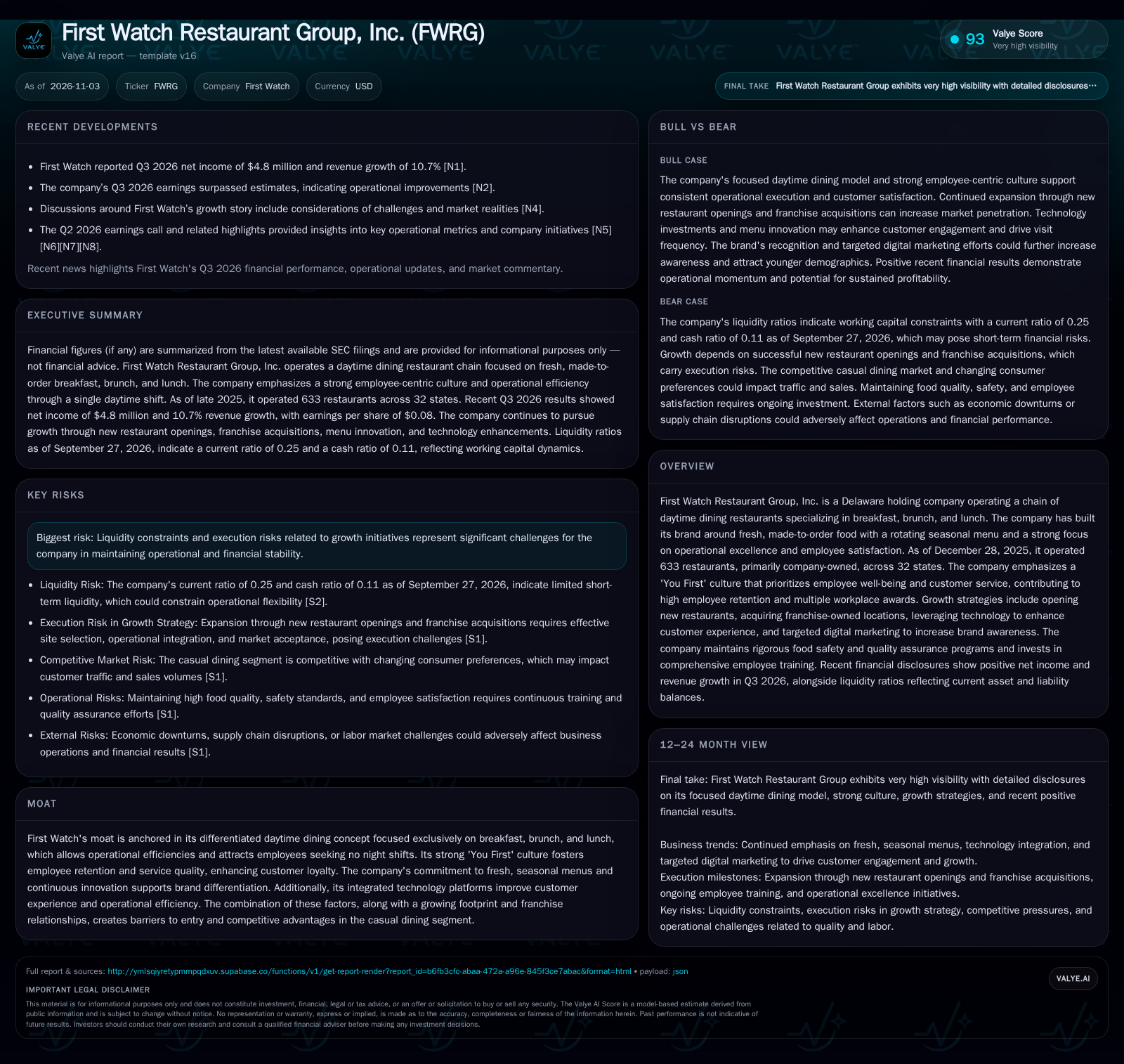
First Watch Restaurant Group operates over 630 daytime-only restaurants, emphasizing fresh, made-to-order menus and employee-centric culture. Q3 2026 delivered 10.7% revenue growth and $4.8 million net income, but liquidity ratios are tight, with a current ratio of 0.25 and a cash ratio of 0.11. The brand’s growth strategy relies on new openings, franchise acquisitions, and technology investments, but working capital constraints and execution risks are rising as the company scales. Sustaining operational momentum will require balancing expansion with financial discipline and adapting to industry volatility. [S1] [S2] [N1] [N2]
First Watch Restaurant Group has built a distinct niche in the U.S. casual dining landscape by focusing exclusively on breakfast, brunch, and lunch, operating a single daytime shift and prioritizing employee well-being. Its rapid expansion—now at over 630 locations—and solid Q3 2026 financial results underscore operational momentum and consumer appeal. However, the company’s aggressive growth ambitions are increasingly constrained by a thin liquidity position and rising execution complexity. The challenge now is whether First Watch can continue to scale profitably while maintaining the operational excellence and culture that have defined its brand in a competitive and evolving market.
Recent Expansion, Profitability, and Capital Constraints Shape the Near-Term Outlook
First Watch Restaurant Group operates 633 restaurants across 32 states, with 560 company-owned and 73 franchised as of December 28, 2025 [S1]. This footprint reflects both organic growth and franchise buybacks. The company reported Q3 2026 net income of $4.8 million and 10.7% revenue growth, surpassing earnings estimates and signaling operational execution [S2] [N1] [N2]. However, liquidity metrics are notably tight: as of September 27, 2026, First Watch reported $21.1 million in cash and equivalents, current assets of $47.2 million, and current liabilities of $191.1 million, yielding a current ratio of 0.25 and cash ratio of 0.11 [S2].
How the Daytime-Only Model Informs Revenue Drivers and Fixed-Cost Discipline
First Watch’s economics are fundamentally shaped by its single-shift, daytime-only restaurant model. This structure allows for lower labor costs, more predictable scheduling, and reduced utility and security expenses compared to full-service, multi-daypart peers. The emphasis on made-to-order, fresh menu items supports a premium positioning and can command higher average checks than traditional fast-casual breakfast formats. Revenue is driven by traffic, average ticket, and frequency—each influenced by menu innovation, digital marketing, and service quality.
Fixed costs—lease, management, and kitchen staff—are amortized across a compressed operating day, requiring high seat utilization during peak morning and lunch hours. Variable costs (food, hourly labor) scale with volume, but labor efficiency is improved by the absence of late-night staffing. Menu rotation and fresh ingredient sourcing may increase COGS volatility but can be offset by pricing flexibility if the brand sustains customer loyalty. Growth through company-owned units requires upfront capital and working capital for new sites, while franchise acquisitions typically involve buyout payments and integration costs.
Operating leverage is significant: incremental revenue from higher traffic or new locations can flow through to the bottom line if cost discipline is maintained.
The daytime-only operational model also impacts capital allocation decisions and asset turnover rates. Because the restaurants operate a compressed service window, fixed assets such as kitchen equipment and dining space must achieve high throughput during limited hours to justify investment. This dynamic necessitates precise demand forecasting and staffing models to avoid underutilization or overcapacity, which could erode margins. Moreover, the emphasis on fresh, made-to-order offerings introduces complexity in inventory management, requiring sophisticated supply chain coordination to minimize waste while ensuring availability. Balancing these factors is critical to maintaining cost efficiency and supporting scalable expansion without disproportionate increases in working capital requirements.
Daytime Differentiation, Culture, and Brand—But Imitation and Substitution Risks Remain
First Watch’s competitive positioning relies on its exclusive focus on daytime dining, differentiated seasonal menus, and a reputation for employee satisfaction. The single-shift model attracts talent seeking work-life balance, supporting higher retention and consistent service—an advantage in an industry plagued by turnover. Menu innovation, including fresh juices and seasonal rotations, helps drive frequency and brand differentiation.
However, barriers to entry in casual dining are limited, and established breakfast and brunch competitors—including both national chains and regional independents—can replicate menu features and service models. Fast-casual and quick-service brands are increasingly targeting the breakfast/lunch dayparts, intensifying competition for traffic and real estate. Technology-driven ordering and mobile engagement are now standard across the industry, reducing any first-mover advantage. Ultimately, First Watch’s moat depends on its ability to sustain culture and operational consistency at scale, even as it faces labor market volatility, evolving consumer tastes, and the threat of imitation.
Another dimension of competitive risk lies in the evolving consumer preference for convenience and digital engagement. While First Watch’s focus on in-person daytime dining creates a distinct niche, the growing prevalence of delivery and off-premise consumption in breakfast and lunch segments could pressure traffic if not proactively addressed. Competitors leveraging technology to offer seamless ordering, rapid fulfillment, and loyalty integration may capture incremental share, especially among younger demographics. Therefore, sustaining competitive advantage may require First Watch to continuously invest in digital platforms and omni-channel capabilities, balancing these investments against the capital constraints inherent in their growth model.
Labor market dynamics also present a nuanced challenge to the company’s culture-driven retention advantage. While the single-shift schedule and employee-centric policies reduce turnover relative to industry norms, broader labor shortages and wage inflation in the hospitality sector could still elevate costs and complicate staffing. The ability to maintain service quality and operational consistency hinges on not only attracting but also developing and retaining talent at scale, which may require enhanced training programs and incentive structures. Failure to adapt human capital strategies to changing labor market conditions could erode the brand’s service differentiation and operational efficiency over time.
If Expansion Is Matched by Execution, Brand Loyalty Could Unlock High-Margin Growth
In a favorable scenario, First Watch successfully executes its new unit opening and franchise acquisition strategy, converting scale into stronger brand recognition and market penetration. The company’s focus on employee satisfaction and customer service maintains low turnover and high guest frequency, while menu innovation and digital marketing resonate with a younger, experience-seeking demographic. Operational leverage from higher same-store sales and controlled costs allows incremental revenue to drive margin expansion, offsetting the impact of tight liquidity.
Evidence of successful integration of acquired franchise units and sustained workplace awards would further validate the company’s ability to scale its culture. If these factors are present, First Watch could emerge as a leading daytime dining brand with defensible economics and attractive returns.
Sustained Growth but With Margin Volatility and Rising Execution Demands
The most likely outcome is that First Watch continues to grow its footprint and revenue, but faces margin pressures and working capital constraints as it scales. New restaurant openings and franchise acquisitions contribute to top-line growth, but integration complexity, local market saturation, and the need to sustain service quality introduce cost variability and execution risk. The company’s single-shift model continues to support labor efficiency, but rising input costs, competitive discounting, and periodic supply chain disruptions challenge profitability.
Evidence supporting this path includes continued, but not accelerating, revenue growth, stable or declining operating margins, and little improvement in liquidity ratios. Any signs of declining employee retention, customer service scores, or negative franchisee feedback would signal that the company is reaching the limits of its operational model.
Liquidity Pressure and Execution Missteps Could Trigger a Strategic Slowdown
Adverse outcomes could emerge if First Watch’s aggressive expansion outpaces its ability to generate cash or secure external funding. If integration of acquired franchises falters or new locations underperform, fixed cost deleverage could quickly erode profitability.
Confirmation of this scenario would include negative operating cash flow, emergency capital raises, delayed or cancelled new openings, or deteriorating vendor and landlord relationships. Erosion of the company’s employee-centric culture—evidenced by rising turnover or declining workplace ratings—would further undermine brand value. In this environment, First Watch could be forced to slow expansion, restructure obligations, or even consider asset sales to restore balance sheet flexibility.
What Will Test the First Watch Thesis in the Next 12-24 Months
Sustained same-store sales growth (SSS); a useful metric would be quarterly SSS% and underlying traffic versus ticket mix.
Trends in operating and restaurant-level margins, especially in the context of rising input and labor costs.
Pace and cost of new unit openings and franchise acquisitions; delays or cost overruns would signal execution risk.
Employee turnover and retention rates, if disclosed, as leading indicators of culture sustainability and service quality.
Customer satisfaction and repeat visit metrics; a decline would test the durability of the brand’s differentiation.
Integration outcomes and performance of acquired franchise locations versus legacy company-owned units.
Evidence of access to additional capital, such as new credit facilities or equity raises, to support ongoing expansion.
Disclaimer: This is research-only, informational analysis and not investment advice. It may include AI-generated interpretation and general industry context. Always verify important details using primary sources.

Comments