
Precision BioSciences: ARCUS Platform Progress and the Economics of Precommercial Gene Editing
Precision BioSciences is a clinical-stage gene editing company leveraging its proprietary ARCUS platform, with lead programs targeting chronic hepatitis B and Duchenne muscular dystrophy.
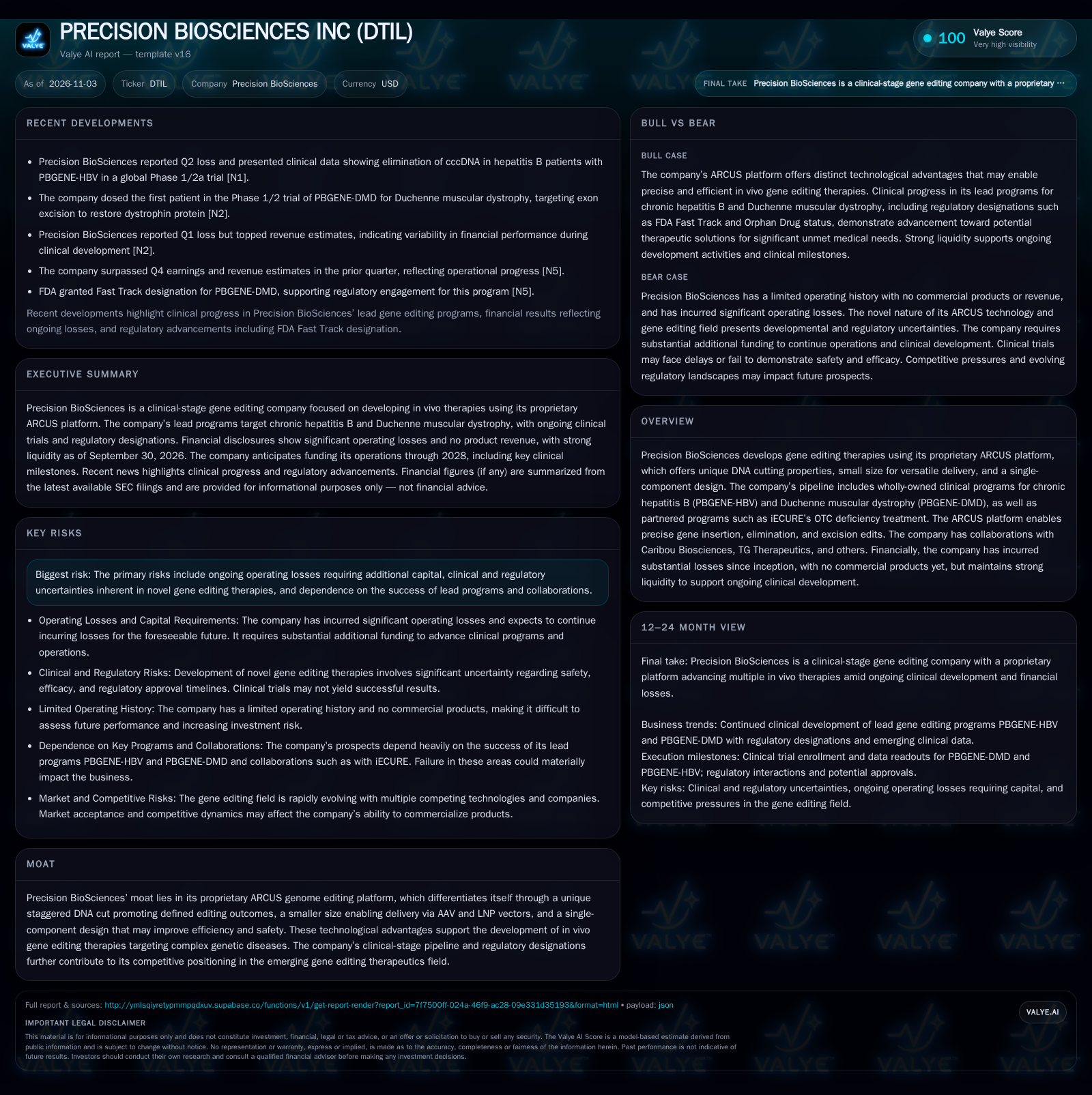
Precision BioSciences is a clinical-stage gene editing company leveraging its proprietary ARCUS platform, with lead programs targeting chronic hepatitis B and Duchenne muscular dystrophy. Despite meaningful progress, including clinical data showing cccDNA elimination in hepatitis B and regulatory designations for DMD, the company remains precommercial, has incurred significant losses, and will require additional funding beyond its current cash runway. The thesis hinges on ARCUS’s differentiation, clinical milestones, and the ability to transition from R&D to a sustainable commercial model in a competitive, high-risk field.
Precision BioSciences represents a high-potential but high-risk proposition in the gene editing therapeutics space. Its proprietary ARCUS platform offers technical advantages that could translate into differentiated clinical outcomes, evidenced by recent data in hepatitis B and regulatory momentum in Duchenne muscular dystrophy. However, the company remains precommercial, has posted substantial losses, and faces the sector’s familiar hurdles: clinical, regulatory, and funding risk. The next two years will be pivotal as ARCUS approaches key clinical milestones and Precision tests whether its technology and pipeline can break through to commercial validation.
Recent Clinical Progress and Financial Position Define the Near-Term Outlook
Precision BioSciences’ most material recent facts are: (1) clinical data showing elimination of cccDNA in hepatitis B patients for its lead PBGENE-HBV program, (2) ongoing Phase 1/2 trials for PBGENE-DMD with multiple FDA designations, (3) no product revenue and a net loss of $58.7 million for the first nine months of 2026, and (4) a cash position of $81.7 million with a current ratio of 10.47 as of September 30, 2026 [S1] [S2] [N1]. These facts matter because they underscore both the technical progress and the continued financial risk of a precommercial gene editing company. The clinical readout in hepatitis B supports the potential for ARCUS to deliver curative therapies, while the regulatory designations for DMD suggest a path toward expedited review. However, the absence of revenue and ongoing losses highlight the need for continued external funding, and the company’s liquidity, while solid for now, is finite and tied to achieving key clinical milestones that would justify further investment.
How Precommercial Gene Editing Companies Create Value—and Where Precision Stands
Precision BioSciences’ business model is centered on developing proprietary in vivo gene editing therapies, primarily funded through equity, partnerships, and milestone payments rather than product sales [S2]. The economics of this model are characterized by high fixed costs (R&D, clinical trials, regulatory compliance) and low variable costs until commercial launch. Margins, if successful, could be significant due to the premium pricing potential of gene therapies targeting high-unmet-need indications. However, the path to value creation is non-linear, with value inflection points tied to clinical data, regulatory milestones, and strategic collaborations.
The company’s wholly-owned pipeline assets (PBGENE-HBV and PBGENE-DMD) offer potentially large market opportunities, but the cost to reach commercialization remains substantial and uncertain due to the need for broad and deep clinical evidence, manufacturing scale-up, and commercialization infrastructure. Partnered programs (such as with iECURE) may provide some risk-sharing and near-term cash, but the economics are likely less favorable than wholly-owned assets. Precision’s reported losses and accumulated deficit reflect the capital intensity and binary risk profile typical of clinical-stage biotech, with future funding requirements likely to remain high until commercial validation is achieved [S2].
ARCUS Platform’s Differentiation and the Challenge of Standing Out in Gene Editing
Precision BioSciences competes in a rapidly evolving field dominated by CRISPR-based platforms, TALENs, and other emerging gene editing technologies. ARCUS distinguishes itself through a smaller, single-component design (facilitating delivery via AAV or LNP) and a unique staggered DNA cut, which may enhance editing precision and safety [S1]. These features could translate into clinical advantages, particularly for in vivo delivery to tissues such as liver and muscle, where delivery efficiency and off-target effects are key bottlenecks.
However, the competitive landscape includes well-capitalized peers with validated platforms and extensive pipelines. The ability of ARCUS to deliver superior efficacy, safety, or manufacturability will be tested as more clinical data emerges—not only from Precision’s own trials but also as competitors advance parallel programs. Market adoption will likely depend on a combination of clinical differentiation, regulatory success, intellectual property protection, and the ability to secure payer reimbursement. Switching costs for gene editing therapies are inherently high for patients, but for prescribers and payers, platform stickiness will be determined by clinical outcomes and economic value, not technological elegance alone.
Clinical Validation Unlocks Platform Leverage and Partnering Opportunities
The most favorable scenario for Precision BioSciences is that its ARCUS-based therapies achieve strong safety and efficacy in ongoing clinical trials, particularly for PBGENE-HBV and PBGENE-DMD. If ARCUS demonstrates a clear advantage—such as enabling functional cures in hepatitis B or restoring dystrophin in a significant subset of DMD patients—it could catalyze major value inflection points. Regulatory designations (Rare Pediatric Disease, Orphan Drug, Fast-Track) for PBGENE-DMD suggest the potential for expedited review and market exclusivity, which, combined with positive data, could attract large pharma partners or acquirers.
Confirmation of this scenario would come from positive Phase 1/2 data (showing meaningful clinical benefit and safety), additional partnerships or licensing deals, and potentially the initiation of pivotal trials. Evidence of strategic interest from larger biopharma companies, or the ability to monetize the ARCUS platform through non-dilutive deals, would further validate the upside. Falsification would occur if clinical results fail to show differentiated efficacy or safety, or if partnering interest remains tepid despite clinical progress.
ARCUS Advances, but Commercialization Remains Distant and Dilution Risk Persists
In the most plausible scenario, Precision BioSciences continues to advance PBGENE-HBV and PBGENE-DMD through mid-stage clinical development, generating incremental data that supports continued investment but does not yet deliver definitive proof-of-concept or commercial readiness. The company leverages its current liquidity to reach key clinical milestones through 2028, as management projects [S2].
During this period, Precision may secure additional partnership funding, possibly on less favorable terms, or access capital markets for further equity raises. The commercial launch of any product remains beyond the forecast period, and the company continues to operate at a loss, relying on its ability to demonstrate steady clinical progress to justify ongoing investor support. This scenario would be confirmed by continued reporting of cash burn and losses, incremental clinical updates (rather than breakthrough results), and announcements of new or renewed collaborations.
Clinical Setbacks or Funding Shortfalls Jeopardize Platform Viability
The adverse scenario centers on clinical or regulatory setbacks—such as safety signals, lack of efficacy, or trial delays—undermining confidence in ARCUS and reducing the company’s ability to raise funds or attract partners. Given Precision’s lack of revenue and ongoing cash burn, any material delay or failure in its lead programs could force the company to pause development, seek unfavorable financing, or pursue asset sales under duress.
This scenario would be confirmed by negative clinical news (such as failed endpoints or safety issues), an inability to secure new partnerships or capital, or public disclosure of going-concern risk. Falsification would require the company to demonstrate resilience—either by pivoting rapidly to new indications with compelling preclinical data, or by securing alternative funding sources that extend runway despite setbacks.
Milestones That Will Determine Whether ARCUS Can Change the Gene Editing Landscape
Clinical trial readouts for PBGENE-HBV and PBGENE-DMD—especially efficacy and safety results in their respective Phase 1/2 trials—will be pivotal for validating ARCUS.
Updates on the regulatory status of PBGENE-DMD, including progress toward pivotal trials and implications of Rare Pediatric Disease, Orphan Drug, and Fast-Track designations.
New or expanded strategic partnerships, licensing agreements, or non-dilutive funding events that could help offset operating losses and share risk.
Evidence of manufacturing scalability and delivery efficiency for ARCUS-based therapies, if disclosed, as these will impact commercial viability.
Any developments in competitive clinical programs targeting the same indications—such as new data from alternative gene editing or gene therapy platforms.
Changes in regulatory guidance or payer attitudes toward gene editing therapies that could affect the commercial potential of ARCUS programs.
Progress or setbacks in partnered programs (e.g., with iECURE), which may offer early validation or highlight platform limitations.
Disclaimer: This is research-only, informational analysis and not investment advice. It may include AI-generated interpretation and general industry context. Always verify important details using primary sources.

Comments