
Newbridge Acquisition Ltd: Navigating China-Linked SPAC Complexity as the Startech Deal Advances
Newbridge Acquisition Ltd has secured $57.5 million in trust and moved to formalize a business combination with Startech Group Inc., but faces unique regulatory and operational hurdles due to its China ties and exclusion of VIE structures. The success of its SPAC thesis hinges on closing this deal within a challenging cross-border environment.
Newbridge Acquisition Ltd, a China-linked SPAC, holds $57.5M in trust and has announced a business combination agreement with Startech Group Inc. The company’s path to value creation depends on successfully closing this transaction amid restrictive Chinese regulatory oversight and the deliberate exclusion of VIE-based targets, which narrows its acquisition universe and amplifies execution risk. The outcome will test whether Newbridge’s regional connections and capital can overcome structural and geopolitical headwinds.
Newbridge Acquisition Ltd stands at a pivotal juncture for SPACs with cross-border ambitions. Having raised $57.5 million in its 2026 IPO and placed the funds in trust, it has now announced a business combination with Startech Group Inc. But unlike many peers, Newbridge’s China-centric management and explicit avoidance of VIE-structured targets both restrict its acquisition field and expose it to unique regulatory and legal risks. The next phase will reveal whether its regional expertise and capital raise can deliver a successful merger despite the tightening policy and compliance environment.
Startech Deal and Trust Assets: Where Newbridge Stands Today
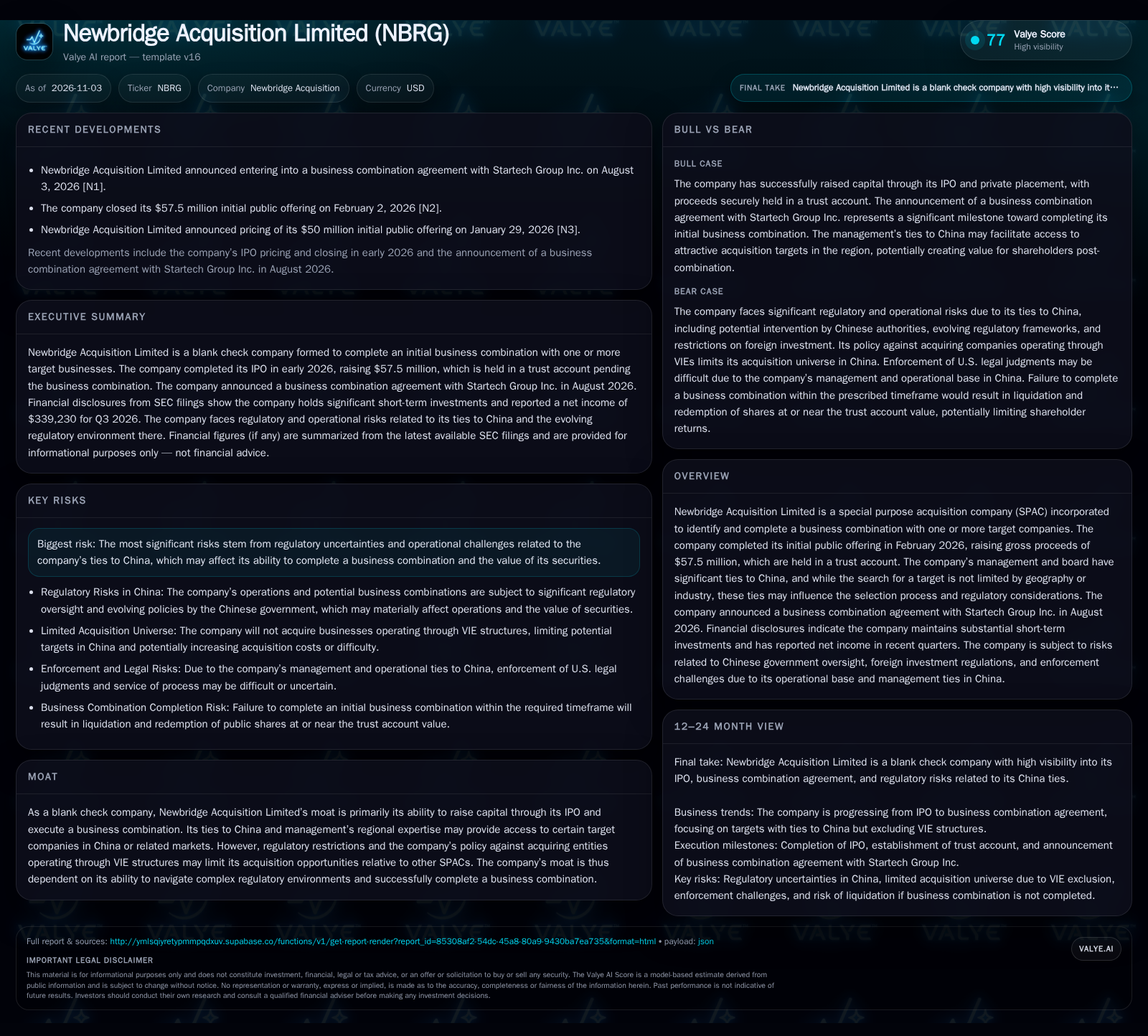
Newbridge Acquisition Ltd completed its $57.5 million IPO in February 2026, with all proceeds—including a $1.86 million private placement—securely deposited in a Citibank trust account managed by Equiniti Trust Company [N2] [S2]. This capital pool is earmarked for an initial business combination and cannot be accessed for other purposes until the deal closes or shareholders opt for redemption. In August 2026, Newbridge announced a definitive business combination agreement with Startech Group Inc.; the deal, if closed, will see Startech shareholders receive shares valued at $1 billion, based on a $10.00 per share exchange ratio [N1] [S2]. As of September 30, 2026, Newbridge reported $58.78 million in short-term investments, net income of $339,230 for Q3, and a current ratio of 0.64, reflecting the pre-combination, non-operating status typical for SPACs [S2].
SPAC Economics: How Value Is Created (or Lost) in a Cross-Border Deal
Newbridge’s economics are currently those of a SPAC: its only income is interest from trust investments, with no operating revenue until the business combination closes [S2]. The core value proposition is to identify and merge with a promising private company, offering public market access, capital, and (potentially) a premium valuation. The announced Startech deal proposes an effective $1 billion valuation for the target, a level that presumes significant forward growth or strategic value.
Key mechanisms for value creation include the arbitrage between trust value and post-merger enterprise value, the ability to attract PIPE (private investment in public equity) financing if needed, and the potential for post-merger share appreciation if the combined entity meets or exceeds market expectations. However, the economics are highly sensitive to deal completion: if the merger fails, shareholders can redeem at trust value, capping upside but limiting downside. If the deal closes but is poorly received, or if regulatory complications reduce Startech’s value or operational freedom, post-merger returns could disappoint.
Operating leverage and cost structure will only become relevant after the transaction closes and Startech’s financials are consolidated. Until then, Newbridge’s burn is minimal—mostly legal, compliance, and deal diligence expenses.
Competing in the SPAC Arena: China Ties, VIE Exclusion, and Regulatory Headwinds
Newbridge’s competitive edge rests on its management’s China expertise and relationships, potentially providing access to targets overlooked or out of reach for other SPACs. This could be valuable in sourcing proprietary deals or navigating local due diligence. However, the explicit policy to avoid targets operating through variable interest entity (VIE) structures—a workaround commonly used by Chinese tech and internet firms to list overseas—removes a large swath of high-growth targets from consideration.
This restriction, coupled with tightening Chinese regulatory scrutiny of outbound deals and U.S. listing activity, means Newbridge is fishing in a smaller, more scrutinized pool. It must compete with other SPACs, private equity, and strategic acquirers for compliant, high-quality targets. Furthermore, the predominance of Chinese citizens on its board and management could both facilitate target access and complicate cross-border legal enforcement or U.S. regulatory navigation.
In effect, Newbridge’s competitive position is a double-edged sword: its China ties may unlock unique opportunities, but the same relationships amplify exposure to geopolitical, compliance, and enforcement risks.
Unlocking Value: How a Successful Startech Merger Could Play Out
The favorable scenario is that Newbridge successfully completes the merger with Startech Group Inc., with all necessary shareholder and regulatory approvals secured and the newly combined entity listed on Nasdaq or a comparable U.S. exchange [S2]. If Startech is a high-growth, profitable business with sound governance, the public listing could provide access to new capital, enhance its profile, and drive multiple expansion.
For this scenario to play out, clear evidence would include: SEC effectiveness of the registration statement, Nasdaq listing approval, strong PIPE or institutional investor participation, and robust market interest post-merger. Further upside would be confirmed if Startech’s financials show rapid revenue growth, healthy margins, and a credible path to scalability post-combination. The absence of regulatory intervention from either U.S. or Chinese authorities would also be a necessary condition for sustained value creation.
Most Likely Outcome: Deal Completion Amid Ongoing Friction
The most plausible path is that Newbridge and Startech manage to close the business combination, but not without navigating a series of regulatory, legal, and cross-border process hurdles. The deal structure—requiring domestication to Delaware and a complex merger process—reflects the reality of operating at the intersection of U.S. capital markets and Chinese business interests [S2].
This scenario would be confirmed by the sequential satisfaction of closing conditions: shareholder votes, SEC registration effectiveness, exchange listing approval, and the absence of material legal or regulatory objections. However, post-merger share performance may be muted if market participants remain cautious about China-linked assets or if Startech’s business model is perceived as vulnerable to policy shifts or enforcement risk.
Falsifying this scenario would require evidence of a breakdown in negotiations, regulatory rejection, or an inability to meet listing or registration requirements.
Deal Failure or Regulatory Shock: How Returns Could Unravel
The adverse scenario is that Newbridge fails to close the Startech merger—due to regulatory intervention, shareholder rejection, legal process breakdown, or failure to secure a required listing. In this case, SPAC shareholders would likely opt for redemption at or near trust value, resulting in minimal returns beyond interest income, and the company would proceed to liquidation [S2].
Downside could also materialize post-merger if Startech is subject to unexpected regulatory restrictions, capital controls, or if its business proves less robust than anticipated. Legal risks are amplified by the China-centric board and operational base, potentially hindering recourse for U.S. investors if disputes arise. Confirmation of this scenario would include failed closing votes, negative regulatory actions, or a forced liquidation announcement.
Milestones and External Triggers That Will Define the Newbridge Thesis
Progress on SEC registration effectiveness and timely approval of the business combination proxy/registration statement would be a leading indicator.
Shareholder vote outcomes for both Newbridge and Startech—clear passage would confirm deal momentum.
Nasdaq or other national exchange listing approval for the combined entity; failure here would threaten deal closure.
Any regulatory action or commentary from Chinese authorities affecting Startech, cross-border listings, or outbound capital flows.
Material PIPE financing commitments or other institutional investor participation at or above trust value, if disclosed.
Startech’s pro forma financial disclosures: revenue growth rates, profitability, and business model transparency, if provided.
Redemption rates among SPAC shareholders—a high percentage would signal weak conviction in the deal.
Legal or process delays related to the domestication from BVI to Delaware or merger mechanics.
Disclaimer: This is research-only, informational analysis and not investment advice. It may include AI-generated interpretation and general industry context. Always verify important details using primary sources.

Comments