
BETA Technologies: Vertically Integrated Electric Aviation at an Inflection Point
With a $3.47 billion civil aircraft order backlog, proprietary propulsion technologies, and a reported cash position, BETA Technologies is executing on a multi-pronged strategy to commercialize electric aviation across logistics, defense, and infrastructure. The next phase hinges on manufacturing scale-up, regulatory milestones, and converting recurring aftermarket opportunities—amid persistent losses and intensifying competition.
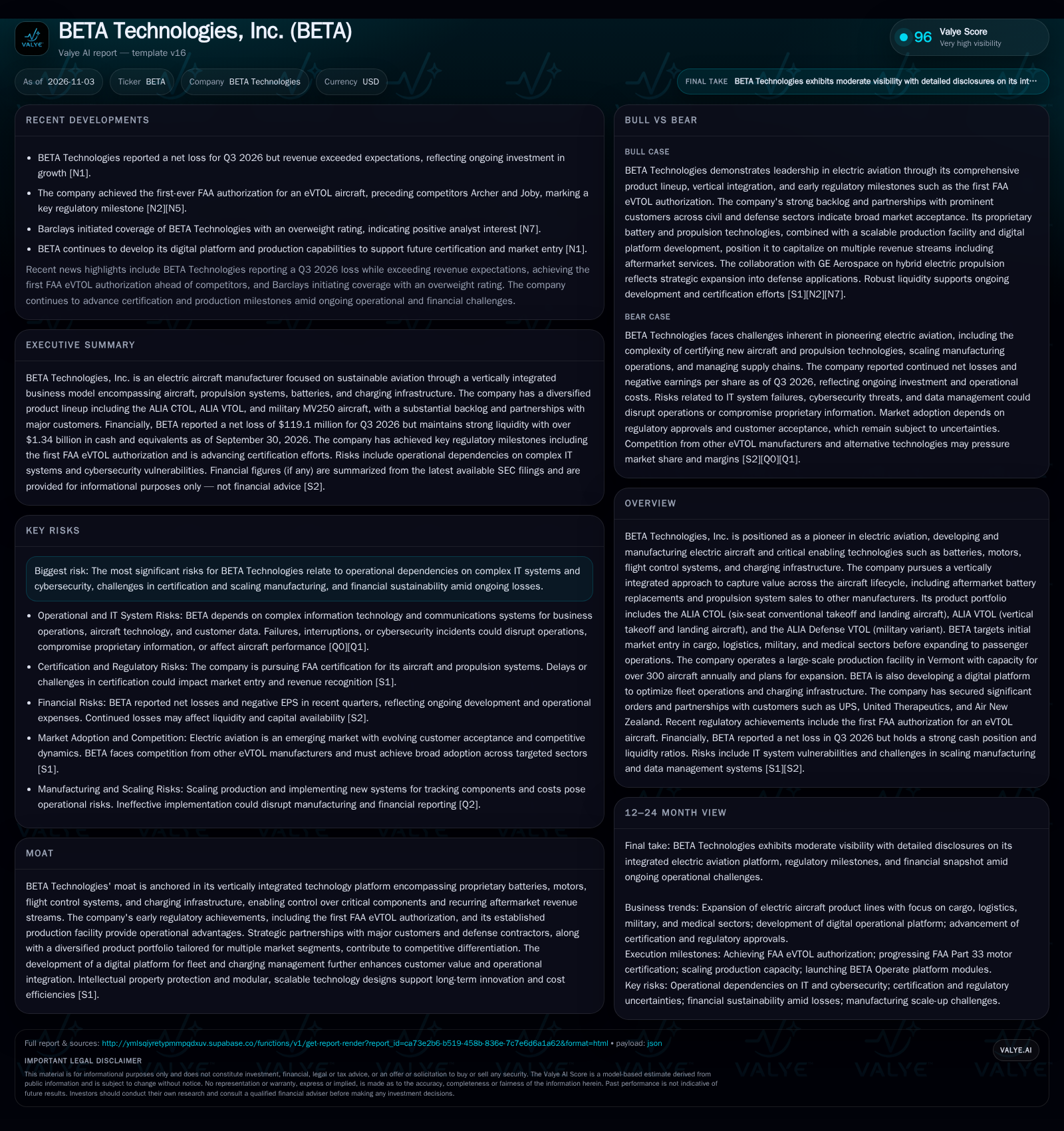
BETA Technologies is attempting to reshape aviation with a fully integrated electric aircraft platform, spanning aircraft, propulsion, batteries, and charging infrastructure. Its substantial order backlog, high-profile partnerships, and proprietary tech offer early-mover advantages, but the path to profitability depends on efficient scale-up, successful FAA certification, and sustained customer adoption. Execution risk remains high given ongoing losses and the complexity of the emerging eVTOL market. [S1] [S2]
BETA Technologies stands at the forefront of electric aviation, leveraging a vertically integrated approach that spans aircraft development, proprietary batteries, propulsion systems, and charging infrastructure. Its $3.47 billion order backlog and collaborations with leading logistics, medical, and defense players provide commercial validation, but the next phase will test the company’s ability to scale production, achieve regulatory approvals, and convert early interest into high-margin, recurring revenue. With significant liquidity but ongoing losses, BETA’s future will be shaped by both its execution on operational milestones and the broader pace of electric aircraft adoption. [S1] [S2]
Order Backlog, Liquidity, and Partnerships Define BETA’s Current Position
As of early 2026, BETA Technologies reports a civil aircraft order backlog of 891 units valued at $3.47 billion, spanning customers in logistics, medical, and defense sectors. This backlog not only demonstrates initial product-market fit but also underpins revenue visibility as the company targets market entry. Key partnerships—including a $1 billion propulsion contract with EVE Air Mobility and a $300 million equity investment from GE Aerospace—reflect both commercial validation and strategic alignment across civil and defense applications. [S1] [S2]
Capturing Value Across the Electric Aviation Lifecycle
BETA’s vertically integrated business model is designed to capture high-margin value at every stage of the electric aircraft lifecycle. By manufacturing its own batteries, propulsion systems, flight controls, and charging infrastructure, BETA can internalize margins that would otherwise accrue to suppliers. The economics are further enhanced by the company’s aftermarket strategy: proprietary battery packs, requiring replacement every 12-24 months, could drive recurring revenue streams with attractive margins—assuming successful fleet deployment and customer retention. The sale of propulsion systems (e.g., pusher motors) to third parties opens additional B2B revenue channels with lower customer acquisition costs.
Pricing power in this nascent market is likely to be variable and customer-specific, particularly as BETA initially targets logistics and defense users who may value reliability, safety, and operational cost savings over upfront price alone. Fixed costs are high due to R&D, certification, and plant investments, but operating leverage could be substantial if order flow translates into sustained production volume. The capital intensity of aircraft manufacturing and infrastructure build-out will require disciplined capital allocation—even with current liquidity, future expansion or slower-than-expected adoption could drive a need for additional funding.
Early-Mover Advantage or Temporary Lead? BETA in the Evolving eVTOL Ecosystem
BETA’s competitive position is grounded in its end-to-end control over core technologies, including proprietary batteries, high-efficiency motors, and a digital operations platform. This integration could create switching frictions for customers reliant on BETA’s ecosystem, particularly if aftermarket services and data-driven optimizations deliver tangible operational savings. The alignment with major logistics, defense, and medical partners broadens BETA’s exposure beyond passenger transport—a segment with longer regulatory and adoption cycles.
However, the eVTOL and electric aircraft market is rapidly attracting capital and talent, with competitors ranging from pure-play startups to established aerospace OEMs. Substitution risk is significant: advances in hybrid-electric, hydrogen, or even improved combustion efficiency could challenge the total-cost-of-ownership advantage of BETA’s solutions. In addition, the value of proprietary infrastructure (like charging networks) depends on industry-wide standardization—BETA’s CCS-1 compatibility may help, but cross-platform interoperability remains an open question.
If Certification and Scale Are Achieved, Aftermarket and Platform Flywheels Could Accelerate
The most favorable scenario for BETA sees the company successfully achieving FAA Part 33 certification for its H500A electric motor and broader aircraft approvals on schedule, unlocking its $3.47 billion order backlog and enabling rapid delivery ramp. As aircraft enter service, recurring battery replacements and aftermarket services could build a high-margin revenue flywheel, especially if BETA Operate’s digital modules deliver measurable uptime and efficiency gains for fleet operators. Expansion of charging infrastructure and adoption of BETA’s propulsion systems by third parties could further broaden recurring revenue pools.
Confirmation of this scenario would come from timely certification milestones, a rapid increase in aircraft deliveries and deployments, early evidence of battery replacement cycles, and visible adoption of the digital platform. Additional long-term contracts or follow-on orders from blue-chip customers would reinforce the durability of BETA’s ecosystem. A sustained improvement in gross margin and narrowing net losses would indicate operating leverage is beginning to materialize.
Execution on Backlog with Delays and Mixed Adoption
The most plausible trajectory involves BETA converting a portion of its backlog into deliveries over the next 12-24 months, but encountering typical aerospace certification and manufacturing delays. Adoption by logistics, defense, and medical customers would proceed in phases, with aftermarket revenue building more gradually than the bull case assumes. The company’s digital and infrastructure offerings may see selective uptake, especially if customers opt for interoperability or multi-vendor solutions.
Evidence for this scenario would include steady but not exponential delivery growth, moderate gross margin expansion offset by continued R&D and scale-up expenses, and incremental progress on FAA and defense certifications. Revenue mix may remain lumpy as initial aircraft deliveries are offset by uneven aftermarket uptake. Additional fundraising may be required if losses persist or if expansion plans accelerate ahead of cash flow breakeven.
What If Certification or Adoption Falter? Risks to Backlog Conversion and Funding
In a less favorable scenario, BETA could face protracted certification delays or technical setbacks with its aircraft, batteries, or propulsion systems, resulting in pushouts or cancellations of backlog orders. Slow manufacturing ramp or supply chain disruptions could further hinder delivery schedules, while customer hesitancy or emerging competition erode the perceived value of BETA’s integrated platform. If battery replacement cycles are longer than expected or customers seek alternative suppliers, anticipated aftermarket revenue could disappoint.
This scenario would be confirmed by repeated regulatory setbacks, order deferrals or cancellations, declining backlog, and a lack of visible scale-up in deliveries. Persistent high net losses, diminishing cash reserves, or the need for dilutive capital raises would suggest the business is struggling to reach critical mass. Negative customer feedback or a shift in industry standards away from BETA’s technology stack would also signal structural risk.
Milestones That Will Determine BETA’s Ability to Capture Long-Term Value
Progress toward FAA Part 33 certification for the H500A motor and broader aircraft approvals—delays or successful achievement would be a primary signal of near-term trajectory.
Aircraft deliveries to key customers such as UPS, United Therapeutics, and Air New Zealand—volume, timing, and acceptance rates will clarify backlog conversion and revenue realization.
Aftermarket battery replacement frequency and realized pricing—if disclosed, this will test the recurring revenue thesis.
Adoption rates and monetization of the BETA Operate digital platform—customer engagement and willingness to pay are critical for software margins.
Expansion pace and utilization of BETA’s charging infrastructure—deployment scale and third-party adoption will affect ecosystem stickiness.
Gross margin trends and R&D/SG&A expense trajectory—operating leverage and cost discipline will indicate progress toward profitability.
Additional long-term supply or propulsion contracts with third parties—these would validate BETA’s component business as a scalable, less capital-intensive growth driver.
Disclaimer: This is research-only, informational analysis and not investment advice. It may include AI-generated interpretation and general industry context. Always verify important details using primary sources.

Comments