
Ichor Holdings: Profitability, Customer Concentration, and the Realities of Fluid Delivery in a Cyclical Market
Ichor Holdings continues to grow profitably by supplying critical fluid delivery subsystems to semiconductor OEMs, but faces mounting cash burn, heavy customer dependency, and the challenge of navigating industry cyclicality. The company’s capital-efficient model and engineering strengths provide leverage, yet its future hinges on diversifying revenue streams and sustaining operational excellence.
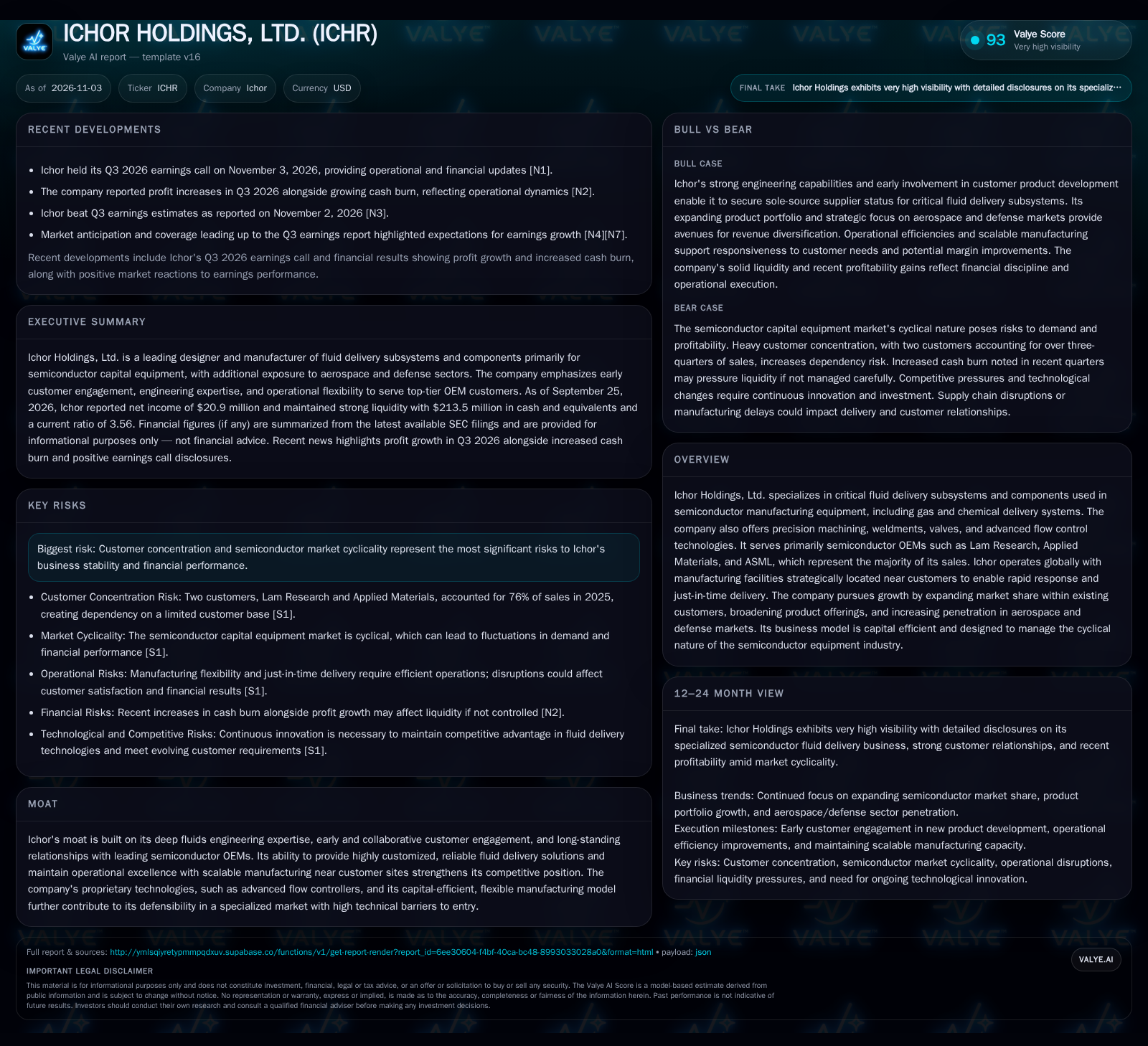
Ichor Holdings posted higher Q3 2026 profits and beat earnings estimates, yet its cash burn has also increased. The company is deeply dependent on two semiconductor OEMs for 76% of sales and operates in a structurally cyclical market. [S1] [S2] [N2] [N3]
However, its business is tightly bound to the fortunes of just a few customers and the unpredictable tides of the semiconductor capital equipment cycle. With rising cash burn and ambitions to diversify into aerospace and defense, Ichor’s next phase will test whether its engineering-led, capital-light model can deliver sustained resilience and growth, or whether customer and market concentration will ultimately constrain its upside. [S1] [S2] [N2] [N3]
Profit Growth Amid Mounting Cash Burn: What Recent Results Reveal
Ichor Holdings reported net income of $20.9 million and basic EPS of $0.56 for the quarter ended September 25, 2026, outpacing earnings expectations and demonstrating ongoing profitability [S2] [N3]. The company’s cash and equivalents stood at $213.5 million, with a current ratio of 3.56 as of the same date [S2]. However, recent news and disclosures show that cash burn has also grown alongside profit, raising questions about whether operational investments, working capital swings, or other factors are driving liquidity consumption [N2]. Customer concentration remains a defining feature: Lam Research, Applied Materials, and ASML collectively accounted for 76% of sales in 2025, underscoring the risk that any shift in these OEMs’ capital spending could have outsized impacts on Ichor’s top line [S1]. These facts highlight a business that is profitable and well-resourced in the near term, but with structural exposures that could rapidly affect financial stability and growth prospects.
How Ichor’s Capital-Light Model and OEM Dependence Shape Its Economics
Ichor’s core business is the design and manufacture of critical fluid delivery subsystems—gas and chemical delivery assemblies, valves, advanced flow controllers, and precision components—sold primarily to semiconductor equipment OEMs. The company’s economics are defined by high engineering content, low capital intensity (capex was just 3.8% of sales in 2025), and significant fixed-cost leverage, especially as it scales output for customer ramps [S1]. Revenue is typically driven by OEM demand for new equipment—peaking during industry capex cycles, then softening during downturns. Early engagement in customer product development may enable Ichor to secure sole-source positions during initial production ramps, potentially locking in favorable pricing and volumes, though evidence of contract length and margin structure is not disclosed. The capital-efficient model allows Ichor to flex capacity and manage overhead, but also means profitability is acutely sensitive to volume swings—a feature common to semiconductor supply chain specialists. If diversification into aerospace and defense scales, revenue mix and margin structure may shift, but these sectors are not yet material drivers.
Defending Share in a Market of Engineering Depth and High Switching Costs
Ichor’s competitive position is anchored in several reinforcing factors: deep engineering expertise in fluidics, early and collaborative product development with leading semiconductor OEMs, and operational flexibility enabled by facilities near customer sites. These features contribute to high switching costs—OEMs are reluctant to risk yield or reliability by changing suppliers for such critical subsystems. However, the intense customer concentration means that bargaining power may reside with the OEMs, not Ichor, especially if multiple suppliers are qualified for non-core subsystems. The market itself is characterized by high technical barriers to entry, regulatory and quality certifications (ISO 9001, AS9100), and the need for cleanroom manufacturing. While Ichor’s proprietary flow control technologies and process know-how are differentiators, the risk is that technological or process shifts at major OEMs could render existing solutions less relevant or prompt insourcing. The company’s moves into aerospace and defense may offer longer product cycles and less cyclicality, but incumbents in those sectors are entrenched and qualification timelines are long. In the core semiconductor segment, peer groups include other subsystem specialists and vertically integrated OEMs, with the persistent risk of customer insourcing or competitor leapfrogging in technology.
Leveraging Engineering and Diversification for Outperformance
The bull case for Ichor rests on the company’s ability to sustain sole-source status with major semiconductor OEMs while expanding wallet share as these customers ramp next-generation equipment platforms. If Ichor’s early engagement model continues to win it design-ins on critical subsystems, and if OEMs increase capital spending amid a cyclical upturn, the company could see outsized revenue and margin growth due to operating leverage. Successful penetration and scaling in aerospace and defense—where program cycles are longer and pricing can be more stable—would further diversify revenues and reduce cyclicality. Evidence that would confirm this scenario includes: increasing sales to a broader set of customers, rising revenue share from non-semiconductor sectors, improving gross margins (suggesting pricing power or mix shift), and stable or falling cash burn as growth is achieved efficiently. The scenario would be falsified if customer concentration remains static, new sector sales fail to materialize, or margin expansion does not accompany revenue growth.
Cyclical Growth, Managed Risks, and Incremental Diversification
The most plausible trajectory is that Ichor continues to ride the cyclical waves of semiconductor capital equipment demand, maintaining profitability and capital efficiency but with earnings and cash flow subject to swings in customer capex. The company is likely to retain strong positions with its core OEM customers, but material diversification into aerospace and defense will be gradual given long qualification cycles and entrenched incumbents. Operational discipline—maintaining lean overhead, flexing manufacturing, and closely managing working capital—will be essential to preserve profitability during downturns. The company could see incremental gains in market share or product breadth within its existing customer base, but the structural risks of concentration and industry cyclicality will persist. This scenario would be confirmed by continued profit generation, stable or modestly growing cash balances, high customer concentration, and slow but steady progress in non-core sectors. It would be falsified by a sharp drop in semiconductor OEM demand, operational disruptions, or a failure to control cash burn.
Customer Retrenchment and Cash Burn Escalate Structural Exposures
An adverse scenario unfolds if one or more major OEM customers cut back on equipment orders—due to industry downturn, share loss, or insourcing—resulting in a rapid revenue and profit contraction for Ichor. With 76% of sales tied to two customers, even a modest shift in their procurement strategy could sharply impact Ichor’s top line [S1]. If cash burn accelerates—whether from operational missteps, supply chain issues, or failed diversification bets—liquidity could be pressured despite the current reported cash balance. The company’s fixed cost base, though designed to flex, may still leave it vulnerable to under-absorption if volumes fall quickly. Evidence for this scenario would include declining backlog or orders from top customers, negative operating cash flow, deteriorating current ratio, and rising inventory or receivable days. The scenario would be less likely if Ichor demonstrates the ability to win new customer programs outside its historical core, or if cost actions quickly resize the business to new demand realities.
Testing the Ichor Thesis: Metrics and Milestones That Will Shape the Outcome
Revenue concentration by customer—tracking whether the share of sales from Lam Research and Applied Materials declines or remains elevated would indicate progress (or lack thereof) on diversification.
Cash burn and free cash flow trends—monitoring quarterly operating and investing cash flows, as rising cash burn could signal unsustainable working capital or cost pressures.
Gross and operating margin progression—improving margins would suggest successful leverage of engineering value and operational efficiency; margin compression could point to pricing or cost challenges.
Sales mix evolution—a useful metric would be the percentage of revenue derived from aerospace, defense, or new semiconductor customers, if disclosed.
Order backlog and new program wins—evidence of multi-year, multi-customer program awards would strengthen the case for revenue visibility and diversification.
Capital expenditure as a percentage of sales—continued capital efficiency would confirm the scalability of the model, while rising capex could indicate a shift in strategy or required reinvestment.
Inventory and receivables turnover—deterioration here could signal demand softening, supply chain issues, or customer stress.
Employee and facility footprint—changes in headcount or manufacturing capacity, if disclosed, would help gauge readiness for demand swings or diversification efforts.
Disclaimer: This is research-only, informational analysis and not investment advice. It may include AI-generated interpretation and general industry context. Always verify important details using primary sources.

Comments