
Nuveen Churchill Direct Lending: Platform Scale, Middle Market Focus, and the Dynamics of BDC Growth
Nuveen Churchill Direct Lending Corp. leverages deep sponsor relationships and a senior loan focus to serve private equity-backed U.S. middle market companies. As a recently public BDC, it combines the capital and sourcing reach of Churchill/Nuveen with an incentive-driven fee structure, targeting risk-adjusted yield in a competitive and cyclical credit environment.
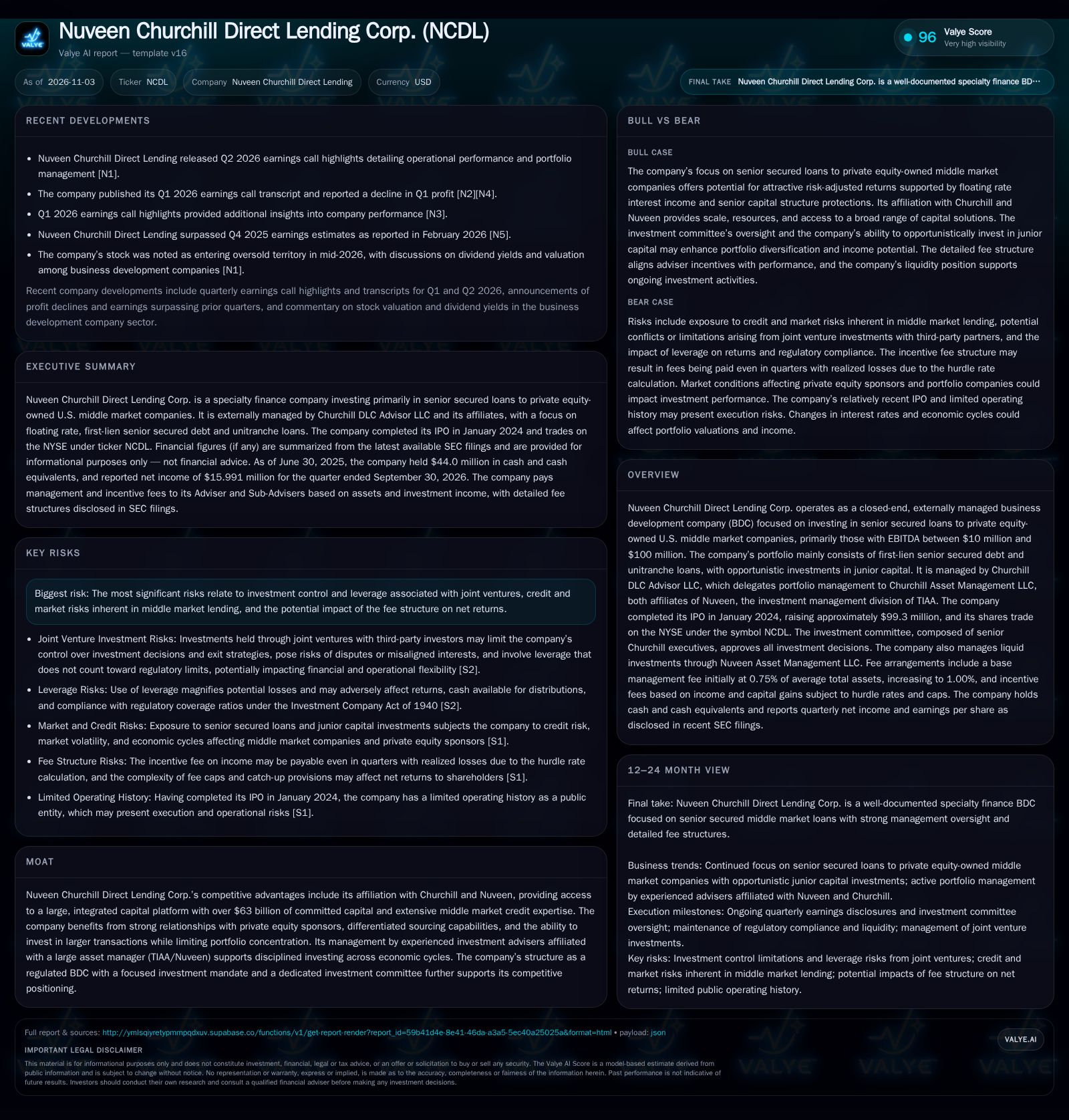
Nuveen Churchill Direct Lending Corp. (NCDL) is a business development company investing primarily in senior secured, floating-rate loans to private equity-owned U.S. middle market firms. Backed by Churchill/Nuveen’s capital platform, its strategy targets current income and risk protection but faces structural risks from leverage, fee alignment, and joint ventures. Recent net income and cash balances suggest operational momentum, yet market cycles, execution discipline, and sponsor deal flows will be crucial to long-term performance. [S1] [S2]
Nuveen Churchill Direct Lending Corp. stands at the intersection of private credit’s rapid institutionalization and the growth of business development companies (BDCs) as public vehicles for alternative income. Its approach—directly originated, senior secured, floating-rate loans to private equity-backed mid-sized U.S. companies—offers both yield and downside protection, supported by the sourcing and underwriting heft of Churchill and Nuveen. However, with a relatively short public track record, a complex fee structure, and exposure to joint venture and leverage dynamics, NCDL’s ability to weather credit cycles and capitalize on sponsor deal flow will determine whether its platform advantages translate into durable shareholder returns.
Recent Financials and Strategic Positioning Shape the Near-Term Outlook
Nuveen Churchill Direct Lending Corp. reported net income of $15.991 million for the quarter ended September 30, 2026, and held $44.0 million in cash and equivalents as of June 30, 2025. The company reported cash and liquidity metrics for the period; these figures do not by themselves establish operating runway, investment capacity, financial flexibility, or financing capacity. The company completed its IPO in January 2024, raising $99.3 million, and now operates as a public BDC with a mandate centered on directly originated senior secured loans to private equity-owned middle market firms. [S1] [S2]
Affiliation with Churchill and Nuveen—entities with $63 billion in private credit and $1.4 trillion in overall assets under management, respectively—provides NCDL with significant sourcing capabilities and institutional credibility, positioning it to compete for high-quality sponsor-backed deals. [S1]
Recent quarterly developments include a reported decline in Q1 2026 profit, suggesting that earnings may be sensitive to timing of deal activity, credit costs, or other portfolio dynamics. [N2] [N4]
How the Senior Loan Model Drives Revenue, Costs, and Returns
NCDL’s core revenue engine is the spread between interest income from its portfolio of senior secured, primarily floating-rate loans and its own cost of capital. Most loans target middle market borrowers—those with $10 million to $100 million in EBITDA—where yields tend to be higher than in broadly syndicated markets due to less competition and greater complexity. By focusing on first-lien and unitranche structures, NCDL aims to maximize current income while mitigating loss risk through seniority and collateral coverage.
Fee arrangements are central to NCDL’s economics. The Adviser receives a base management fee (initially 0.75% of average total assets, rising to 1.00%), plus incentive fees on both investment income (above a 6% annualized hurdle) and realized capital gains. This structure can drive alignment in strong markets but may also result in fees being paid even during periods with realized losses due to the quarterly hurdle calculation. [S1]
Externally managed BDCs like NCDL typically exhibit high operating leverage: fixed management/advisory fees scale with assets, while direct costs remain modest. This can amplify both upside and downside to net returns depending on portfolio performance and credit cycles. Capital needs are ongoing, as the company must regularly raise or recycle capital to fund new loans, maintain regulatory asset coverage, and support distributions.
Sourcing Clout and Sponsor Relationships as Differentiators—But Not Moat Guarantees
The company’s most tangible competitive advantage is its direct link to Churchill and Nuveen, which together offer a broad origination network, sponsor relationships, and the ability to participate in larger or more complex deals than many independent BDCs. This confers access to deal flow, information, and underwriting expertise that is difficult for smaller or less connected peers to replicate.
However, the middle market private credit landscape is increasingly crowded as institutional capital—pension funds, insurers, and asset managers—seeks yield, compressing spreads and intensifying competition for sponsor-backed loans. Direct competitors include other large, sponsor-focused BDCs and private credit funds, as well as traditional banks in less restrictive lending environments.
While senior loan focus and sponsor exclusivity help limit default risk and improve pricing, these advantages are not unassailable. Economic downturns can pressure credit quality across the sector, and larger platforms may see increased scrutiny of underwriting discipline, especially as they expand into junior capital or pursue joint ventures.
If Sponsor Deal Flow Remains Robust and Credit Losses Stay Low, Operating Leverage Could Drive Outperformance
A favorable scenario would see a continued strong pipeline of private equity-backed middle market deals, allowing NCDL to deploy capital into high-quality, floating-rate loans at attractive spreads. If credit losses remain minimal—supported by sponsor support, tight covenants, and prudent underwriting—net investment income could rise steadily, amplified by the company’s external management structure and fee leverage.
The company’s affiliation with Churchill and Nuveen could enable it to win larger allocations in competitive deals, further boosting scale and portfolio diversification. If NCDL successfully executes opportunistic junior capital investments without compromising overall risk, returns could benefit from equity-like upside in select cases.
Confirmation would come from continued growth in net investment income, stable or increasing dividends, and low levels of non-accruals or realized losses relative to peers. Expansion of assets under management and repeat sponsor mandates would also signal competitive strength.
A Disciplined Middle Market Lender Navigates Cyclical Headwinds and Growth Opportunities
The most plausible scenario is steady, moderate growth in the loan book, with periodic fluctuations in earnings reflecting the ebb and flow of private equity activity, credit conditions, and competitive dynamics. NCDL’s senior loan focus and sponsor relationships may help it maintain above-average credit quality, but spread compression and rising competition could limit outsized returns.
The company is likely to continue balancing core first-lien lending with selective junior capital and joint venture activity, subject to risk controls and regulatory requirements. Operating leverage works in both directions: as assets grow, returns to shareholders may increase, but any credit deterioration or misalignment in fee structures could quickly erode net yields.
Evidence supporting this scenario would be stable net income, manageable credit losses, and regular dividend payments, with no outsized swings in book value or asset quality relative to other sponsor-focused BDCs.
Leverage, Credit Cycles, and Fee Structure Could Amplify Losses in a Downturn
In a negative scenario, a slowdown in private equity transactions, deterioration in borrower fundamentals, or broader credit market stress could lead to rising non-accruals and realized losses in the portfolio. If joint ventures or junior capital exposures underperform, NCDL could face both direct credit losses and disputes or loss of control over recovery processes.
Because the fee structure allows for incentive fees even in some loss quarters (due to the hurdle mechanism), net returns to shareholders could be further squeezed during periods of stress. Leverage, including off-balance-sheet exposures in joint ventures, may magnify these effects and potentially constrain regulatory asset coverage ratios.
Falsifying this scenario would require evidence of stable or improving credit metrics, low realized losses, and resilience in net investment income even during periods of market volatility.
Testing the Nuveen Churchill Direct Lending Thesis: Concrete Milestones and External Triggers
Quarterly trends in net investment income and realized losses, as reported in SEC filings, will be crucial to assess core earning power and credit performance.
The proportion of the loan portfolio on non-accrual status, if disclosed, would provide direct insight into credit quality and risk management effectiveness.
Growth in total assets and new loan originations, especially allocations in sponsor-backed deals, will test the company’s ability to capitalize on its sourcing platform.
Changes in the yield on the portfolio versus cost of capital will reveal the impact of spread compression or rising funding costs.
Fee and expense ratios relative to peers, if disclosed, would help evaluate the impact of the external management structure on net returns.
Updates on joint venture activity, including size, performance, and any disputes or control issues, would clarify risk exposures outside the core portfolio.
Evidence of repeat mandates or deepening relationships with private equity sponsors would signal continued competitive strength.
Disclaimer: This is research-only, informational analysis and not investment advice. It may include AI-generated interpretation and general industry context. Always verify important details using primary sources.

Comments